
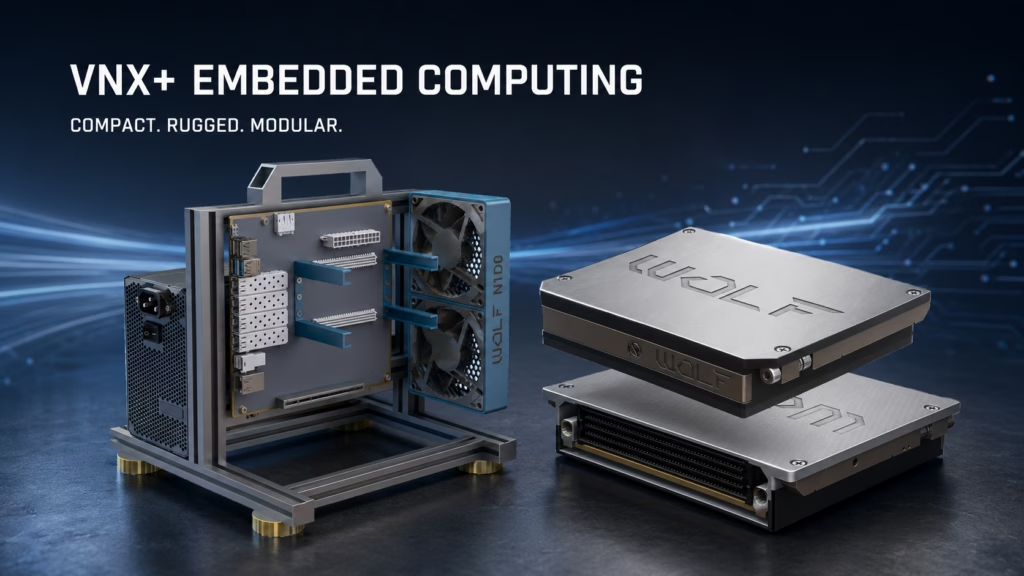
The VNX+ embedded computing standard has progressed from an emerging proposal to a ratified family of ANSI/VITA 90 standards. Designed for rugged, high-performance computing where size, weight and power are tightly constrained, VNX+ extends open, modular computing into platforms that may not have sufficient space or power for a traditional VPX system. However, selecting VNX+ involves more than choosing a smaller module. Engineers must still consider processing requirements, I/O profiles, thermal management, software, environmental qualification and system-level interoperability.
VNX+ Moves from Proposal to Ratified Standard
When we first wrote about VNX+ in 2024, VITA 90 was still under development. Therefore, many architectural and performance details were subject to change.
That position changed in February 2026, when ANSI and VITA formally ratified the VNX+ family as an Enhanced Small Form Factor, or eSFF, system architecture.
VNX+ builds on the mechanical foundation established by the earlier ANSI/VITA 74 VNX standard. However, it adds higher-speed signalling, broader system versatility and enhanced mechanical provisions for rugged applications.
As a result, VNX+ is no longer simply a promising concept. It now provides an approved standards framework around which manufacturers, systems integrators and end users can develop compact embedded computing systems.
What Is the VNX+ Embedded Computing Standard?
VNX+ is an open-standard architecture for compact, conduction-cooled embedded computing systems.
It is intended for applications that require capable computing and high-speed data movement but cannot accommodate the footprint, weight, power demand or cooling requirements of a larger VPX system.
A typical VNX+ architecture may include:
- A system backplane
- A power supply unit
- 19 mm and/or 13 mm VNX+ Plug-In Modules
- Compute, accelerator, storage or specialised I/O modules
- Ancillary modules for lower-speed interfaces
- A system-level I/O transition board
- A suitable conduction-cooled enclosure or chassis
Importantly, ANSI/VITA 90 is a family of related standards rather than a single specification that defines every aspect of the finished system.
The standards released in 2026 include:
- ANSI/VITA 90.0-2026: VNX+ Base Standard
- ANSI/VITA 90.1-2026: VNX+ Profile Tables
- VITA 90.2-2026-VDSTU: VNX+ Optical and RF Connector Modules – Type 2
- ANSI/VITA 90.3-2026: VNX+ Power Supply and Storage Modules
- ANSI/VITA 90.4-2026: VNX+ Cooling and Mounting Systems
- ANSI/VITA 90.7-2026: VNX+ Optical and RF Connector Modules – Type 7
Additional work within the VITA 90 family is continuing. Consequently, engineers should confirm the status and applicability of each relevant base standard, profile and supporting specification when defining a system.
Why Was VNX+ Developed?
Modern defence and aerospace platforms are becoming smaller, more autonomous and more distributed. At the same time, they must process increasing volumes of sensor, video and mission data.
This creates a difficult engineering problem. More processing capability generally requires additional electrical power and produces more heat. Yet a small UAV, sensor pod, compact vehicle subsystem, wearable system or space-constrained payload may have very limited room for electronics, cooling hardware and power conversion.
VNX+ addresses this problem by creating a smaller modular architecture designed specifically for high-performance embedded computing in constrained environments.
Instead of sending all raw sensor data to a central mission computer, a VNX+ module may allow processing to occur closer to the sensor. For example, it could support video conversion, image processing, AI inference, data compression or preliminary sensor analysis at the edge.
This distributed approach can potentially:
- Reduce the volume of data sent across the platform
- Lower communications bandwidth requirements
- Reduce response latency
- Support more autonomous operation
- Place computing closer to sensors and other data sources
- Simplify future upgrades through modular hardware
- Improve the use of available space, weight and power
However, these advantages depend on the design of the complete system. Module selection, backplane topology, power delivery, sustained thermal performance and software integration must all be considered together.
Does VNX+ Replace VPX?
VNX+ is best considered a complement to VPX, rather than a direct replacement.
VPX remains appropriate when a platform needs greater processing density, more expansion capacity, additional PCIe connectivity, larger discrete GPUs or significant power and cooling headroom. A 3U or 6U VPX system can also support larger numbers of specialised modules within a well-established ecosystem.
VNX+, by comparison, addresses applications in which the physical and thermal limits of the platform are among the primary design constraints.
The choice should therefore be based on the system requirement rather than an assumption that the smallest available form factor is automatically preferable.
VPX may be the better choice when:
- Maximum computing or graphics performance is required
- Several high-bandwidth modules must operate together
- The system needs substantial expansion capacity
- The platform can accommodate a larger chassis
- Higher power consumption and heat dissipation can be managed
VNX+ may be the better choice when:
- Installation space is extremely limited
- Weight directly affects range, endurance or payload
- Available electrical power is tightly constrained
- Processing must be located close to a sensor
- A compact modular alternative to a custom board is preferred
- The application requires rugged, conduction-cooled computing at the edge
Some systems may use both. For instance, a central VPX mission computer could perform sensor fusion and higher-level processing, while smaller VNX+ nodes positioned near individual sensors manage acquisition, conversion or preliminary processing.
Ruggedisation and Thermal Management
Small size does not remove the need for environmental performance. In fact, compact systems can make thermal design more challenging because heat must be removed through a smaller mechanical envelope.
VNX+ is designed around compact, conduction-cooled Plug-In Modules without airflow paths across the modules. This architecture can improve suitability for sealed systems and harsh environments where dust, moisture, contamination, altitude or limited airflow make conventional air cooling impractical.
Nevertheless, compliance with a module standard should not be confused with qualification of the complete system.
Engineers must still confirm:
- The module’s operating temperature range
- Power consumption under sustained mission workloads
- The thermal path from the electronics to the enclosure
- Chassis surface temperature and available heat rejection
- Shock and vibration requirements
- Altitude and pressure conditions
- Humidity, dust, salt fog and other environmental exposure
- Electromagnetic compatibility requirements
- Conformal-coating requirements
- Qualification and acceptance-test evidence
For this reason, thermal and mechanical design should begin early. It should not be treated as an enclosure decision made after the processing hardware has already been selected.
Interoperability Requires Careful Engineering
An open standard provides a common framework, but it does not mean that every VNX+ module will operate in every VNX+ slot without prior engineering analysis.
System designers still need to confirm the applicable slot and module profiles, connector mappings, data-plane interfaces, control interfaces, power requirements and mechanical configuration.
Key questions include:
- Which ANSI/VITA 90 profiles apply to the proposed architecture?
- Which PCIe, Ethernet, video, RF or optical interfaces are required?
- Are the module and backplane profiles electrically compatible?
- How much bandwidth is needed between modules?
- What power must be supplied at start-up and under full processing load?
- Can the chassis maintain acceptable component temperatures?
- Which operating system, drivers and Board Support Package are required?
- What cybersecurity and secure-storage provisions are needed?
- How will the system be developed, tested and qualified?
- What lifecycle and configuration-control support is available?
Answering these questions early can reduce the likelihood of costly backplane, chassis, cabling or software changes later in the program.
WOLF VNX+ Computing and Video Solutions
WOLF Advanced Technology is developing an expanding range of VNX+ hardware for rugged AI, video and high-performance embedded computing.
The current range includes the WOLF-N4XP compute node, WOLF-N180 video I/O module and WOLF-N1D0 development platform.
WOLF-N4XP Secure AI and HPC Compute Node
The WOLF-N4XP, also identified as the VNXP-ORIN-NX, is a compact compute node based on the NVIDIA Jetson Orin NX 16 GB.
It combines CPU and GPU processing, AI inference capability, onboard NVMe storage, PCIe Gen4 connectivity, Ethernet, camera and video interfaces, security features and system management within a rugged VNX+ module.
Potential applications include:
- Edge AI inference
- Machine vision
- Autonomous platforms
- Video encoding and decoding
- Sensor processing
- Compact airborne computing
- Secure local data processing and storage
Depending on configuration, the module operates within a 20 W to 35 W power range. Therefore, processing performance, thermal headroom and mission workload should be evaluated together when selecting its operating mode.
WOLF-N180 Rugged Video I/O Module
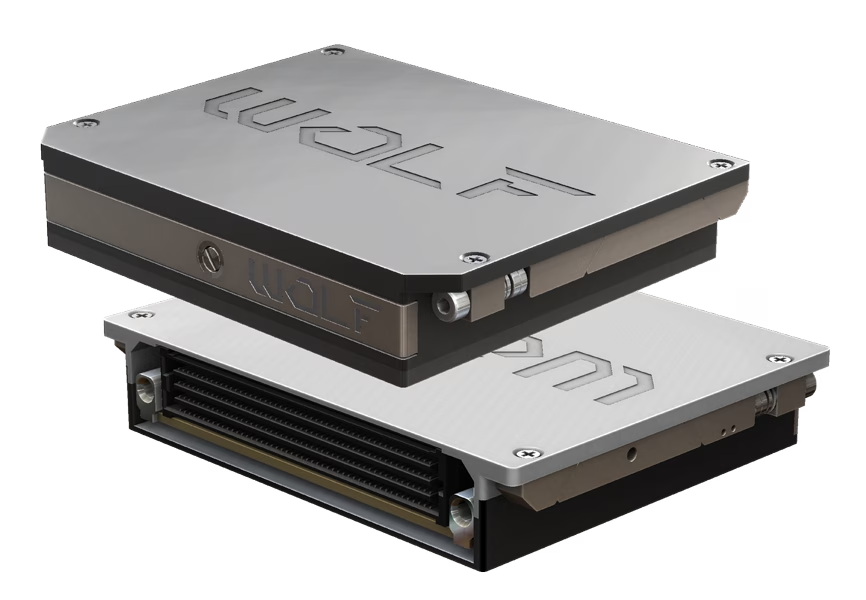
The WOLF-N180, or VNXP-FGX2-VIO, is a VNX+ video capture, conversion and transmission module based on WOLF’s second-generation FGX2 frame-grabber technology.
It supports configurations with up to two 12G-SDI or up to four 6G, 3G or HD-SDI inputs and outputs. In addition, Modified Commercial Off-The-Shelf configuration options can support other analogue or digital video interfaces.
The module can be paired with a suitable WOLF compute or GPU module to support low-latency video transfer and processing while reducing host CPU involvement.
Potential applications include:
- Electro-optical and infrared sensor processing
- Machine vision
- Synthetic vision
- Real-time video conversion
- Airborne and vehicle video systems
- Sensor ingest and distribution
- High-resolution video processing at the edge
WOLF-N1D0 VNX+ Development Platform
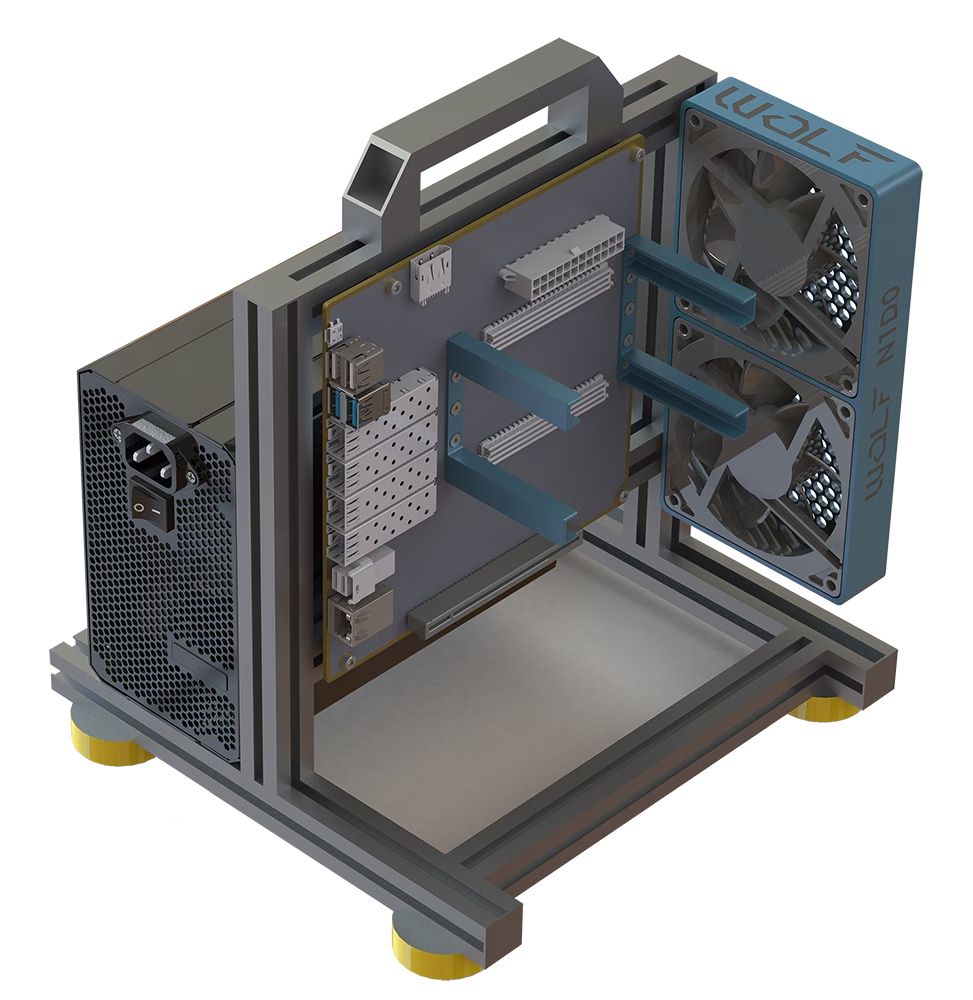
The WOLF-N1D0 development platform provides two VNX+ module sites for evaluating the WOLF-N4XP and WOLF-N180.
It enables engineers to conduct module bring-up, interface testing, software development and end-to-end video and computing trials before committing to a rugged deployment chassis.
This is particularly useful because VNX+ selection should be validated at a system level. A development platform allows teams to investigate data flow, PCIe bandwidth, video interfaces, application software and module interaction earlier in the development cycle.
Where Could VNX+ Be Used?
The VNX+ architecture is relevant to compact applications across defence, aerospace and other rugged industries, including:
- Small uncrewed aerial systems
- Uncrewed ground and maritime platforms
- Aircraft sensor and mission payloads
- Compact C5ISR equipment
- Electro-optical and infrared systems
- Portable and wearable computing
- Radar and signal-processing nodes
- Machine-vision systems
- Ground-vehicle electronics
- Naval and maritime systems
- Space-constrained industrial equipment
- Small satellites and experimental space payloads
Suitability must still be assessed against each program’s environmental, radiation, safety, security and qualification requirements. In particular, a rugged terrestrial module should not automatically be assumed to be suitable for space deployment without the necessary component selection, analysis and qualification.
How Metromatics Can Assist with VNX+ System Selection
VNX+ introduces valuable options for engineers developing smaller and more distributed computing architectures. However, successful implementation depends on choosing a suitable combination of processing, I/O, backplane, power, cooling, enclosure and software.
Metromatics can work with Australian and New Zealand defence and aerospace customers to:
- Compare VNX+, 3U VPX, 6U VPX and XMC approaches
- Review application workloads and interface requirements
- Identify suitable WOLF compute and video modules
- Discuss standard and modified COTS configurations
- Examine system power and thermal constraints
- Support development-platform selection
- Coordinate technical questions with WOLF
- Assist with rugged chassis and system-integration requirements
- Provide local commercial and technical support
Providing the following information will help us assess the most appropriate architecture:
- Available installation envelope
- Maximum system weight
- Power supply and power budget
- Required processing or AI workload
- Sensor and video interfaces
- Data rates and latency requirements
- Operating-system requirements
- Environmental and qualification requirements
- Cybersecurity and data-storage requirements
- Expected program lifecycle and quantities
Conclusion
The ratification of ANSI/VITA 90 represents an important milestone for VNX+. It gives engineers a formal standards framework for developing compact, rugged and modular embedded computing systems where traditional VPX hardware may be too large or consume more power than the platform can support.
However, VNX+ should not be selected only because it is smaller. The correct architecture depends on the required workload, interfaces, environmental conditions, software, lifecycle and thermal performance of the complete system.
Metromatics can help customers assess these requirements, compare VNX+ with established VPX and mezzanine alternatives, and identify suitable WOLF computing and video solutions.
Contact Metromatics to discuss your VNX+ application, development requirements or rugged embedded computing architecture.
Learn more about modern VNX+ systems from WOLF’s White Paper.