
Precision Navigation for Defence, UAV, Robotics & Autonomous Systems
High-Accuracy Inertial Navigation, Position and Orientation for Defence, UAVs, Robotics and Autonomous Systems
Metromatics is proud to be the exclusive Australian supplier of VectorNav. VectorNav is a global leader in:
- high-accuracy inertial navigation systems (INS)
- inertial measurement units (IMUs)
- attitude & heading reference systems (AHRS)
- tactical-grade GNSS/INS solutions
Built around cutting-edge MEMS sensor technology and advanced onboard sensor-fusion algorithms, VectorNav products deliver:
- Superior orientation, position, and velocity accuracy
- Low-SWaP navigation solutions for compact platforms
- High reliability for defence, aerospace, UAV, marine and robotics applications
- Proven performance in challenging GPS-denied and high-dynamic environments
Whether you need a compact IMU for a stabilised payload, a high-precision AHRS for a gimbal, or a tactical-grade GNSS/INS for autonomous navigation, VectorNav sensors provide unmatched performance in a miniature, ruggedised package.
Click Here to read more about VectorNav product families
VectorNav Product Families
VectorNav’s product line fits into five core technology categories, aligned with industry standards and engineering workflows.
1. Inertial Measurement Units (IMUs)
VectorNav IMUs combine 3-axis gyroscopes, accelerometers, and magnetometers to provide raw inertial data and precise 3D motion sensing.
Ideal for:
UAV stabilisation, Robotics, Antenna alignment, Gimbals & stabilised platforms, Guidance & control systems
Typical products:
VN-100 VN-110
2. Attitude & Heading Reference Systems (AHRS)
VectorNav AHRS units deliver real-time roll, pitch, yaw, attitude and heading using VectorNav’s onboard Extended Kalman Filter (EKF).
Designed for:
Vehicle orientation, Gimbal control, Payload stabilisation, Marine navigation, Autonomous systems
Typical products:
VN-100 VN-110 VN-310
3. GNSS/INS Navigation Systems
GNSS-aided inertial navigation systems fuse MEMS IMU, GNSS (single or dual antenna), and onboard EKF to output robust position, velocity, orientation, and navigation.
Used in:
UAVs & drones, Robotics, Survey systems, Military navigation, Marine & subsea platforms
Typical products:
VN-200 VN-210 VN-300 VN-310
4. Tactical-Grade Navigation Systems
Tactical-grade sensors provide extremely low drift, ultra-stable gyros, and superior navigation accuracy for mission-critical applications.
Ideal for:
Defence and military platforms, High-performance UAVs, Autonomous ground vehicles, High-precision targeting systems, Long-duration missions, GPS-challenged environments
Typical product:
VN-310
Why Choose VectorNav?
- High-performance MEMS inertial sensors
- Advanced onboard sensor fusion (EKF)
- Dual-antenna GNSS options (true heading)
- Miniature, low-SWaP form factors
- Rugged, industrial, and tactical-grade performance
- Reliable operation in GPS-denied environments
- Full SDK, API, and integration tools
- Backed by Metromatics’ local engineering support in Australia
Applications & Industries
- Defence & military systems
- UAVs & drones (navigation, stabilisation, targeting)
- Autonomous ground vehicles
- Robotics & industrial automation
- Gimbals, antennas & stabilised platforms
- Marine and subsea vehicles (AUVs, ROVs)
- Surveying & geospatial systems
- Aerospace research and flight control
- Satellite pointing & telemetry
These products excel in systems requiring reliable navigation data in compact, ruggedised hardware.
How to Choose the Right VectorNav Sensor
| Requirement / Use Case | Recommended Category | Example Models (on your site) |
|---|---|---|
| Basic inertial sensing | IMU | VN-100 |
| Orientation & heading | AHRS | VN-110 |
| GNSS-aided navigation | GNSS/INS | VN-200 VN-210 VN-300 VN-310 |
| Tactical-grade precision | Tactical-Grade Navigation Systems | VN-110 VN-310 |
FAQ’s About VectorNav’s Inertial Navigation Systems
Q1. What is the difference between an IMU and an INS?
An IMU measures acceleration and rotation; an INS combines an IMU with GNSS and onboard algorithms to output position, velocity, and navigation data.
Q2. Do VectorNav sensors work in GPS-denied environments?
Yes — tactical-grade models like the VN-310 provide robust performance when GNSS signals are degraded or unavailable.
Q3. Can VectorNav units provide true heading without a magnetometer?
Yes — dual-antenna GNSS models (e.g. VN-310) provide true heading without dependence on magnetic sensors.
Q4. What industries use VectorNav sensors?
Defence, UAVs, robotics, marine systems, surveying, aerospace, and industrial automation.
Q5. Does Metromatics offer local support for VectorNav products?
Yes — as the exclusive Australian supplier, Metromatics provides full technical support, advice, integration help, and product selection guidance.
-
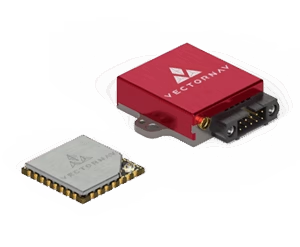
GNSS Inertial Navigation System (VN-200)
Read more about GNSS Inertial Navigation System (VN-200) -


Tactical IMU AHRS (VN-110)
Read more about Tactical IMU AHRS (VN-110) -
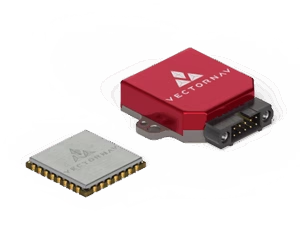
VectorNav Compact Rugged IMU (VN-100)
Read more about VectorNav Compact Rugged IMU (VN-100) -
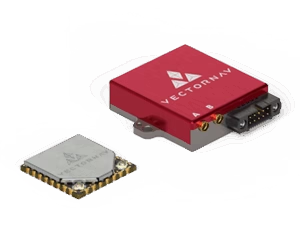
VectorNav Dual Antenna GNSS/INS (VN-300)
Read more about VectorNav Dual Antenna GNSS/INS (VN-300) -
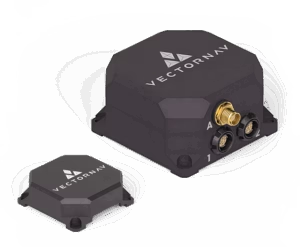
VectorNav High-Precision GNSS/INS (VN-210)
Read more about VectorNav High-Precision GNSS/INS (VN-210) -
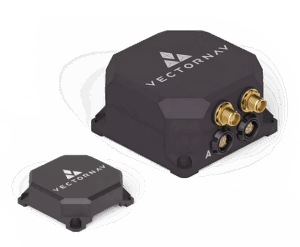
VectorNav Tactical GNSS/INS (VN-310)
Read more about VectorNav Tactical GNSS/INS (VN-310)