
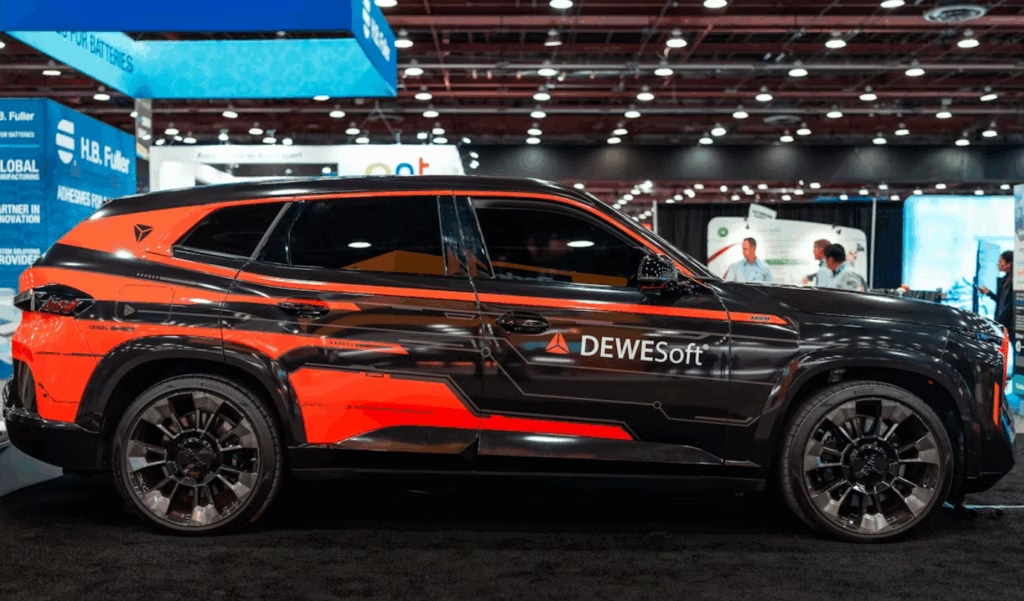
As modern vehicles combine high-performance drivetrains with electrification and advanced control systems, engineers face increasing complexity during validation. Lab simulations alone are no longer sufficient. To fully understand how these systems behave together, engineers require a robust automotive vehicle testing DAQ system. One that is capable of capturing accurate, synchronised data in real driving conditions.
Recent hybrid vehicle testing highlights how a flexible, on-vehicle data acquisition approach enables deeper insight. Such as performance, dynamics, and system interaction during real-world operation.
Why Real-World Vehicle Testing Still Matters
While simulation and dyno testing are essential during development. Real-world testing remains critical for validating assumptions and uncovering behaviours that only appear on the road.
For hybrid and performance vehicles in particular, real-world testing helps engineers:
- Observe transient events during acceleration, braking, and load changes
- Understand interactions between mechanical, electrical, and control systems
- Validate simulation models against measured data
- Capture driver-influenced behaviour under realistic conditions
An automotive vehicle testing DAQ system bridges the gap between theoretical performance and actual vehicle behaviour.
Key Challenges in Hybrid Vehicle Measurement

Testing modern hybrid vehicles presents several challenges for test and measurement teams:
- Multiple data domains must be captured simultaneously, including dynamics, acoustics, and electrical signals
- High channel counts are often required without adding excessive vehicle weight
- Measurement systems must be compact and non-intrusive
- Data must remain time-aligned across all sensors to maintain engineering value
Without proper synchronisation and system flexibility, valuable test data can be difficult to interpret or correlate.
Measurement Approach Using an Automotive Vehicle Testing DAQ System
In this application, engineers deployed a modular automotive vehicle testing DAQ system directly onto a high-performance hybrid vehicle. The system was configured to collect a wide range of parameters during real-world driving, including:
- Vehicle motion and acceleration
- Braking and handling behaviour
- Noise and vibration characteristics
- Power-related signals
- GPS-based speed and position data
The modular architecture allowed engineers to tailor the system to the test objectives while maintaining a compact footprint suitable for on-road use.
Importance of Synchronised Data Capture
One of the most critical aspects of automotive vehicle testing is time alignment. Capturing data from multiple sensors only becomes meaningful when every signal is synchronised to a common timeline.
With fully synchronised measurement, engineers can:
- Correlate noise or vibration events with specific driving actions
- Identify cause-and-effect relationships across vehicle systems
- Replay test runs for detailed post-analysis
- Compare multiple test sessions with confidence
This approach significantly improves the quality and usefulness of the collected data.
From Data Collection to Engineering Insight
A modern automotive vehicle testing DAQ system is not just about recording data—it must also support efficient analysis.
Advanced software tools allow engineers to:
- Review time-domain and frequency-domain behaviour
- Isolate specific events during test runs
- Compare results across different driving scenarios
- Visualise complex datasets in an accessible format
These capabilities help transform raw measurement data into actionable engineering insight that supports design decisions and performance optimisation.
Local Expertise and System Support
While the underlying DAQ technology is developed by the manufacturer, successful vehicle testing depends heavily on local expertise.
As the authorised distributor in Australia and New Zealand, Metromatics supports automotive and transport organisations with:
- DAQ system selection and configuration guidance
- Integration of sensors and measurement hardware
- Support for on-vehicle and proving-ground test setups
- Ongoing technical support across the test lifecycle
This local capability ensures test engineers can deploy automotive vehicle testing DAQ systems efficiently and with confidence.
Frequently Asked Questions
What is an automotive vehicle testing DAQ system?
It is a data acquisition platform designed to measure, record, and synchronise multiple vehicle parameters. During testing, both on-road and in controlled environments.
Why is synchronisation important in vehicle testing?
Synchronised data allows engineers to correlate events across different systems, improving accuracy and confidence in analysis.
Can these systems be used outside laboratory environments?
Yes. Automotive vehicle testing DAQ systems are commonly deployed directly on vehicles for real-world driving tests.
Is this type of testing relevant for hybrid vehicles?
Absolutely. Hybrid vehicles involve complex interactions between mechanical and electrical systems that benefit greatly from real-world, synchronised measurement.
Learn More from the Technology Originator
This article is based on a vehicle testing application published by Dewesoft. The developer of the DAQ technology used in this project.
For the original supplier perspective and full application background, refer to the Dewesoft article on hybrid vehicle testing.