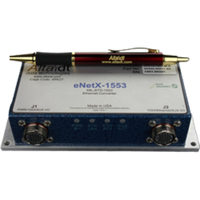
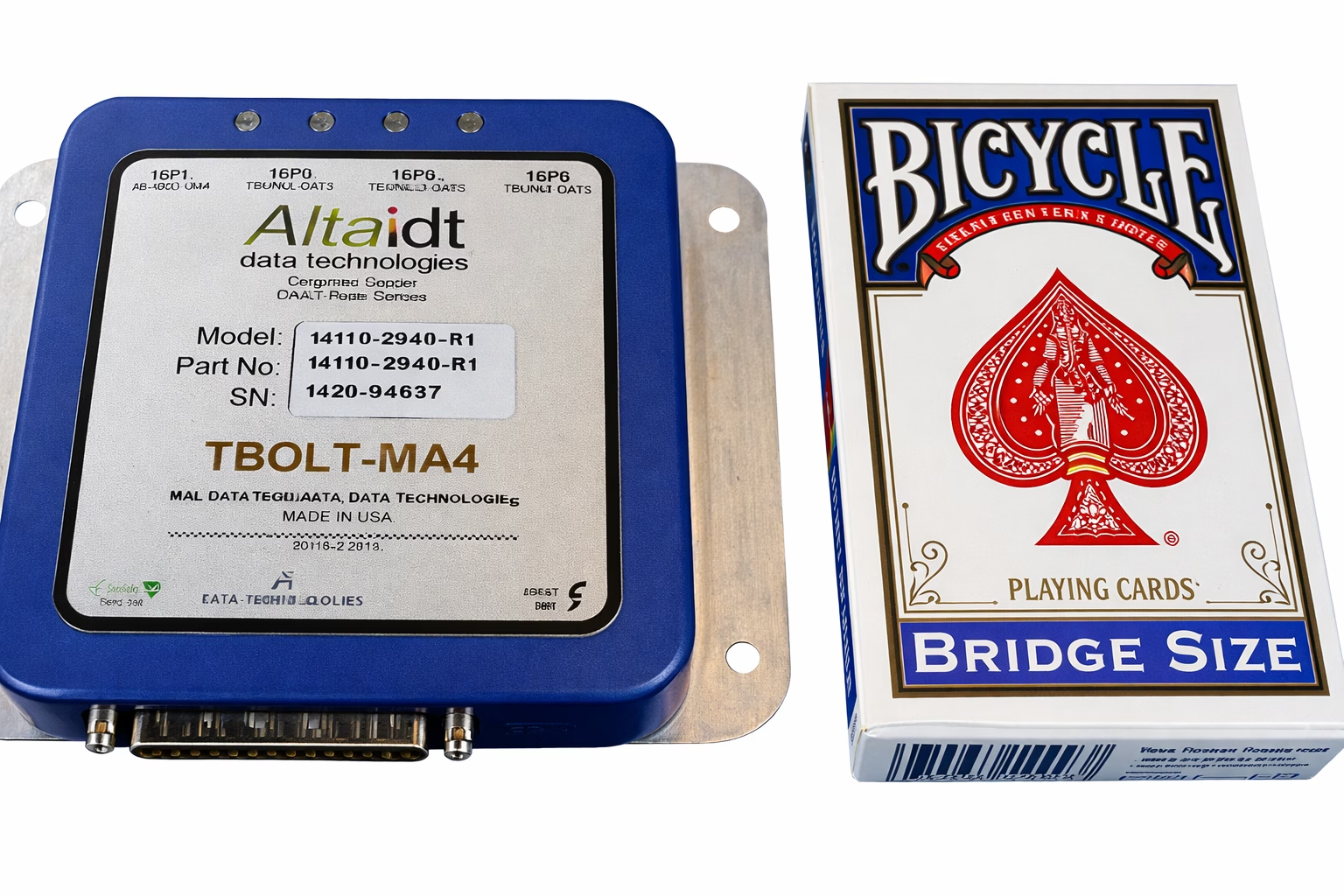
The MIL-STD-1553 Thunderbolt Interface (TBOLT-MA4 series) is an external Thunderbolt 3 appliance. Designed for engineers who need deterministic, real-time access to avionics data buses using modern computers. It connects directly to a Thunderbolt-enabled laptop, desktop, or server. In addition, it exposes MIL-STD-1553 and ARINC 429/717 I/O without installing internal PCIe cards.
As a result, defence, aerospace, and MRO teams can deploy a single portable interface. Whether that is across laboratories, integration rigs, production test stations, and flight-line maintenance kits. The device uses the same AltaAPI software architecture as Alta Data PCIe products. Therefore, allowing existing test applications to migrate with minimal changes. Bus counts, ARINC channel density, and auxiliary I/O are model dependent.
Key Features
Thunderbolt 3 (USB-C) host interface delivering PCIe-class performance
MIL-STD-1553: up to 2 dual-redundant independent buses (model dependent)
ARINC 429: up to 8 channels total, including RX/TX and RX-only channels (model dependent)
ARINC 717 support available on selected channels (model dependent)
Hardware and polling interrupt modes for real-time deterministic operation
On-board buffering with dedicated RAM per channel/bank (model dependent)
Optional features including variable 1553 voltage, transmit inhibit, conformal coating, and NVRAM write protection (model dependent)
Auxiliary I/O options including avionics discretes, RS-485 discrete, TTL triggers, clocks, and IRIG-B receive (model dependent)
Applications and Use Cases
Portable MIL-STD-1553 Thunderbolt interface for avionics test
Combined 1553 and ARINC 429/717 interface for integration and validation labs
Laptop-based maintenance and troubleshooting on the flight line
Depot-level repair and overhaul test systems
Production and acceptance test benches where internal PCIe cards are impractical
Engineering development environments requiring flexible, reusable I/O hardware
Technical Specifications
| Parameter | Specification |
|---|---|
| Product series | TBOLT-MA4 Thunderbolt appliance |
| Host interface | Thunderbolt 3 (USB-C, Thunderbolt-certified cable required) |
| MIL-STD-1553 buses | 1–2 dual-redundant buses (model dependent) |
| ARINC channels | Up to 8 total; ARINC 429 and optional ARINC 717 (model dependent) |
| On-board memory | 1 MB RAM per channel/bank (model dependent) |
| Power | Bus-powered via Thunderbolt; consumption varies by configuration |
| Dimensions | Approximately 110 × 89 × 17 mm |
| Weight | Approximately 180 g |
| Operating temperature | 0 °C to +60 °C |
| Storage temperature | −55 °C to +120 °C |
| Humidity | 5–95% RH, non-condensing |
| Supported operating systems | Windows; Linux support available (model and kernel dependent) |
| Warranty | 5-year limited warranty |
Certifications and Compliance
RoHS compliant (EU and China)
Additional compliance documentation available on request
Classified by the manufacturer as a non-safety-critical commercial avionics interface
Installation and Deployment
Connect directly to a Thunderbolt 3-enabled host using a certified Thunderbolt cable
No external power supply required; device is bus powered
Avionics and auxiliary I/O provided via dedicated rear connector and optional breakout cables
Suitable for bench-top, portable case, or temporary rack-mounted deployments
Software integration via AltaAPI SDK and supported Alta Data tools
Lead Times and Local Support
Lead times vary depending on configuration, options, and order quantity. However, generally around 4-6 Weeks. Metromatics supplies the MIL-STD-1553 Thunderbolt interface in Australia and New Zealand. They also offer local support before sales, help with setup, and technical assistance after sales.
Why Metromatics
Proven experience supporting defence and aerospace test programs
Local engineering support for Alta Data Technologies interfaces
Assistance with configuration selection, procurement, and integration
Long-term product support aligned with program life-cycle requirements
Specify your required MIL-STD-1553 and ARINC channel configuration. Metromatics will identify the correct Thunderbolt interface model. Metromatics local support is available for quotation, lead-time confirmation, and integration planning. Call us now.
View our full range of MIL-STD-1553 interfaces or see our other ARINC 429 and ARINC 717 interface options.
Frequently Asked Questions – MIL-STD-1553 Thunderbolt Interface
1. Does this MIL-STD-1553 Thunderbolt interface behave like an internal PCIe card in terms of timing and determinism?
Yes. The interface uses Thunderbolt 3 to expose a PCIe-class connection to the host system. As a result, it supports hardware interrupts and deterministic bus control rather than USB-style polling. Real-time behaviour is therefore comparable to Alta Data internal PCIe 1553 and ARINC cards. Subject to host operating system configuration and driver settings.
2. Can the same unit be used for both MIL-STD-1553 and ARINC 429/717 at the same time?
Yes, but this is model dependent. Some TBOLT-MA4 configurations support combined MIL-STD-1553 and ARINC 429/717 operation within a single appliance. While other models are configured for 1553-only or ARINC-only use. Engineers should define required bus counts and ARINC channel density at procurement to ensure the correct configuration is supplied.
3. Is this suitable for portable and flight-line use, or is it limited to laboratory environments?
The unit is well suited to portable and flight-line test use where a Thunderbolt-enabled laptop is available. It is compact, bus powered, and does not require an external power supply. However, it operates over a commercial temperature range and is not a ruggedised or safety-critical device unless additional qualification is performed at the system level.