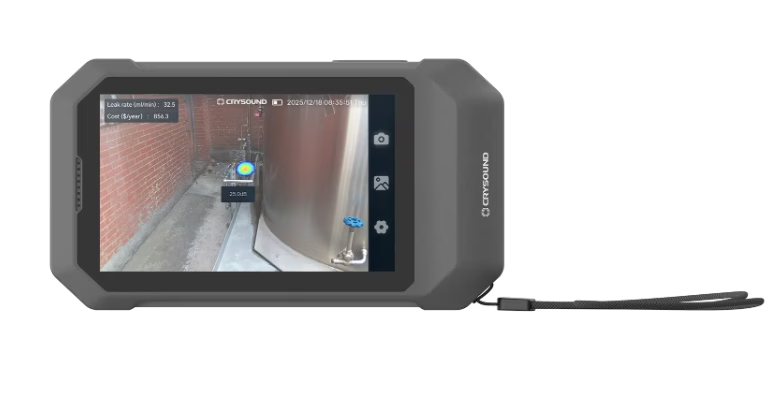
See, quantify and document compressed-air leaks
Compressed-air leaks increase energy consumption, reduce system pressure and place additional demand on compressors. However, conventional leak surveys can take considerable time, particularly when pipelines, couplings and pneumatic equipment are spread across a large or noisy facility.
The CRY8025 allows technicians to scan equipment without making physical contact. Its acoustic heatmap shows the probable leak location directly over the live camera image.
Once it finds a leak, the CRY8025 can estimate:
- Leakage rate
- Potential economic loss
- Relative importance of the repair
- Data required for maintenance reporting
This information helps maintenance teams address high-value leaks first instead of treating every detected leak as equally urgent.
Key features
- 64-channel MEMS digital microphone array
- Acoustic and ultrasonic frequency coverage from 2 kHz to 65 kHz
- Real-time sound visualisation and localisation
- Compressed-air, pressurised-gas and vacuum leak detection
- Leak-rate quantification
- Estimated economic-loss calculations
- Partial-discharge screening and localisation
- Automatic and manual frequency selection
- Five-megapixel autofocus visual camera
- Built-in LED inspection light
- Photo, video, audio and acoustic-data recording
- 32 GB internal storage
- Wi-Fi, Bluetooth 5.2 and USB-C connectivity
- Mobile and computer-based data access
- Post-processing and professional report generation
- IP54-rated enclosure
- 1.5 m drop-tested construction
- Compact 270 g design
- Up to three hours of battery operation
How does the CRY8025 work?
Pressurised air or gas escaping through a small opening produces acoustic and ultrasonic energy. Similarly, partial discharge and some mechanical faults generate distinctive sound patterns.
The CRY8025 uses signals from its 64 microphones to calculate where the sound is coming from. It then places a coloured acoustic hotspot over the live visual image.
This approach allows technicians to scan multiple components from a distance rather than checking each connection individually with a point detector or soap solution.
The camera’s automatic frequency-selection function simplifies setup by selecting a suitable detection band. Experienced operators can also adjust the frequency range manually to reduce interference from other equipment.
Compressed-air leak detection and quantification
The CRY8025 can inspect compressed-air systems while equipment remains operating. Typical inspection points include:
- Pipe connections
- Valves and manifolds
- Couplings and quick-connect fittings
- Flexible hoses and tubing
- Pneumatic cylinders
- Filters, regulators and lubricators
- Machine air supplies
- Compressor-room pipework
- Overhead compressed-air lines
- Difficult-to-reach fittings
CRYSOUND states that the camera can detect a leak of 0.0028 L/min from 10 m at 6.9 bar under the manufacturer’s specified test conditions. Actual performance will depend on pressure, leak geometry, distance, frequency, background noise, obstructions and environmental conditions.
Estimate the cost of compressed-air losses
Locating a compressed-air leak is only the first step. Maintenance and energy managers also need to understand which repairs offer the greatest potential return.
The CRY8025 estimates the economic impact associated with detected leaks. Teams can use this information to:
- Rank leaks according to estimated loss
- Prioritise maintenance work
- Support repair expenditure
- Demonstrate potential energy savings
- Track leak-reduction initiatives
- Communicate findings to management or customers
Actual financial savings will depend on compressor efficiency, operating hours, system pressure, electricity costs and whether the identified leaks are successfully repaired.
Create professional inspection reports
The CRY8025 records images, video, audio and acoustic data during an inspection. Users can transfer the results to a compatible phone or computer using Wi-Fi or USB-C.
Post-processing and reporting functions allow inspection teams to organise findings and create reports containing:
- Acoustic images
- Identified leak locations
- Estimated leak rates
- Estimated economic losses
- Inspection notes
- Equipment or asset identification
- Supporting images and recordings
- Recommended maintenance follow-up
This reporting capability makes the CRY8025 particularly suitable for compressed-air auditors, maintenance service providers and organisations managing formal leak-reduction programs.
Pressurised-gas and vacuum leak detection
The CRY8025 can help locate leaks in pressurised-gas and vacuum systems when the pressure difference generates a detectable acoustic or ultrasonic signal.
Potential applications include:
- Industrial gas lines
- Vacuum equipment
- Process machinery
- Pneumatic systems
- HVAC installations
- Manufacturing test systems
- Vacuum-assisted production processes
The CRY8025 detects sound generated by a leak. It does not identify the gas, measure its concentration or warn personnel about hazardous atmospheric conditions. Continue using appropriately certified gas-detection and safety equipment where required.
Partial-discharge screening
Partial discharge in high-voltage electrical equipment can produce ultrasonic energy. The CRY8025 allows qualified personnel to scan electrical assets from a distance and identify probable areas of ultrasonic activity.
Potential inspection targets include:
- Switchgear cabinets
- Bus ducts and busbars
- Insulators
- Cable terminations
- High-voltage connections
- Transformers
- Substation equipment
The CRY8025 supports initial partial-discharge screening and localisation. Any suspected activity should receive appropriate follow-up testing by qualified electrical personnel.
HVAC and building-system troubleshooting
The CRY8025 can also help technicians locate airflow noise and difficult-to-identify acoustic faults in HVAC and building systems.
Applications can include:
- Duct leakage
- Abnormal airflow noise
- Failing dampers
- Vacuum leaks
- Mechanical equipment noise
- Hard-to-reach sound sources
By showing the probable sound source on screen, the camera can reduce repeated listening checks and unnecessary equipment disassembly.
Abnormal machinery and automotive noise
When a fault produces an audible sound that is difficult to pinpoint, the CRY8025 can help isolate the source.
Potential applications include:
- Industrial machinery troubleshooting
- Automotive repair
- Component testing
- Enclosure noise investigation
- Manufacturing quality control
- Production-line fault finding
- General sound-source localisation
Compact design for routine inspections
At only 270 g, the CRY8025 is designed for technicians to carry during everyday maintenance rounds.
Its smartphone-style touchscreen interface, automatic frequency selection and one-tap recording functions reduce setup time. Furthermore, its IP54 enclosure and 1.5 m drop-tested design support use in general industrial environments.
The CRY8025 is not waterproof and should not be immersed. The manufacturer’s published information does not identify the camera as ATEX or IECEx certified, so do not use it in classified hazardous areas unless its suitability has been separately confirmed.
Technical specifications
| Specification | CRYSOUND CRY8025 |
|---|---|
| Product type | Pocket Pro acoustic imaging camera |
| Microphone array | 64-channel MEMS digital microphone array |
| Frequency range | 2 kHz to 65 kHz |
| Sound-pressure range | 28 to 132 dB |
| Dynamic range | Up to 12 dB |
| Stated inspection distance | 0.3 to 120 m |
| Manufacturer-stated minimum detectable leak | 0.0028 L/min at 10 m and 6.9 bar |
| Leak analysis | Leak-rate quantification and estimated economic loss |
| Visual camera | 5 megapixels with autofocus |
| Focal length | 2.26 mm |
| Field of view | 66° horizontal × 52° vertical |
| Inspection light | Integrated LED |
| Display | 4.3-inch capacitive touchscreen |
| Display resolution | 800 × 480 pixels |
| Maximum screen brightness | 400 nits, adjustable |
| Internal storage | 32 GB |
| File formats | JPG, MP4, WAV and CDAT |
| Maximum video duration | 5 minutes per recording |
| Connectivity | Wi-Fi 802.11a/b/g/n/ac, Bluetooth 5.2 and USB-C 3.0 |
| Data export | Wi-Fi and USB-C |
| Battery | Rechargeable 3.85 V, 3900 mAh |
| Battery operating time | Up to 3 hours |
| Charging | 9 VDC, 1 A via USB-C |
| Environmental protection | IP54 |
| Drop resistance | Tested to 1.5 m |
| Operating temperature | –10°C to +50°C |
| Operating humidity | 10–95%, non-condensing |
| Storage temperature | –20°C to +55°C |
| Dimensions | 150 × 83 × 27.5 mm |
| Weight | 270 g |
CRY8024 versus CRY8025
Both models use the same core acoustic imaging platform. The CRY8024 suits routine inspections where technicians primarily need to locate and record faults. The CRY8025 adds the analysis and reporting functions required for leak-reduction programs, professional surveys and customer deliverables.
| Capability | CRY8024 SonoCam Pocket | CRY8025 SonoCam Pocket Pro |
|---|---|---|
| Primary purpose | Quick localisation and reporting | Leak evaluation and professional reporting |
| Microphone array | 64 channels | 64 channels |
| Frequency range | 2–65 kHz | 2–65 kHz |
| Leak localisation | Yes | Yes |
| Partial-discharge screening | Yes | Yes |
| Leak-rate quantification | No | Yes |
| Economic-loss estimation | No | Yes |
| PC post-processing | Basic data transfer | Analysis and post-processing |
| Professional reports | Basic mobile reporting | Standardised professional reports |
| Best suited to | Routine maintenance and rapid troubleshooting | Leak audits, energy programs and service reporting |
Who should choose the CRY8025?
The CRY8025 is the better choice for:
- Compressed-air auditors
- Energy-efficiency consultants
- Maintenance service providers
- Reliability and condition-monitoring teams
- Manufacturers with formal leak-reduction programs
- Multi-site maintenance departments
- Organisations that need documented inspection reports
- Teams that need to prioritise repairs by estimated loss
Choose the CRY8024 when fast localisation and basic reporting are sufficient. Choose the CRY8025 when the organisation also needs leak-rate estimates, financial-loss calculations, post-processing and professional reports.
Frequently asked questions
What is a compressed-air leak detection camera?
A compressed-air leak detection camera uses an array of microphones to locate the acoustic and ultrasonic sound produced by escaping air. It displays the probable leak location over a live visual image.
Does the CRY8025 measure leak rates?
The CRY8025 provides an estimated leak rate based on the detected acoustic signal and inspection conditions. Results can help teams compare leaks and prioritise repairs.
Can it calculate the cost of an air leak?
Yes. The CRY8025 can estimate the economic loss associated with a detected leak. Actual costs will depend on system pressure, compressor efficiency, operating hours and local electricity prices.
Can the CRY8025 detect gases?
It can locate leaks from pressurised gases when escaping gas produces a detectable acoustic signal. It does not identify the gas or measure gas concentration.
Can it detect partial discharge?
The camera supports acoustic and ultrasonic screening for probable partial-discharge activity. Qualified personnel should investigate suspected activity using appropriate electrical testing procedures.
What is the difference between the CRY8024 and CRY8025?
The CRY8024 focuses on quick fault localisation and mobile reporting. The CRY8025 Compressed Air Leak Detection Camera adds leakage quantification, economic-loss estimation, PC analysis and professional report generation.
Enquire about the CRYSOUND CRY8025
Looking for a Compressed Air Leak Detection Camera that can locate leaks, estimate losses and produce professional reports?
Contact Metromatics for product information, availability and assistance selecting between the CRYSOUND CRY8024 and CRY8025 acoustic imaging cameras.