What is the XSR Spire? | The XSR Spire is a compact, rugged embedded computer designed for defence applications where computing must occur directly at the tactical edge. Rather than relying on remote processing, it enables mission systems to process, analyse and distribute critical information in real time. Therefore, improving responsiveness while reducing latency and communications overhead. Its sealed architecture, passive cooling design and software defined capabilities also make it ideal for defence integrators developing next-generation C5ISR, autonomy, sensor fusion as well as mission command systems. |
Why Choose the XSR Spire Rugged Embedded Computer? | Modern defence platforms generate vast amounts of mission data from sensors, communications systems and autonomous payloads. As a result, spectra designed this rugged embedded computer with the ability to processes information closer to the source. As a result, this improves operational awareness and also reduces dependence on external infrastructure. Spectra also engineered the XSR Spire with a compact footprint. Its compact footprint concentrates Size, Weight and Power (SWaP) on mission processing while also supporting persistent onboard computing, secure networking and long-term reliability in harsh operational conditions. |
Built for Harsh Defence Environments | Thanks to the following features, the XSR Spire withstands demanding military operating environments. It also delivers dependable performance across air, land and multi-domain platforms.
|
Engineered for Persistent Edge Computing | The XSR Spire’s persistent onboard architecture is purpose-built for applications that perform mission computing at the edge and require real-time data. For example, as a result of combining onboard processing, secure networking and software defined functionality in a single sealed platform, the XSR Spire helps defence organisations:
|
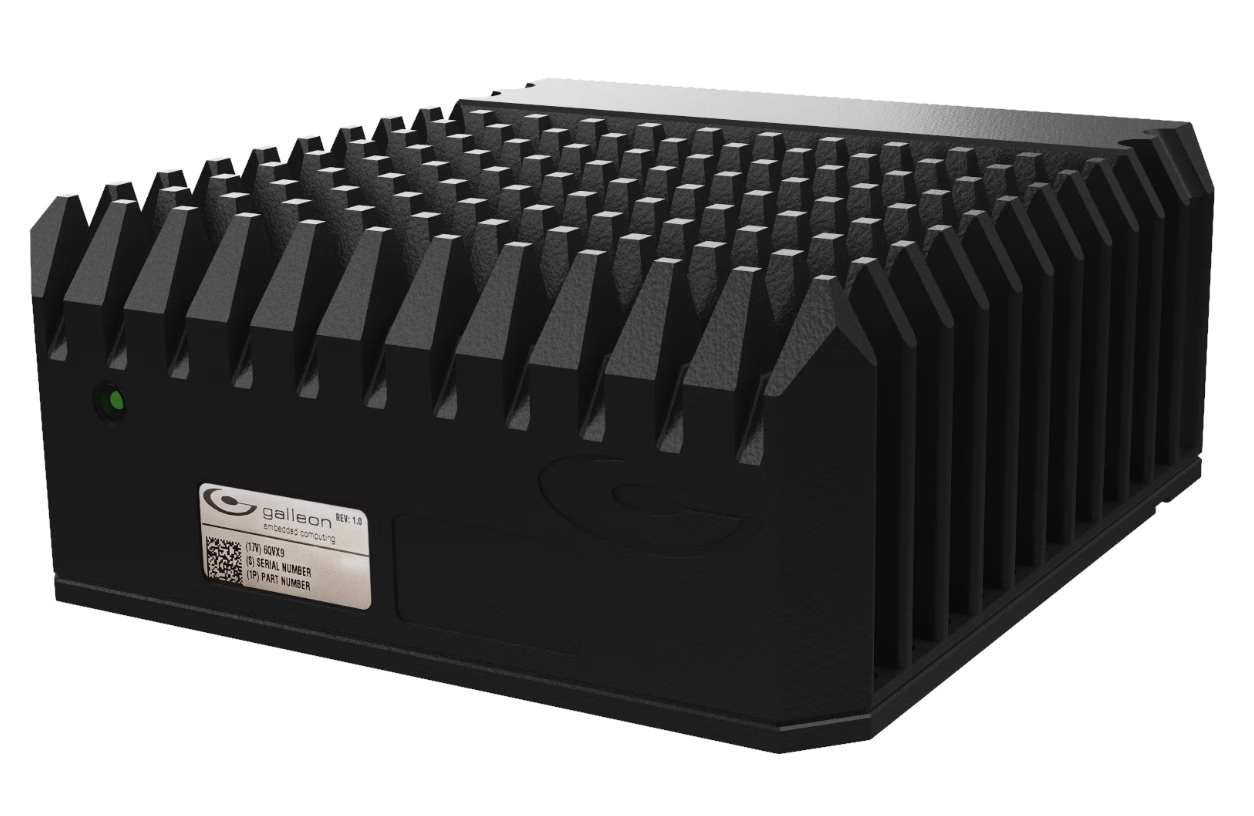
XSR Spire Rugged Embedded Computer
Modern defence platforms require high-performance computing in increasingly compact and demanding environments. The XSR Spire Rugged Embedded Computer is purpose-built to deliver persistent onboard processing, secure networking and software-defined functionality in a sealed, deployment-ready platform optimised for sustained edge computing.
Derived from Spectra Defense Technologies’ proven XSR architecture, the XSR Spire combines powerful Intel® Xeon® processing, low SWaP design and rugged environmental protection to support mission-critical applications across airborne, ground vehicle and multi-domain defence platforms.
- Details
- Ratings
- Key Benefits
- Key Features
- Applications
- Specifications
- FAQ
- The Metromatics Advantage
- Product Brochures
Key Benefits of the XSR Spire Rugged Embedded Computer
| Key Benefit | How It Benefits Your Defence Platform |
|---|---|
| Persistent Edge Processing | Process mission-critical data directly on the platform to enable real-time sensor fusion, Edge AI, and faster operational decision-making while reducing latency and reliance on external infrastructure. |
| Compact SWaP-Optimised Design | Minimise size, weight and power requirements without sacrificing computing performance, making the XSR Spire ideal for airborne, ground vehicle and other space-constrained defence applications. |
| Improved Thermal Performance | An enhanced thermal design supports sustained processing during demanding compute workloads and elevated ambient temperatures, helping maintain reliable performance throughout extended missions. |
| Passive Cooling for Greater Reliability | Passive convection cooling eliminates moving parts, reducing maintenance requirements while improving long-term reliability in harsh operational environments. |
| Built for Harsh Defence Environments | A sealed enclosure with IP66/IP67 environmental protection and support for key military standards helps ensure dependable operation across air, land and multi-domain platforms. |
| Flexible Platform Integration | Support for XMC and mPCIe expansion, along with mission I/O including CAN Bus, ARINC 429 and MIL-STD-1553B, enables easier integration into new and existing defence systems. |
| High-Speed Secure Connectivity | Copper and fibre Ethernet options up to 10 GbE provide the bandwidth required for modern mission systems, sensor networks and edge computing applications. |
| ITAR Free | Supports international defence programs by reducing export control complexity for Australian, European and allied defence organisations. |
Key Features of the XSR Spire Rugged Embedded Computer
- Intel® Xeon® W-11865MRE processor optimised for edge workloads
- Up to 96 GB DDR4 ECC memory
- Up to 16 TB persistent onboard NVMe storage
- Passive convection cooling
- IP66/IP67 sealed enclosure
- Improved thermal design
- Copper and fibre Ethernet connectivity up to 10 GbE
- Mission I/O including CAN Bus, ARINC 429 and MIL-STD-1553B
- XMC or dual mPCIe expansion
- 12–48 VDC power input
- 35–70 W power consumption (configuration dependent)
- ITAR Free
Typical Applications for the XSR Spire Rugged Embedded Computer
The XSR Spire Rugged Embedded Computer is designed for mission-critical defence applications including:
- Battlefield Management Systems
- Mission Command
- Tactical Networking
- Sensor Fusion
- Edge AI and Machine Learning Inference
- Vehicle Autonomy
- Crewed-Uncrewed Teaming
- Situational Awareness
- Airborne Mission Systems
- Ground Vehicle Integration
- Multi-Domain Operations
- Persistent Edge Computing
Technical Highlights of the XSR Spire Rugged Embedded Computer
| Specification | Details |
|---|---|
| Processor | Intel® Xeon® W-11865MRE |
| Memory | Up to 96 GB DDR4 ECC |
| Storage | Up to 16 TB NVMe |
| Cooling | Passive convection |
| Environmental Sealing | IP66 / IP67 |
| Temperature | -40°C to +71°C (extended configuration) |
| Power Input | 12–48 VDC |
| Networking | Copper & Fibre Ethernet up to 10 GbE |
| Expansion | XMC or Dual mPCIe |
| Compliance | MIL-STD-810H, MIL-STD-461G, MIL-STD-704F, MIL-STD-1275E |
| Weight | 3.6–4.0 kg |
Frequently Asked Questions for the XSR Spire Rugged Embedded Computer
| Frequently Asked Question | Answer |
|---|---|
What is the XSR Spire used for? | The XSR Spire is a rugged embedded computer designed for persistent edge processing across defence platforms, including airborne, ground vehicle and multi-domain systems. It supports mission computing, sensor fusion, secure networking and Edge AI applications. You can learn more about it here. |
Is the XSR Spire suitable for harsh military environments? | Yes. The XSR Spire features IP66/IP67 environmental sealing and is designed to meet MIL-STD-810H, MIL-STD-461G, MIL-STD-704F and MIL-STD-1275E requirements for demanding defence applications. |
Does the XSR Spire support expansion? | Yes. The platform supports either one XMC expansion slot or two mPCIe slots, enabling additional mission-specific interfaces and future system upgrades. |
What networking interfaces are available? | Configuration options include copper and fibre Ethernet connectivity up to 10 GbE, along with mission interfaces such as CAN Bus, ARINC 429 and MIL-STD-1553B. |
Why Buy Through Metromatics?
As the exclusive Australian distributor for Spectra Defense Technologies, Metromatics provides local engineering expertise and technical support to help defence organisations integrate rugged embedded computing solutions into complex mission systems.
Whether you’re modernising an existing platform or developing a new defence capability, our team can assist with product selection, system integration and ongoing technical support. Have any other questions? Contact us here.
Download the Spec Sheet for the G2 Ultra-Rugged microNAS – Simply by filling out Spectra’s Form Request. You can also speak with one of our friendly specialists. If you would like to learn more, call us on 61 7 3868-4255.