
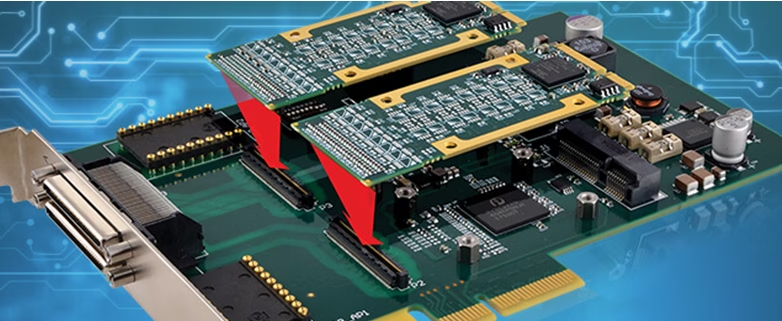
AcroPack® is a modular, mezzanine-based embedded I/O platform from Acromag. Designed for compact, rugged, and long-life embedded systems. Firstly, it enables engineers to integrate high-density analog, digital, serial, and timing I/O. Whilst avoiding the size, rigidity, and redesign overhead of traditional PCIe I/O cards or remote Ethernet I/O.
By decoupling I/O from compute, AcroPack supports scalable architectures across industrial automation, transport, test and measurement, and defence electronics.
What Is Modular Embedded I/O?
Modular embedded I/O is an architecture. Where I/O functions are separate from the main compute platform. Instead of using fixed, monolithic I/O cards. Engineers select modular I/O building blocks that can be reused across different systems.
This approach improves:
- Design flexibility
- Platform reuse
- Upgrade paths
- Long-term lifecycle management
AcroPack is the implementation of this modular embedded I/O concept.
What Is AcroPack®?
AcroPack modules are mini-PCIe-style mezzanine cards that plug into carrier boards. Each module delivers a specific I/O function. While the carrier interfaces those modules to the host system. Achieved by PCIe-based platforms such as PCIe, VPX, XMC, CompactPCI Serial, or COM Express.
This design allows engineers to:
- Select only the I/O required
- Combine multiple I/O types on one carrier
- Reuse the same I/O modules across multiple platforms
How the AcroPack Architecture Works
An AcroPack system consists of three core elements:
Host System
An embedded computer or processor card running the application software.
Carrier Board
A PCIe-based interface card that hosts one or more AcroPack modules and connects them to the host bus.
AcroPack I/O Modules
Compact mezzanine cards providing dedicated I/O functions.
Because the I/O remains modular, system upgrades often involve only a carrier change, reducing redesign risk and engineering cost.
AcroPack I/O Module Types
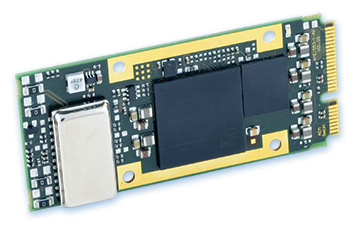
AcroPack supports a wide range of embedded I/O requirements:
Analog I/O Modules
High-resolution A/D and D/A channels for sensors, monitoring, and control loops.
Digital I/O Modules
Isolated and non-isolated inputs and outputs for discrete control and status signals.
Counter and Timer Modules
Event counting, pulse measurement, and timing applications.
Serial & Communication Modules
RS-232, RS-422, RS-485, Ethernet, and other industrial interfaces.
FPGA-Based Modules
Reconfigurable logic for custom protocols, deterministic processing, and specialised control tasks.
Why Modular Embedded I/O Matters
Traditional embedded I/O approaches introduce limitations:
- Fixed PCIe I/O cards are large and platform-specific
- Remote Ethernet I/O adds latency and network complexity
AcroPack addresses these challenges by providing:
- High I/O density in compact systems
- Deterministic, low-latency PCIe performance
- Reduced internal cabling and fewer failure points
- Easier upgrades across long program lifecycles
This makes modular embedded I/O particularly valuable in rugged and mission-critical systems.
Designed for Rugged and Long-Life Systems
Many AcroPack modules support wide operating temperature ranges and are suitable for conduction-cooled designs. This makes them well suited to:
- Defence and aerospace electronics
- Rail and transport systems
- Mining and industrial automation
- Scientific and research equipment
For long-life programs, modular I/O simplifies obsolescence management and future expansion.
Typical AcroPack Applications
AcroPack is commonly deployed in:
- Embedded control and monitoring systems
- Compact data acquisition platforms
- Platform-agnostic defence electronics
- Industrial test and measurement systems
Its modular design allows a single I/O strategy to scale across multiple platforms and deployment phases.
AcroPack vs Traditional Embedded I/O
| Approach | Limitation | AcroPack Advantage |
|---|---|---|
| Fixed PCIe I/O cards | Large, platform-specific | Compact, reusable mezzanine modules |
| Remote Ethernet I/O | Added latency and complexity | Direct PCIe-based access |
| Custom I/O designs | High cost and long development | Off-the-shelf modular I/O |
How Metromatics Supports AcroPack Integration
Metromatics provides local support across Australia and New Zealand, including:
- I/O module and carrier selection
- Embedded system integration guidance
- Support for industrial, transport, and defence programs
- Lifecycle and obsolescence planning
Frequently Asked Questions (FAQ)
What is AcroPack used for?
AcroPack is used to add modular embedded I/O—such as analog, digital, serial, and timing interfaces—to compact and rugged computing systems.
How is AcroPack different from PCIe I/O cards?
AcroPack uses mezzanine modules on carrier boards, allowing the same I/O to be reused across different platforms rather than locking I/O to a single PCIe card.
Is AcroPack suitable for defence and harsh environments?
Yes. Many AcroPack modules support wide temperature ranges and conduction-cooled designs, making them suitable for defence, transport, and industrial environments.
Can AcroPack be used across multiple platforms?
Yes. The same AcroPack I/O modules can be deployed on different carrier boards supporting PCIe, VPX, XMC, CompactPCI Serial, and COM Express architectures.
Does AcroPack support long-life programs?
Yes. Modular embedded I/O simplifies upgrades, reduces redesign effort, and helps manage obsolescence in long-term systems.
Summary
AcroPack® provides a scalable, rugged, and modular embedded I/O architecture that separates I/O from compute. This approach reduces system complexity, improves platform reuse, and supports long-life embedded programs across industrial, transport, and defence applications.
Talk to Metromatics about integrating AcroPack modular embedded I/O into your next embedded system.