
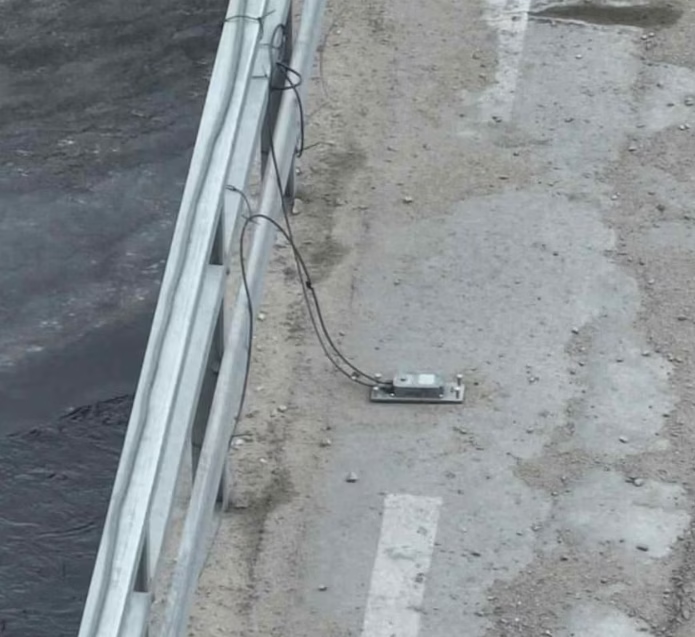
Ageing bridge infrastructure presents a growing challenge for transport authorities worldwide. Many prestressed concrete bridges built in the 1950s–1970s remain critical parts of road and freight networks today. Often carrying heavier loads than originally intended.
Rather than replacing these structures prematurely, infrastructure owners are increasingly adopting structural health monitoring (SHM) using distributed sensor networks and synchronized data acquisition systems.
A recent case study published by Dewesoft demonstrates how IOLITE MEMS-based monitoring devices were used to continuously monitor the behaviour of an operational prestressed concrete bridge, . Helping engineers better understand structural performance and support long-term maintenance planning.
Why structural health monitoring is important for prestressed concrete bridges
Prestressed concrete bridges rely on internal tensioned steel tendons to improve strength and control cracking. Over time, these structures experience:
- increased traffic loading beyond original design expectations
- environmental exposure
- fatigue accumulation
- gradual stiffness changes
- hidden internal degradation not visible during inspections
Traditional inspection programs rely heavily on periodic visual assessment. Structural health monitoring adds continuous measurement capability that helps engineers evaluate actual structural behaviour under real operating conditions.
Case study overview: monitoring a 1960s prestressed concrete bridge
In the Dewesoft application example, a prestressed concrete bridge originally constructed in the early 1960s was instrumented with a distributed monitoring system rather than being immediately replaced.

Engineers deployed IOLITE MEMS monitoring devices to:
- measure vibration behaviour across the structure
- monitor dynamic structural response under heavy traffic
- observe long-term stiffness variation
- track environmental influence on bridge performance
- support predictive maintenance decision-making
This approach transformed the bridge into a long-term research platform supporting infrastructure lifecycle management.
Why MEMS sensors are ideal for bridge structural monitoring
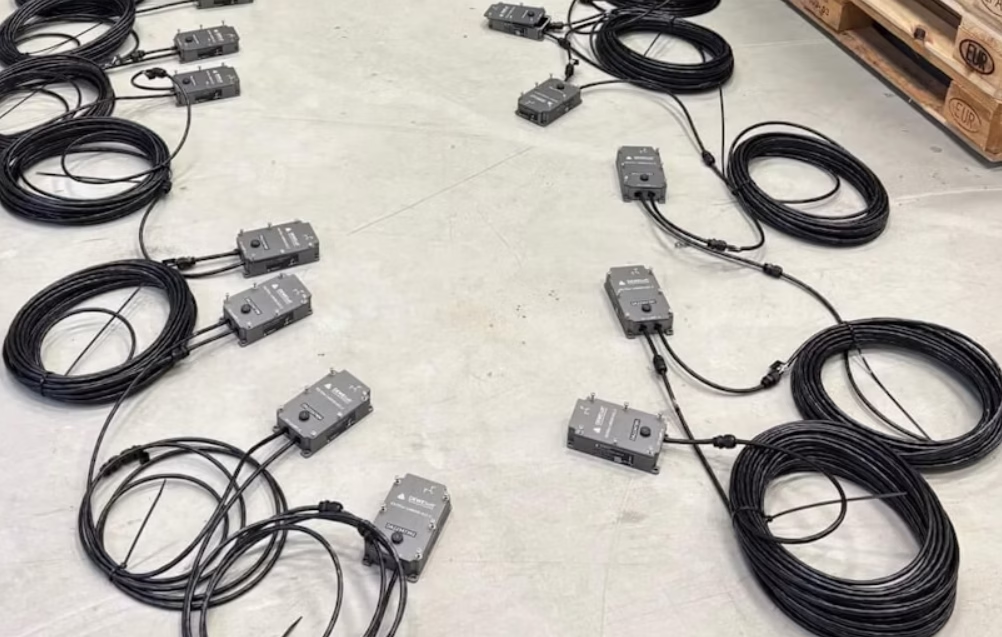
Micro-electromechanical system (MEMS) accelerometers are increasingly used in structural monitoring because they enable scalable deployment across large infrastructure assets.
Compared with traditional wired vibration instrumentation, MEMS-based monitoring systems provide:
- compact sensor footprint
- simplified installation
- distributed deployment across long spans
- continuous long-term measurement capability
- cost-effective scaling to large channel counts
In bridge monitoring applications, MEMS sensors are commonly used to track modal behaviour changes that indicate structural condition variations.
Role of IOLITE MEMS devices in bridge monitoring deployments
In the bridge monitoring case study, IOLITE MEMS devices formed the backbone of the distributed measurement architecture.
These devices allow engineers to install synchronized vibration monitoring nodes directly on bridge structures, enabling continuous measurement of structural response during normal operation.
Typical monitoring capabilities include:
- vibration monitoring across multiple bridge locations
- modal frequency tracking
- operating deflection shape analysis
- stiffness variation detection
- early anomaly identification
Because structural stiffness changes often appear first as vibration signature shifts. MEMS-based monitoring provides early warning indicators of structural condition change.
Distributed monitoring architecture using IOLITE
Bridge structures require sensors to be installed across decks, supports, and structural spans rather than in a single centralized location.
The IOLITE platform supports this through a distributed architecture that enables:
- installation close to measurement points
- reduced analogue cable lengths
- synchronized measurement across the structure
- scalable expansion as monitoring requirements evolve
- reliable long-term monitoring performance
This makes IOLITE particularly suitable for infrastructure monitoring applications where measurement nodes must be deployed across large physical assets.
Benefits of vibration-based structural monitoring for bridge owners
Using MEMS-based distributed monitoring systems provides infrastructure owners with improved visibility of structural performance over time.
Key benefits include:
Improved maintenance planning
Continuous monitoring supports condition-based maintenance rather than schedule-based inspection cycles.
Extended service life
Measured structural behaviour helps confirm whether bridges can safely remain in service longer than expected.
Reduced lifecycle cost
Monitoring enables targeted intervention instead of conservative replacement strategies.
Improved safety confidence
Engineers gain continuous insight into structural response under real traffic conditions.
Supporting bridge monitoring projects across Australia and New Zealand
Many transport bridges across Australia and New Zealand were constructed during major infrastructure expansion periods. So many are now approaching mid-life or late-life operation.
Distributed MEMS monitoring using synchronized data acquisition systems such as the IOLITE platform provides a practical solution for:
- road bridge monitoring programs
- freight corridor infrastructure
- mining transport routes
- rail bridge condition monitoring
- council-managed bridge assets
Metromatics supports structural health monitoring deployments across Australia and New Zealand with Dewesoft IOLITE monitoring systems designed for long-term infrastructure measurement applications. Contact us to learn more.