
When Running Ethernet Cable Becomes the Problem: Wireless vs Wired Remote I/O
Connecting a sensor, instrument or actuator to a control system sounds straightforward—until the required Ethernet cable must cross a roadway, production line, hazardous area or existing facility.
At that point, the cost of conduit, trenching, switches, installation labour and production downtime can outweigh the cost of the remote I/O hardware itself.
Wireless remote I/O provides another option. However, wireless is not automatically better than wired Ethernet. The right choice depends on the site, application, network requirements and consequences of a communication interruption.
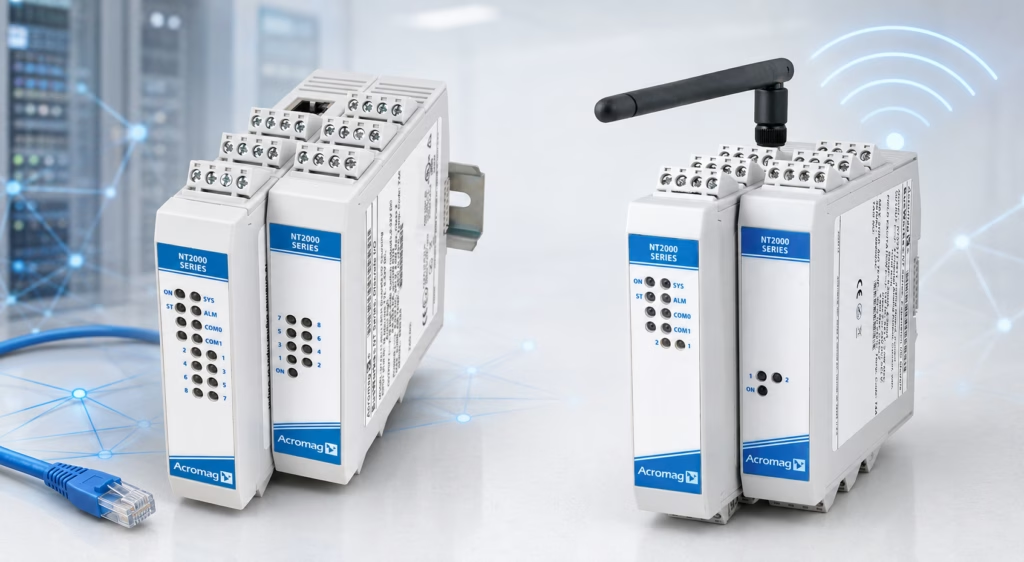
The Acromag BusWorks NT Series gives engineers a choice between NTW wireless I/O and NTE wired Ethernet I/O. Because both options support a broad selection of analog, digital, temperature and multifunction I/O, engineers can select the network connection that suits the installation rather than redesigning the entire I/O architecture.
What is wireless remote I/O?
Wireless remote I/O connects field signals to a PLC, SCADA system or industrial data platform using a wireless network instead of a dedicated Ethernet cable.
Acromag BusWorks NTW modules incorporate dual-band 2.4 GHz and 5 GHz Wi-Fi connectivity. Depending on the selected I/O model, they can monitor or control:
- 4–20 mA current signals
- Voltage signals
- Thermocouples
- RTDs and resistance inputs
- Discrete inputs and outputs
- Relay outputs
- Mixed analog and digital signals
An NTW module can also connect with up to three BusWorks NTX expansion modules. Therefore, engineers can combine different signal types and accommodate up to 64 I/O channels through one network interface and IP address.
Importantly, wireless remote I/O does not eliminate all wiring. The module still requires local DC power, while sensors and actuators must be wired to the I/O terminals. What it can eliminate is the Ethernet network cable between the remote I/O location and the wider control network.
When does wireless remote I/O make sense?
Wireless I/O becomes particularly valuable when installing network cabling would be disruptive, expensive or impractical.
Brownfield plant upgrades
Existing factories and processing facilities are often difficult to modify. Cable routes may be full, drawings may be outdated, and installing new conduit may require production shutdowns.
A wireless I/O node can provide a practical way to add monitoring points without rebuilding sections of the existing network infrastructure.
Equipment separated by roads or operational areas
A sensor or machine may be located across a roadway, loading area, rail line or section of operating plant. Running cable to that location could require trenching, permits, traffic management and protective conduit.
Where suitable Wi-Fi coverage is available, wireless remote I/O may significantly simplify the network connection.
Temporary monitoring projects
Engineers may need to collect additional process data during troubleshooting, commissioning, energy audits or condition-monitoring trials.
For these temporary installations, the cost of permanent Ethernet infrastructure may be difficult to justify. Wireless I/O can make it easier to deploy monitoring points and relocate them when the project is complete.
Distributed infrastructure
Wireless remote I/O may also suit pump stations, water infrastructure, utilities, tank monitoring, building services and other distributed assets located within an available industrial Wi-Fi network.
However, the proposed location must still have a suitable power supply and reliable wireless coverage.
Equipment that may be moved or reconfigured
Production equipment, test systems and modular skids are sometimes relocated as operating requirements change. A wireless network connection can provide more flexibility than fixed Ethernet cabling when equipment layouts are regularly modified.
When is wired Ethernet remote I/O the better choice?
Wired Ethernet remains the preferred option for many industrial control systems.
A physical cable generally provides more predictable communications and avoids dependence on wireless coverage. As a result, wired remote I/O should receive strong consideration when:
- Communications are time-critical
- Network availability is essential to the process
- The site has significant radio-frequency interference
- Wireless devices are restricted by the organisation’s cybersecurity policies
- Suitable Ethernet infrastructure is already available
- Equipment will remain in a fixed location
- The application involves safety-related or critical control functions
- Wireless coverage cannot be reliably maintained
The Acromag BusWorks NTE Series provides dual RJ45 Ethernet ports, allowing modules to be connected using a daisy-chain network topology. NTE modules support field-selectable industrial protocols and can also accept up to three NTX expansion modules.
Wireless versus wired remote I/O comparison
| Consideration | NTW wireless remote I/O | NTE wired remote I/O |
|---|---|---|
| Network connection | Dual-band 2.4 GHz and 5 GHz Wi-Fi, with an RJ45 connection | Dual RJ45 Ethernet ports |
| Best suited to | Locations where installing network cable is difficult, disruptive or costly | Fixed installations with accessible Ethernet infrastructure |
| Installation | May reduce network cabling, trenching and conduit requirements | Requires a physical Ethernet cable route |
| Reliability | Dependent on wireless coverage, interference and network configuration | Typically provides more predictable communications |
| Flexibility | Easier to relocate or use in changing plant layouts | Better suited to permanent equipment locations |
| I/O expansion | Supports NTX expansion modules | Supports NTX expansion modules |
| I/O options | Analog, digital, temperature, relay and multifunction I/O | Analog, digital, temperature, relay and multifunction I/O |
| Industrial integration | Supports commonly used industrial Ethernet and IIoT protocols | Supports commonly used industrial Ethernet and IIoT protocols |
| Configuration | Browser-based configuration | Browser-based configuration |
| Key consideration | Wireless coverage and cybersecurity requirements | Cable installation cost and available network infrastructure |
Could a hybrid system provide the best result?
The decision does not necessarily have to be completely wireless or completely wired.
Acromag NTW modules include an RJ45 Ethernet interface in addition to their wireless capability. Consequently, an NTW installation can provide flexibility during commissioning, troubleshooting or future network changes.
For example, a facility could use:
- Wired NTE modules inside the main production building
- Wireless NTW modules at difficult-to-cable monitoring locations
- NTX expansion modules to increase the I/O capacity at each node
- Ethernet connectivity for configuration and commissioning
- Wireless connectivity where a permanent network cable is not economical
This mixed architecture allows engineers to select the most practical connection for each location while retaining a common BusWorks NT I/O platform.
What about the Acromag BusWorks XT Series?
The BusWorks XT Series remains another wired Ethernet I/O option for industrial installations.
According to the XT Series brochure, these modules offer a space-saving 22.5 mm DIN-rail housing, dual Ethernet ports, wide-temperature operation, USB configuration and redundant or bused DC power. Selected models also support Acromag i2o peer-to-peer communication.
The XT Series may suit established wired architectures requiring high-density DIN-rail mounting, redundant power arrangements or specific XT Series I/O configurations.
However, for a new expandable system where the customer wants the choice of native wired or Wi-Fi connectivity, the BusWorks NT platform provides a more direct comparison between NTE and NTW network interfaces.
Do wireless systems compromise cybersecurity?
Wireless connectivity introduces additional cybersecurity considerations that must be addressed during system design.
Acromag states that current NTW security features include WPA3 Wi-Fi security, TLS 1.2 with public key infrastructure and X.509 certificate management, and AES 256-bit encryption.
Nevertheless, the complete system must still be assessed against the end user’s cybersecurity policies. Engineers should consider:
- Wireless network authentication
- User access and password management
- Network segmentation
- Certificate management
- Firmware maintenance
- Firewall and port requirements
- Remote access permissions
- Monitoring for unauthorised devices
- Procedures for responding to a network interruption
For critical applications, the customer’s operational technology and cybersecurity teams should be involved before selecting the final architecture.
Look beyond the I/O module price
Comparing wireless and wired remote I/O solely on hardware price can produce a misleading result.
For a wired installation, the complete cost may include:
- Ethernet cable
- Conduit or cable tray
- Network switches
- Trenching or civil work
- Installation labour
- Engineering documentation
- Access permits
- Production downtime
Similarly, a wireless installation may require:
- Industrial Wi-Fi infrastructure
- A wireless site survey
- Antenna planning
- Cybersecurity review
- Coverage testing
- Network configuration
- Ongoing wireless network management
Therefore, the best solution is the one that delivers acceptable reliability, security and performance at the lowest total installation and lifecycle cost.
Information needed to select the right remote I/O
Before choosing an NTW wireless or NTE wired solution, document the following:
- Number and type of I/O signals
- Required industrial communication protocol
- Distance between the equipment and control system
- Existing Ethernet and Wi-Fi infrastructure
- Availability of DC power at the remote location
- Environmental conditions
- Required communication response time
- Consequences of a network interruption
- Hazardous-area requirements
- Cybersecurity and site-access policies
- Expected future I/O expansion
- Whether equipment may be relocated
This information makes it easier to determine whether wireless, wired or hybrid remote I/O will provide the most practical result.
Need help selecting wireless or wired remote I/O?
Metromatics supplies and supports Acromag industrial I/O products throughout Australia and New Zealand.
Send our team your I/O list, required protocol and a simple description or drawing of the installation. We can help you compare BusWorks NTW wireless I/O, NTE wired Ethernet I/O and NTX expansion options for your application.
Contact Metromatics to discuss your remote I/O requirements or request a quotation.