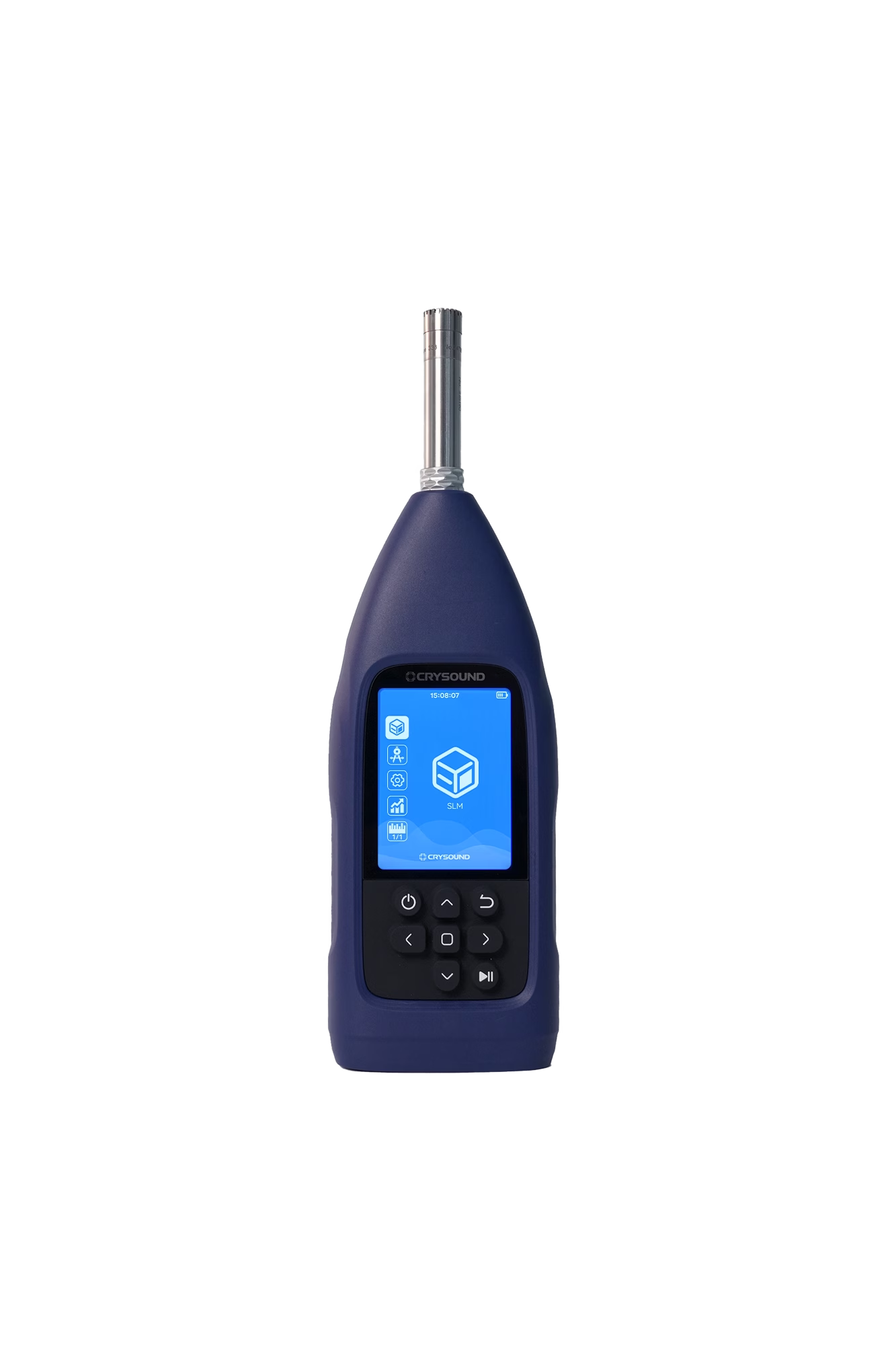
The CRY2834 is designed for professionals who need more than a basic instantaneous sound-level reading. It follows the requirements of IEC 61672-1:2013 Class 2 and supports integrating and statistical measurement functions.
Its 25 dBA to 140 dBA linear operating range allows users to measure a broad spectrum of sound levels without manually changing measurement ranges. Furthermore, A, C and Z frequency weighting and Fast, Slow and Impulse time weighting allow the instrument to be configured for different noise characteristics and assessment methods.
The instrument uses a CRY331 microphone with a specified frequency range of 20 Hz to 12.5 kHz. Its internal noise level is no more than 22 dBA.
Integrating and Statistical Noise Analysis
An integrating sound level meter measures noise over a defined period rather than providing only a momentary sound-pressure-level reading. Therefore, it can produce parameters such as equivalent continuous sound level, maximum level, minimum level and sound exposure.
The CRY2834 also supports statistical analysis. Statistical measurements such as L10, L50 and L90 can help noise professionals understand how frequently particular sound levels are exceeded during the measurement period.
For example, statistical results can help distinguish prevailing background noise from intermittent or elevated noise events. However, the interpretation of these values depends on the applicable measurement method, environment and regulatory requirements.
Key Features and Benefits
- IEC 61672-1:2013 Class 2: Supports general occupational, environmental and industrial sound-level measurement applications requiring Class 2 performance.
- 25 dBA to 140 dBA linear operating range: Measures a broad range of sound levels without manual range selection.
- Integrating measurement: Calculates time-based noise parameters for assessments where sound levels vary throughout the measurement period.
- Statistical analysis: Provides L5, L10, L50, L90 and L95 results for evaluating changing noise conditions.
- Multiple acoustic weightings: A, C and Z frequency weighting and Fast, Slow and Impulse time weighting support different measurement requirements.
- Onboard data storage: A removable 32 GB microSD card records measurements for review and reporting.
- Expandable storage: The microSD card capacity can be increased to a maximum of 64 GB.
- Optional octave-band analysis: Selectable 1/1-octave and 1/3-octave functions help identify the frequency bands contributing to a noise problem.
- Optional monitoring function: Allows the instrument to be configured for noise-monitoring applications.
- Flexible communication: AC/DC outputs, USB-C and RS232 support connection to external equipment.
- Selectable wireless or positioning capability: Choose Bluetooth/Wi-Fi connectivity or GPS according to the application.
- Portable power: The CRY2834 operates from four AA batteries or a 5 V DC or USB-C supply.
Technical Specifications
| Specification | CRYSOUND CRY2834 |
|---|---|
| Applicable standard | IEC 61672-1:2013 Class 2 |
| Linear operating range | 25 dBA to 140 dBA |
| Frequency range | 20 Hz to 12.5 kHz |
| Internal noise | ≤22 dBA |
| Microphone | CRY331 |
| Microphone sensitivity | 40 mV/Pa (-28 dB re 1 V/Pa) ±1.5 dB |
| Microphone self-generated noise | ≤18 dBA |
| Frequency weighting | A, C and Z |
| Time weighting | S, F and I |
| Statistical measurements | L5, L10, L50, L90 and L95 |
| Display | 320 × 240 TFT display |
| Storage | Removable 32 GB microSD card; upgradeable to 64 GB |
| Interfaces | AC/DC, USB-C and RS232 |
| Selectable communication option | Bluetooth/Wi-Fi or GPS |
| Reference levels | 94 dB at 1 kHz and 114 dB at 1 kHz |
| Battery | Four AA batteries |
| External power | 5 V USB-C or 5 V DC |
| Operating temperature | -20°C to +60°C |
| Humidity | ≤90% RH |
| Dimensions | 249 × 76 × 30.5 mm |
| Weight | 330 g with batteries |
| Operation | Physical buttons |
The specifications above are based on CRYSOUND’s current product page and CRY2830 Series datasheet.
Supported Measurement Parameters
The CRY2834 supports measurement parameters including:
- Lp
- Leq,t
- Lpeak
- Leq,T
- Lmax
- Lmin
- SEL
- Lex8h
- LAVG
- TWA
- DOSE
- Ln, including L5, L10, L50, L90 and L95
- SD
- E
These parameters allow the instrument to support instantaneous, integrated, exposure-based and statistical noise measurement. Nevertheless, users should select and interpret each parameter according to the relevant assessment procedure.
Optional Octave-Band and Monitoring Functions
Optional 1/1-octave and 1/3-octave analysis can provide more information about the frequency composition of measured noise. This is useful when an overall sound level identifies a problem but does not reveal which frequencies are responsible.
For example, octave-band information can support investigations involving machinery, ventilation systems, workplace equipment or other identifiable noise sources. It may also assist engineers when evaluating potential noise-control measures.
A monitoring function is also available as an option. Therefore, the required analysis and monitoring modules should be confirmed when requesting a quotation.
Data Storage and Communications
The CRY2834 includes a removable 32 GB microSD card, which can be upgraded to 64 GB. Consequently, users can retain measurement data for subsequent review, documentation and reporting.
Available physical interfaces include:
- AC signal output;
- DC signal output;
- USB-C; and
- RS232.
The instrument can also be configured with Bluetooth/Wi-Fi or GPS. Bluetooth/Wi-Fi supports wireless measurement workflows, while GPS can add positioning information to measurement activities. These are selectable alternatives, so the correct configuration should be specified before ordering.
Applications
The CRY2834 can support:
- workplace noise measurement;
- occupational noise assessments;
- environmental noise surveys;
- industrial noise measurement;
- machinery and equipment noise checks;
- product noise evaluation;
- statistical noise analysis;
- octave-band noise investigations;
- engineering and laboratory acoustic measurements; and
- portable noise-monitoring activities.
CRYSOUND identifies environmental protection, industrial operations and occupational health as principal application areas for the CRY2834.
CRY2834 or CRY2833?
The CRY2834 provides IEC 61672-1:2013 Class 2 performance, while the CRY2833 provides Class 1 performance. Both instruments support integrating and statistical measurement, data storage and optional octave-band analysis.
The appropriate model depends on the required accuracy class, frequency range, measurement procedure and applicable project or regulatory requirements. Therefore, customers should confirm whether Class 1 or Class 2 performance is required before selecting an instrument. The manufacturer’s comparison data identifies the CRY2834 as Class 2 and the CRY2833 as Class 1.
Options and Configuration Considerations
Before ordering the CRY2834, confirm whether the application requires:
- 1/1-octave analysis;
- 1/3-octave analysis;
- monitoring functionality;
- Bluetooth/Wi-Fi communication;
- GPS positioning;
- additional microSD storage;
- a compatible sound calibrator; or
- measurement accessories for the intended environment.
Optional and selectable capabilities should be included in the requested configuration rather than assumed to be standard.
Why Source the CRY2834 Through Metromatics?
Finally, Metromatics can assist Australian and New Zealand customers in comparing the CRY2834 with other acoustic measurement options. The intended noise environment, required accuracy class, measurement parameters, analysis functions and communication requirements can be reviewed before a quotation is prepared.
Contact Metromatics to discuss your occupational, environmental or industrial noise measurement requirements, confirm the appropriate CRY2834 configuration, or request pricing and a quotation.