
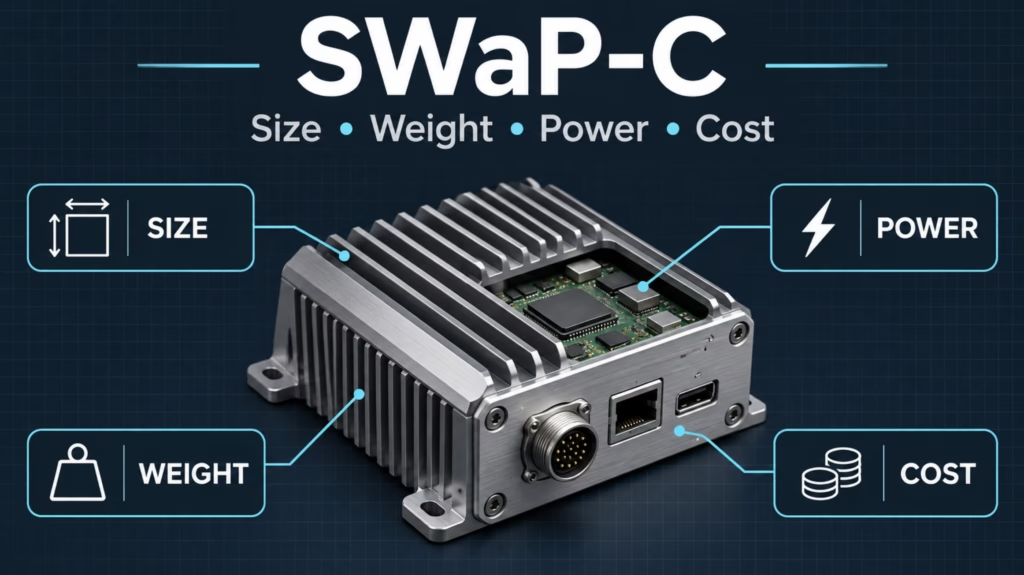
In SWaP-C: No Room for Bad Engineering, WOLF Advanced Technology explains why processing performance alone shouldn’t determine whether hardware suits a project. It is important to consider SWaP-C for rugged embedded computing because while a compute module may meet its processing target, its power, cooling and enclosure requirements can make it difficult to integrate into an intended system.
This is why Wolf emphasises the importance of considering size, weight, power and cost together from the outset to help buyers identify important trade-offs when committing to hardware. The practical question is: can the complete installation deliver the required performance within the project’s physical, power and cost limits?
What does SWaP-C for Rugged Embedded Computing Mean?
SWaP-C stands for Size, Weight, Power and Cost:
- Size: How much space the equipment occupies.
- Weight: How much it weighs.
- Power: How much electrical power it needs to operate.
- Cost: The expense of developing, integrating and deploying the system.
The aim of SWaP-C is to meet your project’s performance requirements while balancing these four factors.
How to Apply SWaP-C to your project Design: Define The Workload Before Comparing Modules
Before comparing hardware, write down what your system needs to do. For a video-processing application you could start by specifying how many video streams it must handle, the required resolution and frame rate, and what processing is required. You should also define how quickly the result is needed or how much delay can the application tolerate between receiving an image and producing an output?
These are the kinds of details you should provide to your supplier when assessing whether particular hardware can handle your combination of requirements because a headline processing figure can’t tell you whether a module can keep up with your particular application. It is also important to ask for test results using a comparable workload where possible.
You can also discuss how you can evaluate the hardware with your own software. Include the software you already use or plan to develop in your discussions with suppliers. Confirm whether the proposed hardware supports your software or what changes would be required. This helps compare both the hardware’s capability and the work required to get your application running before committing your budget.
Check Sustained Performance Within the Power and Cooling Budget
A processor’s operating mode and available cooling affect the performance it can sustain. For example, NVIDIA’s Jetson documentation describes power limits and clock throttling used to keep Orin modules within configured operating constraints.
For an Orin-based design, this means the power mode used for evaluation matters. A result obtained in one configuration should not automatically be assumed achievable in another enclosure or power setting. As a result, it is important to ask for representative workload testing at the intended power configuration and thermal conditions. Also include the supporting electronics in the system power budget, and agree how the module will transfer heat to the enclosure or cooling system.
Two Different WOLF Integration Approaches to Consider
Compact VNX+ Processing
The WOLF VNXP-ORIN-NX processing node uses NVIDIA Jetson Orin NX within a VNX+ module. WOLF documents camera, display and PCIe connectivity, making it a candidate for compact embedded processing architectures.
For an imaging design, establish which camera interfaces are required and whether additional video-capture hardware is needed. Include the chassis, connections and supporting modules when evaluating the installed size and weight.
GPU processing and networking in 3U VPX
The WOLF-153W GPU module combines an NVIDIA RTX 5000E GPU with a ConnectX-7 SmartNIC and dual 40/100GbE optical interfaces.
This combination is relevant where the architecture needs GPU computing and substantial data movement. Confirm the backplane, optical interfaces and power allocation against the intended chassis before considering the module a fit.
These examples serve different architectures. They are not interchangeable modules, and their suitability depends on the complete application.
Compare The Cost of the Installed Solution
A useful comparison includes the board, enclosure, power conversion, cooling, software integration and verification work. A lower board price may not produce the lower project cost if it requires substantial supporting hardware or redesign.
Document assumptions alongside each option. This makes it easier to see whether a price difference buys needed capability or reflects functionality the application will not use.
Bring a Clear Requirements Brief to the Selection Discussion
Before requesting a recommendation, gather the following information about your project requirements:
- The processing workload and acceptance criteria
- Available installation space and total weight allowance
- Power supply limits and expected operating conditions
- Sensor, video, network and output interfaces
- Software environment, quantities and project timing
We are Here to Help
Contact Metromatics with your project requirements to discuss WOLF rugged computing options for your application. We can help you develop a clear brief to help focus the comparison on hardware that fits both the workload and the platform.
FAQs About SWaP-C for Rugged Embedded Computing
Is the smallest option always best?
No. Required performance comes first; efficiency follows.
Why consider SWaP-C early?
To address potential overheating, battery-life and integration problems before they emerge late in development.