
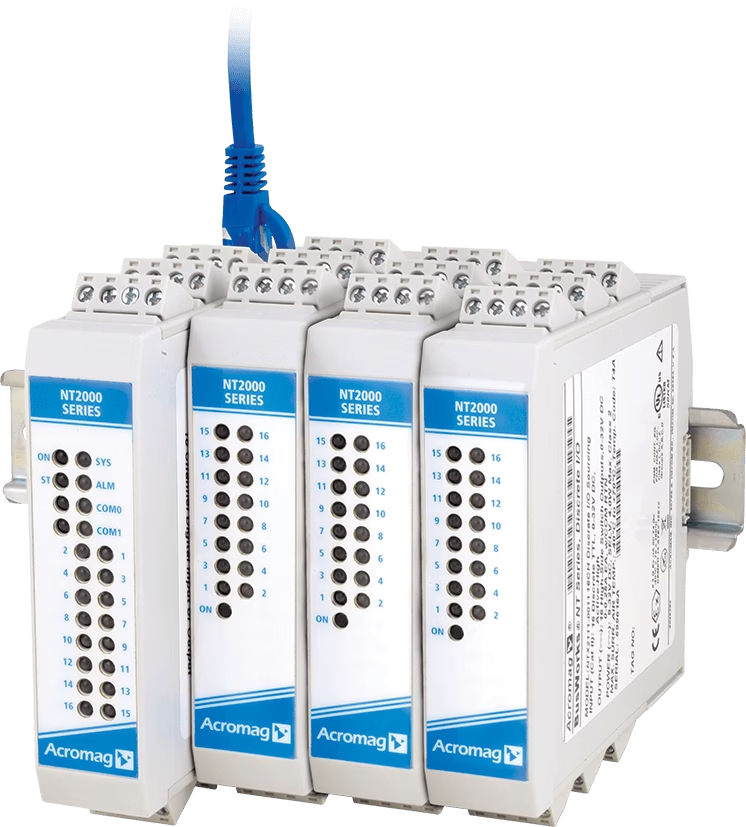
Acromag BusWorks® NT Series Ethernet remote I/O modules connect industrial sensors and actuators with PLC, SCADA, edge and cloud-based systems. Their integrated OPC UA server and MQTT client make field data available to both traditional automation systems and Industrial Internet of Things (IIoT) applications.
The modules also support Modbus TCP/IP, EtherNet/IP and PROFINET. This means an industrial control system can continue using an established Ethernet protocol while OPC UA or MQTT makes selected data available to supervisory software, edge systems or cloud-based applications.
Metromatics supplies and supports Acromag BusWorks remote I/O modules throughout Australia and New Zealand.
Connecting Industrial Field Data with IIoT Systems
Industrial facilities collect valuable data from temperature sensors, pressure transmitters, flow meters, level sensors, switches, motors, valves and other equipment.
Traditionally, this data travels to a PLC or SCADA system through an industrial communication protocol. However, businesses increasingly want to use the same information for:
- Remote monitoring
- Predictive maintenance
- Energy management
- Equipment-performance analysis
- Centralised dashboards
- Edge computing
- Cloud-based reporting
- Multi-site asset monitoring
Acromag BusWorks NT modules help connect these two requirements. They can communicate with automation systems through industrial Ethernet while also making data available through OPC UA, MQTT or RESTful APIs.
What Does OPC UA Provide?
OPC Unified Architecture, usually called OPC UA, is a platform-independent standard for industrial data exchange. It allows compatible equipment and software from different manufacturers to share structured operating information.
The OPC UA server embedded in an Acromag NTE Ethernet I/O module makes its I/O and configuration data available to compatible systems such as:
- SCADA platforms
- Human-machine interfaces
- Industrial historians
- Edge-computing systems
- Data-analytics software
- Asset-monitoring platforms
For example, an NTE module could collect temperature, pressure and equipment-status signals from field devices. An OPC UA-compatible SCADA system could then access these values without relying on a proprietary communication driver for every connection.
OPC UA is particularly useful when an application needs structured access to industrial data from different devices or manufacturers.
What Does MQTT Provide?
MQTT is a lightweight publish-and-subscribe messaging protocol commonly used for IIoT and remote-monitoring applications.
An MQTT client publishes selected data to an MQTT broker. Authorised applications can then subscribe to the information they require.
The MQTT client built into BusWorks NT Ethernet modules can publish process and equipment data for use by compatible:
- MQTT brokers
- Edge gateways
- Remote dashboards
- Cloud platforms
- Analytics systems
- Predictive-maintenance applications
For example, modules installed at several pumping stations could publish operating status, pressure and flow data to a central MQTT broker. A monitoring dashboard could subscribe to the relevant data from every location.
MQTT is useful when data needs to be distributed efficiently to multiple applications, systems or remote users.
OPC UA vs MQTT: Which Should You Use?
MQTT and OPC UA both exchange industrial data, but they perform different functions.
| Requirement | OPC UA | MQTT |
|---|---|---|
| Primary purpose | Structured industrial data exchange | Lightweight message distribution |
| BusWorks NT function | OPC UA server | MQTT client |
| Communication method | Client/server | Publish/subscribe |
| Common destinations | SCADA, HMI, historians and industrial software | MQTT brokers, edge systems and cloud platforms |
| Typical use | Plant and system interoperability | IIoT monitoring, analytics and remote data distribution |
| Data organisation | Structured information model | Topic-based messages |
| Additional infrastructure | Compatible OPC UA client | MQTT broker and subscribing application |
| Can both be used? | Yes | Yes |
OPC UA is often the better choice when SCADA or industrial software needs structured access to equipment data.
MQTT is generally more suitable when selected data must be published to a broker and distributed to dashboards, edge applications, analytics systems or cloud platforms.
In many applications, the protocols complement each other. OPC UA can support plant-level data access while MQTT distributes selected information to wider IIoT systems.
How OPC UA and MQTT Work with Industrial Ethernet
OPC UA and MQTT do not necessarily replace the industrial Ethernet protocol used by the control system.
A BusWorks NT module can support Modbus TCP/IP, EtherNet/IP or PROFINET for communication with a PLC or other industrial controller. OPC UA and MQTT can then make relevant data available to additional systems through the same network infrastructure.
A typical application could work as follows:
- Sensors connect to an NTE Ethernet I/O module and attached NTX expansion modules.
- The module converts the sensor signals into network-accessible data.
- A PLC accesses the I/O through Modbus TCP/IP, EtherNet/IP or PROFINET.
- An OPC UA client accesses structured data for a SCADA or historian application.
- The MQTT client publishes selected measurements to an MQTT broker.
- Remote dashboards or analytics platforms subscribe to the required MQTT data.
This arrangement allows operational and IIoT systems to use the same field information for different purposes.
Depending on the existing architecture, integrated protocol support may also reduce reliance on separate protocol-conversion gateways.
Practical Applications
Pump and Motor Monitoring
A BusWorks NT module can collect motor status, operating temperature, pressure and flow signals. A PLC can use the information for control, while MQTT publishes selected values for remote monitoring or predictive maintenance.
Tank-Level Monitoring
Analogue inputs can collect level and pressure measurements from compatible sensors. OPC UA can make the data available to SCADA, while MQTT can distribute selected readings to a central dashboard or IIoT platform.
Energy Management
Current, voltage or other process measurements can be made available to energy-management and reporting systems. This can help organisations compare consumption across equipment, production areas or remote sites.
Water and Wastewater Infrastructure
Distributed I/O modules can collect pump, valve, flow, pressure and alarm data across treatment facilities or pumping stations. OPC UA and MQTT allow this information to support both operational control and remote reporting.
Manufacturing Equipment
Digital, analogue and temperature signals can be collected from machines and production equipment. The data can then support SCADA visualisation, equipment monitoring and condition-based maintenance.
About the BusWorks NT Platform
BusWorks NT is an expandable remote I/O platform built around two principal module types.
NTE models provide the Ethernet communication interface and onboard I/O processing. Depending on the selected model, an NTE module can support up to 16 I/O signals.
NTX expansion modules add further analogue, digital, relay or temperature I/O. Up to three NTX modules can connect to an NTE module, creating a system with as many as 64 mixed I/O channels under one IP address.
Available modules support:
- Analogue current and voltage inputs
- Analogue current and voltage outputs
- Digital inputs and outputs
- Mechanical relay outputs
- AC inputs
- Thermocouples and millivolt signals
- RTDs and resistance measurements
- Multifunction I/O combinations
For complete model and signal information, view the Acromag BusWorks NT Series remote I/O range.
What Should You Consider Before Selecting a Module?
Before choosing an OPC UA and MQTT remote I/O solution, consider:
- Which field signals need to be monitored or controlled?
- How many I/O channels are required?
- Will a PLC use Modbus TCP/IP, EtherNet/IP or PROFINET?
- Does the SCADA or software platform include an OPC UA client?
- Is an MQTT broker already available?
- Which data needs to be published through MQTT?
- How frequently must the data be updated?
- Will the system require future I/O expansion?
- What network and cybersecurity policies apply?
- Will the installation operate in a demanding industrial environment?
For an existing BusWorks NT installation, the module firmware and current configuration should also be checked before implementing additional communication features.
Why Choose Metromatics?
Metromatics has supported Australian industrial, automation, transport, energy and engineering applications since 1989.
We supply and support Acromag Ethernet remote I/O and signal-conditioning products throughout Australia and New Zealand. Our team can assist with:
- Selecting an appropriate NTE Ethernet module
- Choosing compatible NTX expansion modules
- Matching modules to analogue, digital and temperature signals
- Planning I/O channel capacity
- Reviewing PLC and SCADA communication requirements
- Understanding OPC UA and MQTT connectivity
- Accessing technical documentation
- Product availability and quotations
Frequently Asked Questions
What is an OPC UA remote I/O module?
An OPC UA remote I/O module collects signals from industrial sensors and equipment and makes the data available to OPC UA-compatible SCADA, HMI, historian, edge or software platforms.
Does the Acromag BusWorks NT Series support MQTT?
Yes. NTE Ethernet I/O modules include an MQTT client that can publish selected equipment and process data to a compatible MQTT broker.
Does MQTT send data directly to the cloud?
The MQTT client normally publishes data to an MQTT broker. Authorised cloud, edge, dashboard or analytics applications then subscribe to the relevant data through the broker.
Can OPC UA and MQTT be used together?
Yes. OPC UA and MQTT can perform complementary roles. OPC UA can provide structured access to industrial data, while MQTT distributes selected information to subscribing IIoT applications.
Can the modules still communicate with a PLC?
Yes. BusWorks NT Ethernet modules support Modbus TCP/IP, EtherNet/IP and PROFINET for compatible industrial control systems.
How many I/O channels can a BusWorks NT system support?
An NTE Ethernet module supports up to 16 onboard I/O signals. Up to three NTX expansion modules can increase the system capacity to as many as 64 mixed I/O channels under one IP address.
Do I need an additional gateway?
That depends on the overall system and receiving software. Because the NTE module includes OPC UA server and MQTT client capabilities, some applications may not require a separate gateway solely for these protocols. Other applications may still use an edge gateway for data processing, security, storage or integration.
Connect Field I/O with PLC, SCADA and IIoT Systems
Acromag BusWorks NT modules provide a flexible way to make industrial field data available to operational and IIoT systems.
By combining OPC UA, MQTT and RESTful APIs with Modbus TCP/IP, EtherNet/IP and PROFINET, the modules can support PLC control, SCADA monitoring, edge processing and cloud-based applications.
Metromatics supplies and supports Acromag BusWorks Ethernet remote I/O modules throughout Australia and New Zealand.
Contact Metromatics to discuss your field signals, communication protocols and I/O requirements.