
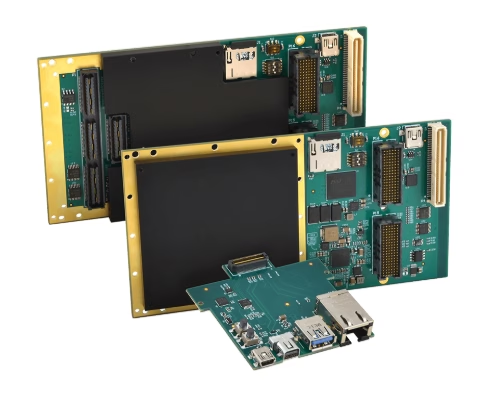
What is an FPGA?
A Field Programmable Gate Array (FPGA) is a semiconductor device. Firstly, that allows engineers to implement custom digital hardware circuits after the device has been manufactured.
An FPGA contains:
- configurable logic blocks
- lookup tables (LUTs)
- flip-flops
- programmable interconnects
- dedicated DSP processing blocks
- high-speed I/O interfaces
These elements can be configured to implement complex digital systems directly in hardware.
Unlike CPUs or GPUs that execute software instructions sequentially. Therefore, the FPGA hardware processes data in parallel with deterministic timing, enabling very high throughput and predictable latency.
This capability makes FPGAs particularly useful in real-time defence and embedded applications.
Why FPGA Technology is Widely Used in Defence Systems
Defence systems often require computing platforms that can operate with deterministic timing. In addition, process large volumes of data, and remain maintainable over long program lifecycles.
FPGAs address these requirements in several ways.
Deterministic Real-Time Processing
Many military systems require precise timing behaviour that cannot tolerate operating system delays.
FPGA logic executes in hardware, making it suitable for applications such as:
- radar signal processing
- electronic warfare systems
- flight control systems
- guidance and navigation processing
- communications signal processing
Parallel Processing for High Data Throughput
FPGA architectures allow many operations to execute simultaneously.
This parallelism makes them effective for workloads such as:
- digital signal processing
- RF processing
- video and image analysis
- encryption and communications processing
- sensor processing pipelines
Long Lifecycle Support
Defence programs often operate for decades. FPGA designs can be migrated to newer devices when components reach end-of-life. Therefore, helping extend platform support and reduce redesign risk.
Custom Hardware Without ASIC Development
ASIC development requires large volumes and high engineering investment. FPGA technology allows engineers to implement custom hardware acceleration without committing to a fixed silicon design.
Evolution of FPGA Technology
FPGA technology has evolved significantly over the past two decades.
Early FPGA Devices
Earlier FPGA designs were primarily used for:
- glue logic
- protocol translation
- digital signal processing
- interface control
These systems relied heavily on external CPUs or DSP processors.
High-Performance FPGA Platforms
Improvements in semiconductor technology dramatically increased FPGA capability. Modern devices include:
- larger programmable logic arrays
- dedicated DSP blocks for signal processing
- larger on-chip memory resources
- high-speed serial interfaces
This enables FPGA devices to handle workloads such as:
- real-time video processing
- RF signal analysis
- high-speed networking
- sensor data processing
In many cases, FPGA implementations deliver high throughput while consuming less power than GPU-based solutions.
Heterogeneous FPGA Computing
The most significant advancement in FPGA architecture is the integration of multiple processing engines within a single device.
Modern devices such as Zynq UltraScale+ MPSoC combine:
- ARM application processors
- real-time control processors
- programmable FPGA logic
- GPU graphics processing
- hardware video codecs
- high-speed communication interfaces
This architecture allows engineers to distribute workloads across the most appropriate compute resources.
For example:
| System Function | Processing Engine |
|---|---|
| Operating systems and application software | ARM processors |
| Real-time control loops | real-time processor cores |
| signal processing algorithms | FPGA programmable logic |
| video or graphics processing | GPU or video engines |
This heterogeneous architecture allows multiple subsystems to be consolidated within a single device.
Where FPGA Fits Relative to CPU and GPU Architectures in Defence Embedded Systems
Modern defence embedded computing platforms typically combine CPU, GPU, and FPGA processing within VPX or XMC architectures. With each device performing a different role in the signal-processing pipeline. Firstly, the CPUs manage operating systems, control logic, and application software. Secondly, the GPUs accelerate parallel workloads such as AI inference and image analytics. Finally, the FPGAs provide deterministic, low-latency processing for sensor interfaces and protocol handling. They also support high-speed signal conditioning close to the data source.
In many radar, ISR, and electronic warfare systems, FPGAs sit at the front end of the processing chain. They do real-time filtering, formatting, and transport of sensor data. They then pass selected information to GPUs or CPUs for higher-level analytics and decision support.
Defence Applications for FPGA Platforms
FPGAs are widely deployed in defence electronics. Especially where high-performance and deterministic processing are required.
Typical applications include:
Radar and RF Processing
- radar signal processing
- beamforming and filtering
- RF spectrum monitoring
Electronic Warfare Systems
- signal detection and classification
- protocol analysis
- threat identification
Autonomous and Uncrewed Platforms
- sensor fusion processing
- navigation systems
- AI inference at the edge
Communications and Networking
- high-speed data routing
- protocol conversion
- secure communications processing
Test and Simulation Systems
- hardware-in-the-loop testing
- system validation
- training simulation environments
These applications require the ability to process large volumes of data in real time while maintaining predictable system behaviour.
Acromag FPGA Modules for Embedded and Defence Applications
Firstly, Acromag develops FPGA modules designed for embedded computing systems. Used in aerospace, defence, industrial automation, and research applications.
Ultimately, these modules integrate FPGA devices into modular embedded form factors commonly used in defence electronics.
Acromag FPGA platforms include:
- XMC FPGA modules
- AcroPack FPGA modules
- FPGA platforms for PCIe embedded systems
- support for embedded architectures such as VPX systems
Acromag modules support devices from the AMD/Xilinx FPGA portfolio including:
- Artix-7 FPGA
- Kintex-7 FPGA
- Spartan FPGA devices
- Zynq UltraScale+ MPSoC
In addition, key capabilities include:
- FPGA-accelerated signal processing
- high-speed digital I/O connectivity
- integration of ARM processor subsystems
- modular embedded platform integration
- long lifecycle component availability
These capabilities enable FPGA acceleration to be integrated directly into defence and embedded computing platforms.
Example Platforms: Acromag XMC-ZU and APZU FPGA Modules
Two FPGA platforms that demonstrate the latest capabilities in embedded FPGA computing are the Acromag XMC-ZU Series and APZU AcroPack modules.
Acromag XMC-ZU Series
The XMC-ZU Series is based on the AMD Zynq UltraScale+ MPSoC architecture.
This platform integrates:
- ARM Cortex-A53 application processors
- ARM Cortex-R5 real-time processors
- UltraScale+ FPGA programmable logic
- GPU graphics processing
- high-speed communication interfaces
The XMC form factor allows integration into embedded computing systems including VPX and PCIe carrier platforms.
Typical uses include:
- radar signal processing systems
- ISR video processing
- sensor fusion platforms
- electronic warfare systems
Acromag APZU AcroPack Modules
The APZU Series uses the same Zynq UltraScale+ architecture in a compact AcroPack mezzanine module.
Advantages include:
- compact embedded form factor
- integrated processors and FPGA logic
- high-density digital I/O
- modular embedded integration
These modules are suitable for:
- embedded signal processing systems
- communications infrastructure
- real-time control platforms
- defence test equipment
FPGA Development Tools and Evaluation Platforms
In addition, when evaluating FPGA technology, development tools and prototyping platforms are an important consideration.
Acromag provides resources to assist engineers with FPGA development, including:
- engineering design kits (EDK) with board support packages and reference designs
- development environments based on AMD/Xilinx Vivado and Vitis toolchains
- evaluation and quick-start kits for testing FPGA functionality on carrier platforms
- modular AcroPack and XMC platforms that simplify integration into embedded systems
These tools allow engineers to begin development quickly while maintaining flexibility to integrate FPGA modules into custom embedded architectures.
Why Engineers Should Consider FPGA for Future Projects
Modern defence systems increasingly require:
- real-time processing
- sensor fusion
- high-speed communications
- AI and autonomous capabilities
Furthermore FPGA technology offers several advantages for these applications:
- deterministic hardware processing
- massive parallel computing capability
- heterogeneous computing architectures
- long lifecycle support
- as well as reduced size, weight and power (SWaP)
For many embedded defence platforms, FPGAs can replace multiple processing devices while maintaining real-time performance.
Acromag FPGA Solutions in Australia and New Zealand
Finally, Metromatics is the local distributor for Acromag FPGA modules in Australia and New Zealand.
Our team provides:
- local technical support
- guidance on FPGA platform selection
- system integration advice
- ongoing sales and service support
If you are designing a defence system, embedded computing platform, or high-performance signal processing solution, FPGA technology is worth evaluating.
Contact Metromatics to discuss your next FPGA project and how Acromag FPGA modules can support your design.