
Emergency-response organisations are operating in a very different environment today. Mobile command vehicles, UAV scout platforms, and connected situational awareness systems now play a key role. They help coordinate safe and effective responses across transport corridors, regional communities, coastal zones, and critical infrastructure networks.
However, these capabilities depend on one critical layer that often sits behind the scenes:
rugged edge-systems infrastructure inside vehicles and field-deployable platforms.
Metromatics supports this infrastructure layer by supplying rugged computing, navigation, and communications technologies. Metromatics supplies rugged edge computing for emergency response vehicles, plus GNSS navigation and networking infrastructure. Designed for integration into mobile command and UAV ground-control systems.
Why Emergency Response Now Depends on Edge Systems
Modern response operations increasingly rely on real-time data from multiple sources, including:
- UAV reconnaissance platforms
- vehicle-mounted cameras
- GNSS positioning systems
- infrastructure monitoring sensors
- mobile communications networks
- dispatch and mapping platforms
Importantly, this information must be processed locally inside vehicles and command platforms, often in environments where cloud connectivity is limited or unreliable.
As a result, rugged edge computing has become essential for supporting real-time situational awareness.
Supporting Mobile Command Vehicles in the Field
Today’s command vehicles operate as mobile coordination centres. Rather than simple transport platforms. They support decision-making during incidents involving transport disruptions, natural disasters, infrastructure failures, and emergency deployments.
Inside these vehicles, rugged computing infrastructure enables:
- live mapping and navigation
- camera and sensor integration
- UAV ground-control interfaces
- communications gateway functions
- vehicle diagnostics monitoring
- coordination between response teams
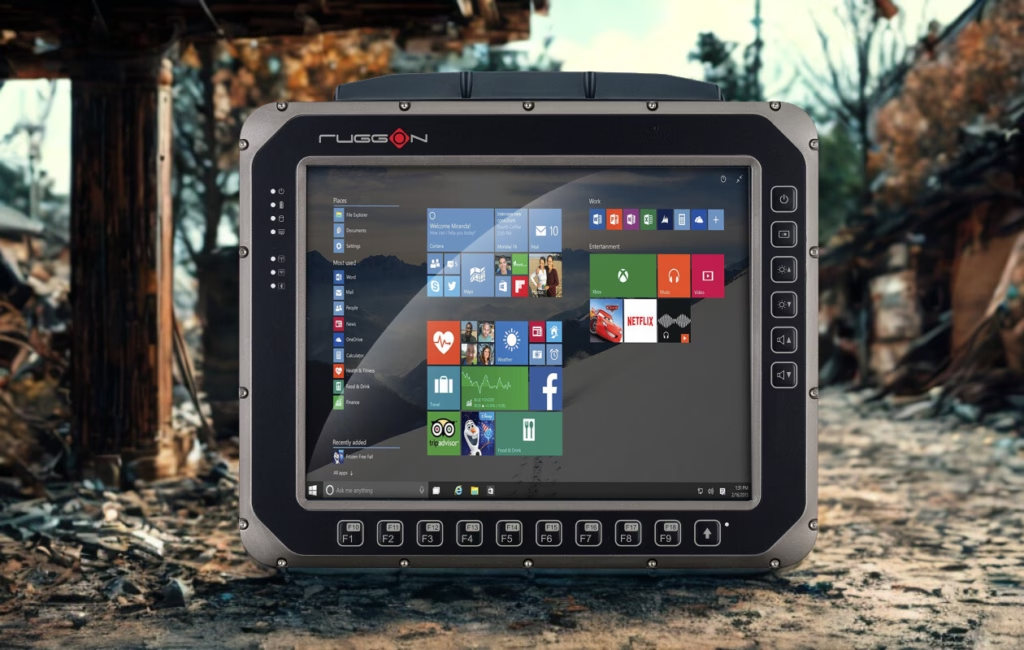
Vehicle-mounted computing platforms such as RuggON mobile data terminals and vehicle-mount computers, together with Crystal Group rugged servers, provide reliable operator interfaces in demanding mobile environments where vibration, temperature variation, and unstable power conditions are common.
Enabling UAV Ground-Control and Remote Monitoring Platforms
Unmanned aerial systems are increasingly used to support emergency-response operations by improving visibility across large or hazardous areas.
These platforms assist with:
- search-and-rescue reconnaissance
- flood monitoring
- bushfire perimeter assessment
- transport-incident visibility
- infrastructure inspection
However, UAV operations depend heavily on reliable ground-control infrastructure.
Rugged edge computing platforms from RuggON, Shuttle, and Compulab support these deployments by providing stable operator interfaces and local processing capability within vehicles and field command stations.
Supporting Reliable Navigation in Challenging Environments
Accurate positioning is essential for coordinating response teams and operating unmanned platforms safely.
In many emergency environments, satellite signals may be degraded due to terrain, structures, smoke, or urban density.
VectorNav GNSS/INS navigation sensors provide reliable positioning and orientation data in these conditions. As a result, they support navigation workflows for:
- UAV operations
- mobile command vehicles
- robotic inspection platforms
- transport-incident response systems
This improves operational awareness and supports safer deployment decisions.
Providing the Communications Infrastructure Behind Situational Awareness
Emergency-response platforms rely on stable communications between sensors, vehicles, operators, and command centres.
Antaira rugged networking platforms provide the Ethernet infrastructure required to connect:
- onboard cameras
- vehicle computers
- operator terminals
- UAV ground-control systems
- roadside monitoring equipment
This networking layer ensures that critical data can move reliably between systems operating in harsh mobile environments.
Supporting Edge AI Processing in Mobile Response Platforms
Many emergency-response deployments now include local analytics to improve response speed and safety.
These systems support:
- object detection in video streams
- sensor fusion across platforms
- mapping workflows
- vehicle-based monitoring applications
- autonomous support-platform coordination
Edge computing platforms from Shuttle and Compulab (where some models feature AI Processing power), or together with WOLF GPU acceleration technologies, enable this processing directly inside vehicles and mobile command environments.
This allows responders to access actionable information immediately, without relying entirely on remote infrastructure.
Supporting Defence and High-Reliability Response Environments
In defence and high-reliability response scenarios, computing platforms must operate under even more demanding environmental conditions.
Technologies from Spectra Defence Technologies support:
- mission data recording
- rugged storage platforms
- vehicle-mounted computing systems
- airborne and maritime ISR integration environments
These capabilities extend situational-awareness infrastructure into defence and security operations where reliability is critical.
Contact Metromatics for Rugged Edge Computing for Emergency Response
Rather than supplying standalone devices, Metromatics supports the infrastructure layer that enables modern emergency-response platforms to operate reliably in the field.
These systems support:
- vehicle-mounted operator interfaces
- GNSS-enabled positioning workflows
- UAV ground-control platforms
- camera and sensor integration
- communications infrastructure inside response vehicles
- edge processing within mobile command environments
As emergency-response technologies continue to evolve toward greater autonomy and real-time situational awareness. Therefore, rugged edge-systems infrastructure remains a critical foundation supporting safe and coordinated operations across Australia and New Zealand. Contact us to learn more about Rugged Edge Computing for Emergency Response.