
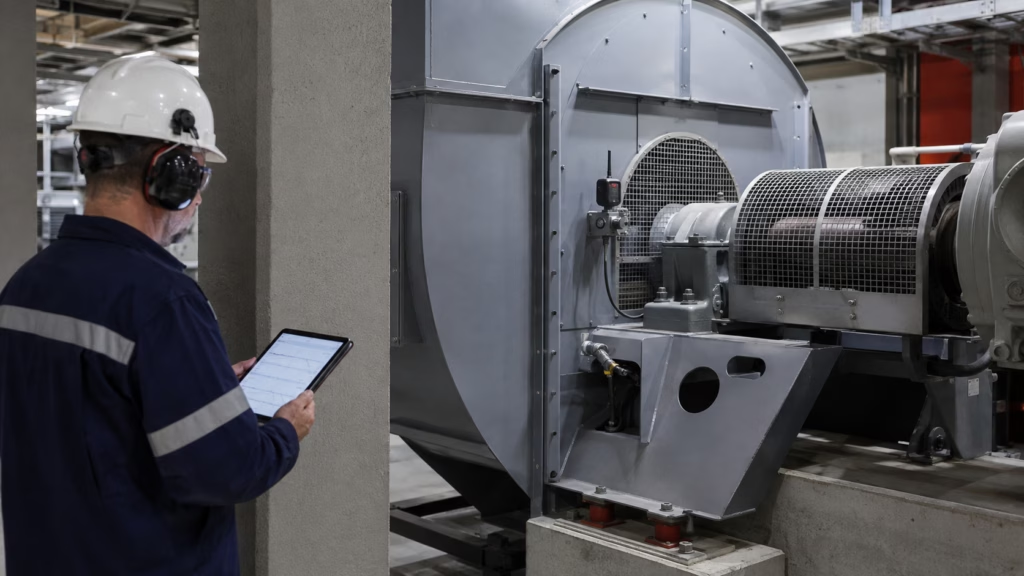
Why distance matters during field balancing
Balancing a fan, rotor or other rotating assembly normally involves more than one measurement. The technician records the original vibration, adds a known trial weight, calculates a correction and then checks the result. Depending on the job, several machine startups may be required before the work is complete.
The physical adjustments take place while the machine is stopped and isolated. During each test run, however, the technician needs vibration and phase information to understand how the rotor is responding.
With a traditional wired setup, cables run from sensors on the machine to the data collector. Those cables can influence where the technician stands, how the equipment is routed and how close the data collector remains to the machine. Wireless field balancing changes that connection. It can allow the technician to view the readings from a more suitable observation point, subject to the site’s communications conditions and safety procedures.
What happens during a balancing job?
Imagine a large industrial fan that has developed excessive vibration. Simply adding a weight and hoping for improvement is not a reliable method. The technician needs to know both the amount of vibration and its relationship to the rotor’s position.
A vibration sensor measures how strongly the machine is moving. A phase reference—often an optical sensor aimed at a reflective mark on the shaft—shows where the rotor is during each revolution. Balancing software combines this information to help calculate the correction weight and position.
The process commonly includes an initial run, a run with a trial weight and one or more trim runs. A final verification confirms the result after the correction has been secured. Each startup provides useful information, but it also creates another period when the machine is operating.
How wireless measurement changes the working position
In a wireless setup, the vibration sensor sends its measurement to a compatible mobile device instead of relying on a cable back to a handheld collector. The technician can then review the reported readings through the balancing application.
In practical terms, a technician may mount the sensor while the machine is stopped and locked out, move to an observation position, and then review the vibration reading after startup. The available distance will depend on the equipment, the surrounding structure, the wireless connection and site conditions. It should never be assumed without checking the actual installation.
The change is simple but important: the balancing calculation still needs the same useful measurements, while the technician may have more flexibility over where to stand during the run.
A real-world example from Erbessd Instruments
Erbessd Instruments published a case involving a fan of approximately 150 horsepower operating at 1,800 RPM. The setup used a wireless triaxial accelerometer on the fan-side bearing and an optical sensor aimed at a reflective shaft mark for the phase reference.
According to the supplier, the technician mounted the equipment while the machine was stopped and locked out. During startup, the technician moved several metres away and observed from behind a solid structure. Erbessd states that the technician was not within 15 metres of the rotor during the measurement process.
The job required six startups: the initial measurement, a trial-weight run, three trim runs and a verification run after welding. All six were observed from a distance.
The initial vibration at the governing fan-side point was reported as 15.3 mm/s. After a final correction of 45 grams split across two blades, the reading fell to 1.2 mm/s—a supplier-reported reduction of 92 per cent. The full job, including welding, took 1.5 hours.
These results belong to one documented job and should not be treated as a promise for every machine. The important safety lesson is also more specific than “wireless is safer”. The wireless connection did not remove the required balancing runs or the need to approach the machine for stopped and isolated work. It changed where the technician could observe the machine while those runs took place.
The components in a portable wireless workflow
A practical field-balancing setup needs more than a sensor alone.
First, the vibration sensor must suit the measurement task and mounting position. Metromatics supplies Erbessd wireless vibration products, including the WiSER 3X Mini Bluetooth triaxial accelerometer for compatible portable vibration applications. A triaxial sensor measures vibration in three directions; in everyday terms, it can capture movement side to side, up and down, and along the machine axis from one mounting location.
Second, balancing needs a phase reference so the software can relate the vibration to the rotor position. In the Erbessd case, an optical sensor read a reflective mark on the shaft.
Third, the technician needs software that can collect the information and guide the balancing process. The WiSER VIBE wireless vibration analysis app supports single-plane field balancing using influence coefficients. Put simply, the software uses the change produced by a known trial weight to calculate a suitable correction.
For broader analysis and reporting, data can be transferred into DigivibeMX vibration analyser software. The Erbessd case states that the measurements were moved into DigivibeMX for the final report.
Metromatics’ Erbessd Instruments product range brings these related options together for customers comparing portable vibration analysis and balancing equipment.
What wireless does not change
Wireless measurement can remove the signal cable between a compatible sensor and mobile device, but it does not remove every hazard or every task near the machine.
The technician still needs to install and remove equipment, apply trial or correction weights where required, inspect the machine and follow the approved shutdown and isolation process. Guards, exclusion zones, lockout and tagout, site risk assessments and the machine manufacturer’s instructions still apply.
Nor does wireless automatically guarantee a connection in every environment. Steel structures, distance, interference and the position of the mobile device can affect communication. A proposed system should be checked against the actual machine and work area before it becomes part of a maintenance procedure.
Questions to ask before choosing a system
Begin with the machine and the job, rather than the word “wireless”.
What type of machine needs balancing, and what speed does it operate at?
Where can the sensor and phase reference be mounted safely?
What measurements and balancing method does the technician require?
Where is the preferred observation position during a run?
Will the site layout support a reliable connection from that position?
Which phone or tablet will run the application?
How will results be stored, reviewed and included in maintenance reports?
These questions help identify whether a portable wireless system fits the task and which components are needed. They also prevent a product choice from getting ahead of the site’s safety and maintenance procedure.
Where wireless field balancing can add value
The strongest use case is not simply a desire to remove cables. It is a job where repeated machine startups are necessary and the technician would benefit from reviewing data at a more suitable distance or behind an available barrier.
Large fans, blowers and other rotating assets can fit this pattern, although every machine and site must be assessed individually. Wireless equipment can also make the measurement setup easier to carry and position in the field, particularly when a conventional cable route would be awkward.
The purpose is not to replace sound balancing practice. It is to give the technician a more flexible way to collect and view the information that practice requires.
How Metromatics can help
Metromatics supplies Erbessd Instruments vibration monitoring and analysis products in Australia and New Zealand. We can help you review the machine, measurement needs, preferred workflow and software requirements before selecting equipment.
If you are considering wireless field balancing for fans or other rotating machinery, contact Metromatics to discuss the application and the practical details that will determine whether it is a suitable fit.
Frequently asked questions
What is wireless field balancing?
Wireless field balancing uses a compatible wireless vibration sensor and balancing software to collect measurements during a balancing job. A phase reference is also used so the vibration can be related to the rotor position.
Does wireless field balancing eliminate machine startups?
No. Balancing still requires the runs needed to measure the original condition, assess a trial weight, refine the correction and verify the result. Wireless measurement can change where the technician views the data during those runs.
Can wireless equipment replace lockout and tagout procedures?
No. Physical work such as mounting equipment or applying weights must follow the site’s approved isolation and safety procedures. Wireless measurement complements those controls; it does not replace them.
Can every fan be balanced with the same wireless setup?
No. The machine, operating speed, sensor mounting, phase-reference access, communications environment, balancing method and reporting needs should all be checked before equipment is selected.