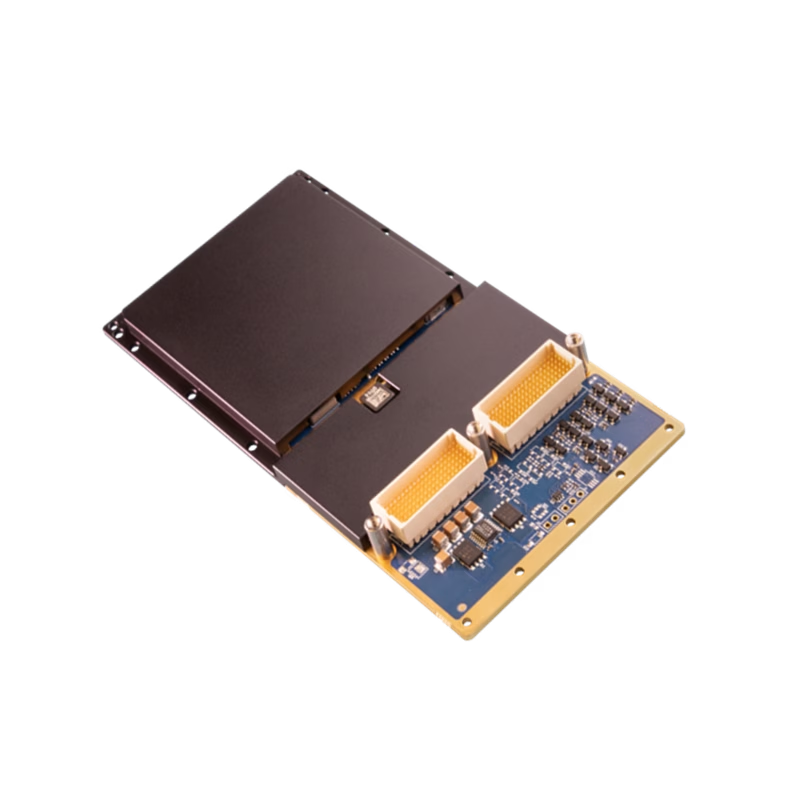
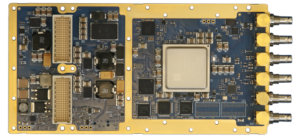
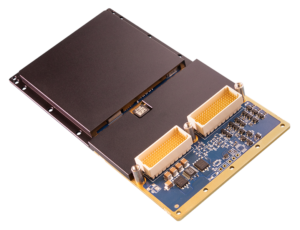
Ada-generation GPU acceleration in an XMC form factor
This rugged XMC GPU module gives system designers access to NVIDIA Ada-generation graphics and compute capability without moving to a full size desktop GPU card. This is useful when the host platform needs GPU acceleration but space, power and cooling are limited by the embedded architecture.
The RTX 2000 Ada embedded GPU combines CUDA, Tensor and RT cores with 8 GB of GDDR6 memory. In a suitable host system, that supports tasks such as embedded visualisation, hardware assisted video encode/decode and AI inference.
Typical application requirements for the Wolf 3576 rugged XMC GPU module
The module is well suited to systems that need one or more of the following:
- Embedded GPU acceleration in an XMC mezzanine.
- Multi-display mission or operator visualisation.
- Hardware video encode/decode capability.
- AI-inference workloads supported by the NVIDIA software stack.
- A configurable 25–50 W power envelope that can be matched to the available thermal budget.
Need help selecting the right rugged XMC GPU module?
Talk to Metromatics about the WOLF-3576, including your XMC carrier, display interfaces, power budget, cooling arrangement and software requirements.
Up to three configurable video outputs
The WOLF-3576 can provide up to three simultaneous video outputs. DisplayPort++ 1.4 is the default interface, while HDMI or DVI can be supported through configuration-dependent component population.
This matters during system design because the required display standard, number of active outputs and carrier routing should be fixed before the module configuration is locked.
Key display capabilities include:
- Up to three simultaneous video outputs.
- DisplayPort++ 1.4 by default.
- Support for 4K at 120 Hz or 5K at 60 Hz with 10-bit colour depth.
- HDMI or DVI options, depending on configuration.
Host connectivity and software
Host connectivity is provided through PCIe Gen4 x8. WOLF also lists NVIDIA GPUDirect RDMA support and Linux and Windows driver availability.
Before ordering, confirm that the host processor, XMC carrier and software baseline support the intended PCIe and NVIDIA driver configuration.
Rugged XMC options for deployed systems
WOLF offers air-cooled and conduction-cooled builds together with configuration options for XMC version, conformal coating, maximum power and variant locking. The selected build should be matched to the carrier and chassis thermal design rather than treated as a fixed module configuration.
For the conduction-cooled build, WOLF specifies a standard operating range from −40°C to +70°C, operation to +85°C, 10G peak sine vibration and 40G peak shock.
What to confirm before ordering
Confirm the following against the host platform and intended use:
- XMC carrier compatibility and P15/P16 signal routing.
- DisplayPort++, HDMI or DVI output requirement.
- Number and resolution of simultaneous displays.
- Required power setting within the 25–50 W range.
- Available sustained cooling capacity.
- Air-cooled or conduction-cooled build.
- PCIe Gen4 x8 host support.
- Linux or Windows driver baseline.
- XMC 1.0, XMC 2.0 or XMC+ requirement.
- Conformal coating and configuration-locking requirements.
Metromatics can help confirm these options before the final module configuration is ordered.