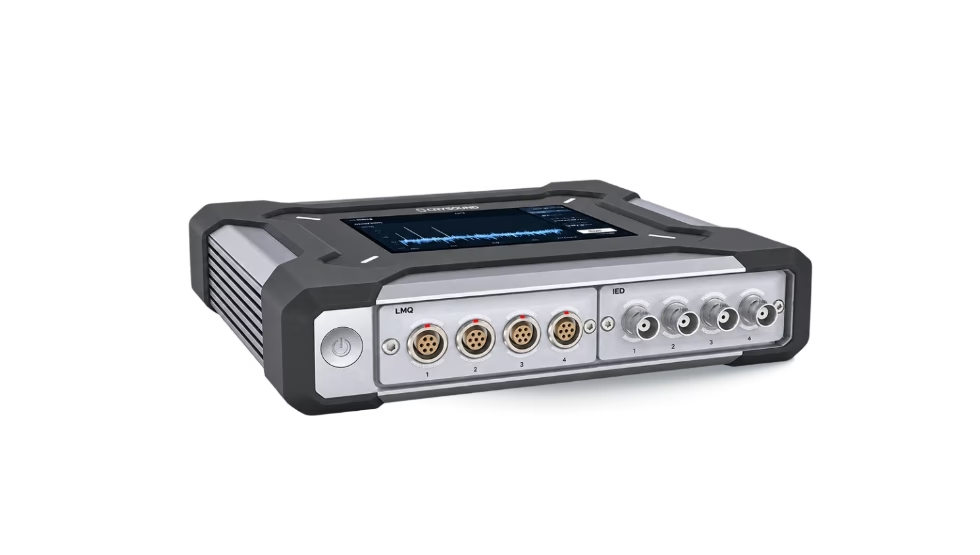
Portable sound and vibration testing at the measurement point
When you’re investigating a noise problem, checking a prototype or setting up a production test station, it helps to see the results while the test is still running. The CRYSOUND CRY5620 SonoDAQ Go lets you monitor waveforms, record signals and review onboard analysis on its 5-inch touchscreen. The main unit weighs 1.25 kg, and its fanless design avoids introducing cooling-fan noise near measurement microphones.
With two configurable module slots, you can set up the SonoDAQ Go for a few microphones and accelerometers, expand to eight synchronised inputs, or combine signal generation and response measurement in one unit. Use it on battery power for portable work, or connect DC power or Power over Ethernet (PoE) at a fixed test station.
Configure the inputs and outputs for your test
- Four or eight measurement inputs. Fit one four-channel input module for a compact setup, or fit two to capture up to eight synchronised channels.
- Four inputs and four outputs. Pair a four-channel input module with the CRY5083 AOS to generate excitation signals and measure the response. The AOS can also drive an external amplifier.
- Four inputs and two outputs for electroacoustic tests. Pair a four-channel input module with the CRY5085 ADD for loudspeaker testing and other setups that need signal output, Class D amplification or impedance measurement.
- Inputs to suit your sensors. Select a module based on sensor type and signal range. Options include IEPE and voltage inputs, with the CRY5014 LMQ also supporting charge-output sensors and 200 V externally polarised microphones. Check the microphone preamplifier, connector and powering requirements when specifying the system.
Record and analyse without a connected PC
Use the touchscreen to configure measurements, monitor signals, start recording and check results on site. Onboard functions include FFT, full-octave and one-third-octave analysis, sound level and sound power measurement, vibration analysis and rotational speed measurement. Reviewing the data at the test point gives you a chance to repeat a run while the setup is still in place.
The unit records directly to the included 256 GB microSD card and supports cards up to 2 TB. CRYSOUND specifies more than four hours of battery operation with two IED modules installed and all eight input channels active.
Use OpenTest for PC-based workflows
Connect the SonoDAQ Go to OpenTest for channel setup, live waveforms, FFT, frequency sweep testing, sound power analysis and custom workflows. OpenDAQ support and a software development kit (SDK) give engineering teams options. These options help integrate the unit into existing test benches and automated test stations. For distributed setups, the CRY5620 can also serve as a supplementary measurement node in a larger SonoDAQ system.
Typical applications
- Product noise and vibration testing. Record microphone and accelerometer signals together when investigating noise from fans, motors, appliances or HVAC equipment.
- Automotive noise, vibration and harshness (NVH). Capture in-cabin noise and vibration during vehicle testing with battery power and onboard recording.
- Loudspeaker and electroacoustic development. Drive a loudspeaker with the appropriate output module, measure its acoustic response and check impedance in the same setup.
- Production and quality testing. Configure a compact station for repeatable acoustic or vibration checks, with OpenTest workflows for PC-based testing.
- Research and teaching. Use the same platform to demonstrate waveform recording, frequency analysis and sensor behaviour in the lab or on site.
Technical specifications
| Specification | CRY5620 SonoDAQ Go |
|---|---|
| Module slots | 2 |
| Maximum input channels | 8 synchronised inputs with two compatible four-channel input modules |
| Display | 5-inch touchscreen |
| Recording storage | 256 GB microSD card included. Supports cards up to 2 TB. |
| Interfaces | USB-C, dual Ethernet interfaces, CAN FD and Wi-Fi |
| Time synchronisation | PTP (IEEE 1588v2) or GPS |
| Isolation between modules | 1,000 V |
| Power options | Built-in 48.18 Wh battery, DC input or Power over Ethernet (PoE powered device) |
| Battery runtime | More than 4 hours with two IED modules and all eight input channels active, as specified by CRYSOUND |
| Operating temperature | −20 °C to +50 °C |
| Operating humidity | 20% to 95% RH, non-condensing |
| Ingress protection and cooling | IP67-rated main unit with fanless cooling |
| Dimensions | 213 × 183 × 50 mm |
| Weight | 1.25 kg, main unit only |
| Software and integration | OpenTest, openDAQ support and SDK |
Compatible input and output modules
| Module | Channels | Choose it for |
|---|---|---|
| CRY5010 IES | 4 analogue inputs | IEPE sensors and voltage measurements |
| CRY5011 IED | 4 analogue inputs | IEPE or voltage acquisition with 32-bit resolution, sampling up to 204.8 kS/s and a specified dynamic range of up to 160 dB in the applicable mode |
| CRY5014 LMQ | 4 analogue inputs | 200 V externally polarised microphones, IEPE sensors, charge-output sensors and voltage inputs via 7-pin LEMO connections |
| CRY5083 AOS | 4 analogue outputs | Multichannel signal generation, excitation and driving external amplifiers |
| CRY5085 ADD | 2 analogue outputs | Electroacoustic testing with a 10 W Class D amplifier mode into 8 Ω and impedance measurement from 4 Ω to 600 Ω |
Module figures are specific to the listed modules. CRYSOUND’s datasheet, launch article and module catalogue identify the CRY5085 ADD as a two-channel output module.
Frequently asked questions
Can the CRY5620 record sound and vibration at the same time?
Yes. With suitable input modules, you can connect compatible measurement microphones and accelerometers and record their signals on synchronised channels. Two four-channel input modules provide up to eight inputs.
Does the SonoDAQ Go need a laptop to record?
No. You can set up and start a recording from the touchscreen, save data directly to microSD and review supported analysis on the unit. OpenTest is available for PC-based measurement and analysis workflows.
Can I use my existing microphones or accelerometers?
It depends on the sensor output, connector and powering requirements. Send Metromatics your sensor and preamplifier model numbers so we can help check which input module and cabling suit your setup.
Can the CRY5620 generate a test signal and measure the response?
Yes. Fit a compatible input module and an AOS or ADD output module. Choose AOS for four analogue outputs or ADD for applications that need two outputs with Class D amplification or impedance measurement.
Downloads and enquiries
Download the CRYSOUND CRY5620 SonoDAQ Go datasheet
Tell us what you need to measure, how many channels you need, which sensors you already use and whether you need to generate a test signal. Metromatics can help you select a module configuration and provide a quote for your application in Australia or New Zealand.