
C5ISR at the Tactical Edge
C5ISR stands for Command, Control, Communications, Computers, Cyber, Intelligence, Surveillance and Reconnaissance. It defines how Defence systems collect, process, and act on data in real time.
In modern Defence platforms—whether land, naval, or airborne—this involves managing high volumes of sensor, video, and mission data across multiple subsystems.
The challenge is not individual components. It is how those components operate together as a cohesive system.
Where C5ISR Systems Break Down
In real-world Defence programs, failures rarely occur at the component level.
They occur at the interfaces between systems.
Common challenges include:
- Inability to distribute ISR video reliably across multiple subsystems
- Sensor, navigation, and event data not properly synchronised
- Latency caused by centralised processing architectures
- Storage systems unable to handle bandwidth or security requirements
- Integration complexity across multiple vendors
These are not product issues.
They are system architecture challenges.
C5ISR System Integration in Australia
Metromatics supports Defence programs across Australia and New Zealand. We provide local engineering support, integration help, and lifecycle sustainment. Our rugged, interoperable technologies align with real C5ISR architectures.
We work with leading global suppliers to support each layer of the system—from sensor input through to operator control and system validation. Many modern C5ISR architectures use modular open standards like SOSA™, CMOSS, and FACE™.These standards reduce lifecycle risk and support long-term platform scalability.
Our role is to:
- Align technologies to system requirements
- Reduce integration risk across multiple vendors
- Support early-stage design decisions
- Provide local engineering, deployment, and lifecycle support
C5ISR System Architecture
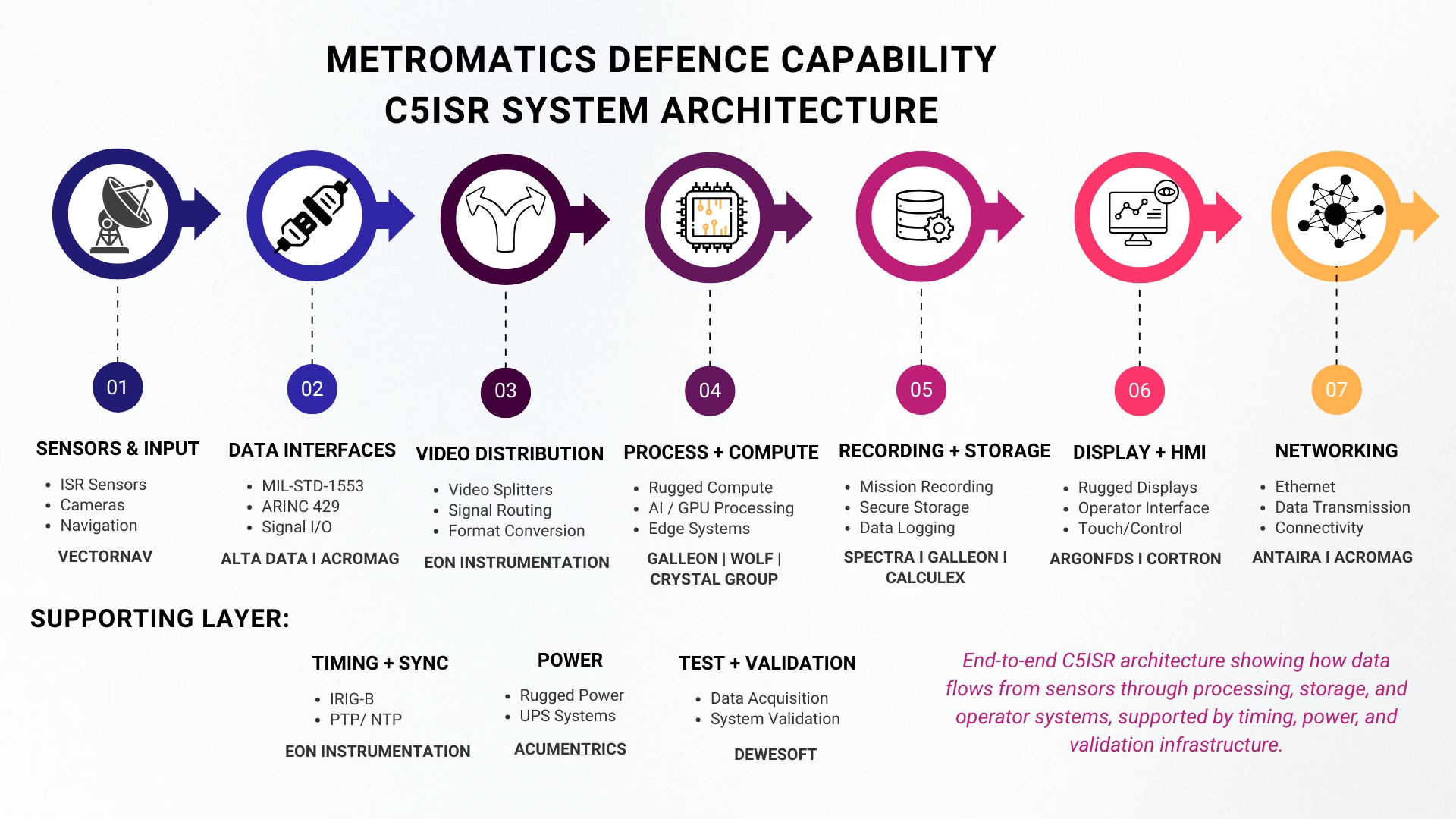
C5ISR systems follow a structured data pipeline:
Sensors → Interfaces → Distribution → Processing → Storage → Visualisation → Operator Control → Network
This architecture is where the most critical design decisions—and the highest risks—exist.
Key Design Considerations for C5ISR Systems
Successful C5ISR systems are defined by how well the architecture is designed.
Key considerations include:
- Data Flow: How is high-bandwidth data (video, sensor inputs) moved across the system?
- Processing Location: What is processed at the edge versus central systems?
- Timing & Synchronisation: How are all subsystems aligned to a common time reference?
- Video Distribution: How is ISR video shared across multiple systems without degradation?
- Security: How is sensitive data protected at rest and in transit?
- SWaP Constraints: How are size, weight, and power managed in deployed environments?
C5ISR Capability Across the System
Metromatics supports Defence integrators by aligning rugged computing, video distribution, timing, storage, networking, and interface technologies. These combine into deployable C5ISR architectures suited to real-world platform integration.
Sensor & Navigation Inputs
Accurate positioning and sensor alignment are fundamental to ISR systems.
- Inertial navigation and GNSS integration
- Sensor data alignment for mission systems
Technologies: VectorNav
Communications & Data Interfaces
Reliable communication between subsystems ensures deterministic system performance.
- MIL-STD-1553 and ARINC 429 avionics interfaces
- Embedded I/O and signal conditioning
- Real-time data exchange across platforms
Technologies: Alta Data Technologies, Acromag
Video Distribution & Signal Management
ISR systems depend heavily on video, which must be distributed across multiple systems without loss of integrity.
- Video splitters and distribution amplifiers
- Routing to displays, recorders, and processing systems
- Support for SDI, HDMI, DVI, and analogue formats
Technologies: EON Instrumentation
Edge Processing & Compute
Processing data at the edge enables real-time decision-making and reduces reliance on central systems.
- Rugged embedded computing platforms
- GPU acceleration for AI and sensor fusion
- Server-class compute for deployed environments
Technologies: Galleon Embedded Computing, WOLF Advanced Technology, Crystal Group
Mission Data Recording & Secure Storage
Capturing and securing mission data is critical for operational use and post-mission analysis.
- High-speed mission data recorders
- Encrypted and removable storage solutions
- Support for ISR, video, and sensor data
Technologies: Spectra Defense Technologies, Calculex
Visualisation & Operator Control
Operators require reliable, intuitive interfaces in demanding environments.
- Sunlight-readable rugged displays
- Sealed, MIL-grade keyboards and control devices
- Integration into vehicles, shelters, and control systems
Technologies: ArgonFDS, Cortron Inc
Networking & Data Transmission
C5ISR systems rely on robust connectivity across distributed platforms.
- Rugged Ethernet switching and communications
- Data transmission across system architectures
Technologies: Antaira, Acromag
Supporting Infrastructure
Timing & Synchronisation
Accurate timing enables correlation of data across systems.
- IRIG-B, PTP, and NTP synchronisation
- Alignment of video, navigation, sensor, and mission-recorded data across distributed subsystems operating at different processing locations.
Technologies: EON Instrumentation
Power & System Reliability
Reliable power ensures continuous system operation in harsh environments.
- Rugged power supplies and UPS systems
Technologies: Acumentrics
Test, Measurement & Validation
C5ISR systems must be validated during development and deployment.
- Data acquisition and system validation tools
Technologies: Dewesoft
Example: ISR Data & Video Workflow
A typical deployed C5ISR system may involve:
- Sensors capturing video and navigation data
- Video distributed across multiple subsystems
- Data processed at the edge for real-time analysis
- Mission data recorded and secured
- Information displayed to operators for decision-making
System performance depends on how effectively these stages are integrated.
Applications
Metromatics supports C5ISR capability across a range of Defence applications:
- ISR platforms and sensor systems
- Ground vehicle modernisation programs
- Naval and maritime systems
- Unmanned systems (UAV / UAS)
- Tactical operations centres
- Defence communications networks
Why Choose Metromatics for C5ISR Systems in Australia
- Local engineering and support across Australia and New Zealand
- Access to specialised Defence technology suppliers
- System-level understanding of C5ISR architectures
- Ability to support programs from design through deployment
- Reduced integration risk across multi-vendor environments
Work With Us
If you are working on a Defence or C5ISR program, Metromatics can support system design, integration, and deployment. We use proven technologies that match real-world requirements. Contact us now to learn more.
Frequently Asked Questions
What is a C5ISR system?
A C5ISR system is an integrated Defence architecture that connects sensors, communications, computing, and operator systems to enable real-time situational awareness and decision-making.
What are the biggest challenges in C5ISR systems?
The main challenges include data integration, video distribution, system synchronisation, latency, and managing secure, high-bandwidth data across multiple subsystems.
Why is edge computing important in C5ISR?
Edge computing reduces latency by processing data locally, enabling faster decision-making and reducing reliance on centralised systems.
How is video distributed in C5ISR systems?
Video is distributed using dedicated hardware such as splitters and distribution systems to ensure multiple subsystems receive the same high-quality signal.
What role does timing play in C5ISR?
Timing ensures all systems operate on a common reference, allowing accurate correlation of sensor, video, and mission data.