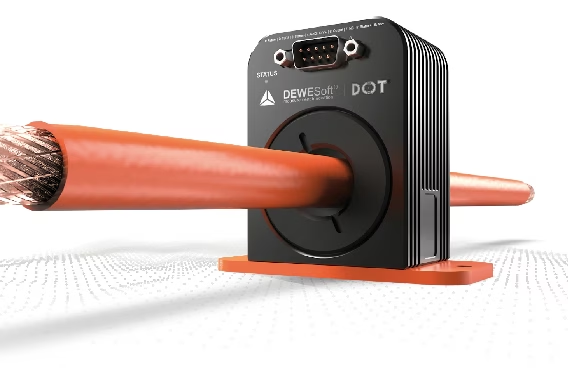
Test engineers have traditionally faced a difficult choice when selecting a current sensor. Hall effect sensors offer compact installation but can suffer from temperature drift, noise and reduced linearity. Conventional zero-flux current transducers provide excellent measurement performance but are often larger, consume significantly more power and require more complex installation.
The Dewesoft DC-CT® bridges this gap. Achieved by combining the measurement characteristics expected from a zero-flux current transducer with substantially lower power consumption and a compact mechanical design. Using patented Platiše Flux Sensor (PFS) technology within the ISOTEL DC-CT architecture. The sensor provides high linearity, excellent bandwidth and stable measurements across demanding test environments.
Why Test Engineers Choose the Dewesoft DC-CT®
High accuracy across AC and DC measurements
The DC-CT measures both AC and DC current with high linearity and low temperature drift. Therfore, making it suitable for precision laboratory testing as well as demanding field applications. Target accuracy ranges from 0.1% down to 0.01%, depending on the application and configuration.
High bandwidth for modern power electronics
Modern EV inverters and switching power electronics generate fast transient events that many current sensors struggle to capture accurately. The DC-CT offers a flat frequency response from DC to 1 MHz (-0.5 dB). Therefore, enabling detailed analysis of PWM switching behaviour and high-frequency current components.
Compact design for confined installations
Available with either a 22 mm or 45 mm aperture. Firstly, the DC-CT provides installation flexibility while remaining considerably smaller than many traditional zero-flux current transducers. The compact design simplifies installation inside test rigs, battery packs and electric drivetrains.
Low power consumption
The innovative sensor design consumes up to ten times less power than conventional zero-flux current transducers. Lower power consumption reduces self-heating, improves thermal stability and simplifies system integration by reducing external hardware requirements.
Designed for demanding environments
The DC-CT is designed to operate from -40 °C to +85 °C. Plus, it provides galvanic isolation up to CAT II 1000 V and CAT III 600 V. Therefore, making it suitable for laboratory, industrial and vehicle-based testing.
Key Features
- High accuracy AC and DC current measurement
- Measures up to 1000 A DC and 700 A AC RMS
- Bandwidth to 1 MHz (-0.5 dB)
- Excellent linearity and low temperature drift
- Compact 22 mm and 45 mm aperture options
- Low power consumption compared with conventional zero-flux current transducers
- Galvanic isolation up to CAT II 1000 V
- TEDS compatible
- Available with DSUB-9 or LEMO connectors
- Fail-safe design that withstands high current when unpowered
- Seven-year manufacturer warranty
Applications
The Dewesoft DC-CT is designed for engineers. Especially, those who require precise current measurement across a broad range of testing applications.
Electric Vehicle and Powertrain Testing
Measure traction motor currents, inverter switching behaviour and drivetrain efficiency. Achieved by using a sensor designed for high-current, high-bandwidth applications. The fail-safe design allows permanent installation within vehicle test fleets. Without risking sensor damage if current flows while the sensor is unpowered.
Battery Testing
Monitor charge and discharge cycles with stable current measurements across long-duration tests. Low temperature drift supports consistent measurement performance throughout varying operating conditions.
Motor and Inverter Testing
Capture fast switching frequencies, harmonic content and efficiency measurements. Achieved by using a current transducer. Capable of measuring both DC and high-frequency AC components with minimal phase shift.
Power Quality and Grid Analysis
Perform accurate power analysis across renewable energy systems, battery storage and electrical distribution networks where reliable DC and AC current measurement is critical.
Available Models
Four standard models allow engineers to select the most suitable aperture size and connector type.
| Model | Current Range | Aperture | Connector |
|---|---|---|---|
| DC-CT-1000I-S22DA | 1000 A | 22 mm | DSUB-9 |
| DC-CT-1000I-S22LA | 1000 A | 22 mm | LEMO |
| DC-CT-1000I-S45DA | 1000 A | 45 mm | DSUB-9 |
| DC-CT-1000I-S45LA | 1000 A | 45 mm | LEMO |
Frequently Asked Questions
What is the difference between the DC-CT and a Hall effect current sensor?
According to the supplied product information. The DC-CT is designed to provide the measurement accuracy and bandwidth associated with zero-flux current transducers. Whilst, offering lower power consumption and a more compact design than traditional zero-flux solutions.
Can the DC-CT measure both AC and DC current?
Yes. The DC-CT is designed to measure both AC and DC current. In addition, it supports applications requiring measurements from DC through to high-frequency AC components.
Which industries commonly use the DC-CT?
Typical applications include electric vehicle testing, battery testing, inverter and motor testing, grid analysis, renewable energy systems and precision power measurement.
Local Support
Metromatics provides local sales, technical advice and application support for Dewesoft test and measurement solutions throughout Australia. So whether you’re selecting a current transducer for a new test bench? Or integrating sensors into an existing data acquisition system? Our engineers can help you identify the most suitable configuration for your application.
Request a Quote
Looking for a high accuracy DC current transducer for EV testing, battery validation, inverter analysis or precision power measurement? Contact Metromatics to discuss your application and select the right Dewesoft DC-CT model for your measurement requirements. To view more of DEWESoft’s Current Clamps and Transducers.