News & Events

FPGA for Defence

FPGA Technology for Defence Systems: What Engineers Need to Know

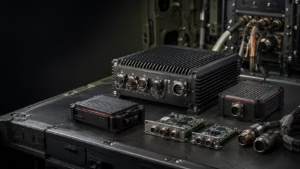
What is an FPGA? A Field Programmable Gate Array (FPGA) is a semiconductor device. Firstly, that allows engineers to implement custom digital hardware circuits after the device has been manufactured. An FPGA contains: These elements can be configured to implement complex …

Power Electronics Diagnostic & Repair Systems

Power Electronics Diagnostic & Repair Systems

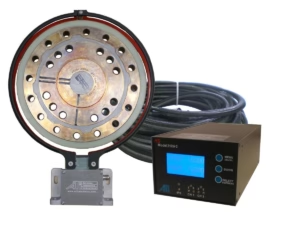
A Safer Way to Troubleshoot Solar, Wind, and Grid Infrastructure As Australia’s energy sector continues to expand across solar, wind, and grid-connected infrastructure, the reliability of power electronics has become critical. Inverters, converters, and control boards are key parts of modern …

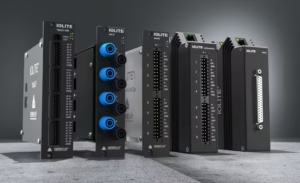
AcroPack® provides a scalable, rugged, and modular embedded I/O architecture that separates I/O from compute. This approach reduces system complexity, improves platform reuse, and supports long-life embedded programs across industrial, transport, and defence applications.

What Is AcroPack®? Modular Embedded I/O Explained

AcroPack® is a modular, mezzanine-based embedded I/O platform from Acromag. Designed for compact, rugged, and long-life embedded systems. Firstly, it enables engineers to integrate high-density analog, digital, serial, and timing I/O. Whilst avoiding the size, rigidity, and redesign overhead of traditional …

Autonomous mobile robot silhouette illustrating IMU, GNSS-INS and sensor fusion integration for robotics platforms

VectorNav Inertial Navigation for Robotics & Autonomous Systems

Robotics and autonomous systems depend on accurate motion, orientation, and navigation data to operate reliably in dynamic environments. Inertial navigation sensors support autonomy by providing continuous reference data for localisation, control, and sensor fusion—particularly when operating across changing terrains and environments. …

Research platform silhouette illustrating IMU, GNSS-INS and sensor integration for motion, position, and timing measurement

VectorNav Inertial Navigation for Research & Universities

Research and university projects increasingly require accurate motion, orientation, and navigation data to support experimentation, validation, and system development. Inertial navigation sensors play a central role. Delivering continuous reference data across controlled tests, field trials, and experimental platforms. VectorNav designs and …

Representative rail vehicle silhouette illustrating GNSS-aided inertial measurement integration for rail test and monitoring systems.

VectorNav Inertial Navigation for Rail & Transport

Rail and transport platforms increasingly rely on accurate motion, orientation, and positioning data. In order, to support vehicle monitoring, system integration, testing, and infrastructure assessment. Firstly, Inertial navigation sensors provide continuous reference data in dynamic operating environments. Especially where vibration, acceleration, …

ground vehicle silhouette showing embedded IMU and GNSS-INS integration for defence navigation and motion reference

VectorNav Inertial Navigation for Defence & Aerospace

Defence and aerospace platforms rely on accurate positioning, navigation and timing (PNT). In order to support mission systems, vehicle control, sensor alignment, and test and evaluation activities. Inertial navigation sensors play a critical role by providing continuous motion and orientation data, …

Inertial navigation system showing IMU and GNSS-INS providing position, orientation, velocity and timing for a moving platform

Inertial Navigation Sensors By VectorNav (IMU, AHRS & GNSS/INS)

Modern platforms increasingly rely on accurate positioning, navigation and timing (PNT) data to operate reliably in dynamic environments. GNSS-derived timing outputs are commonly used for sensor synchronisation, time-aligned data logging, and system coordination within larger platform architectures. Inertial navigation sensors play …