
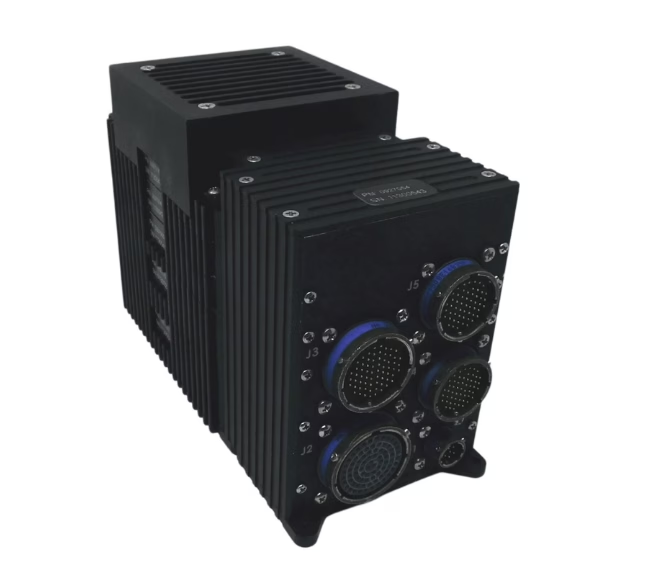
Modern military and specialist helicopters can carry sophisticated avionics, sensors, communications equipment and mission systems. Depending on the aircraft and its role, many of these systems generate data that may need to be captured, time-synchronised, processed or securely stored during flight. Therefore, they require data recording solutions for Helicopters and rotary-wing aircraft.
This can present a complex integration challenge. A recording system may need to accept several aircraft interfaces, capture selected data continuously at the required sustained rates and operate within the platform’s size, weight and power constraints.
Equipment intended for aircraft installation must also be assessed against the applicable shock, vibration, temperature, electromagnetic, electrical and airworthiness requirements.
Spectra Defense Technologies provides Rugged Data Recording Solutions for Helicopters and Rotary-Wing Aircraft, including flight testing, mission data and video recording, avionics evaluation, training and post-flight analysis. Recorded data can also provide input to aircraft condition-monitoring and fleet-reliability programs when combined with appropriate analytics software and engineering processes.
Metromatics supplies and supports Spectra Defense recording technology for customers throughout Australia and New Zealand.
What is the difference between a helicopter, rotorcraft and rotary-wing aircraft?
Under Australian civil aviation regulations, CASA defines rotorcraft as aircraft that are helicopters, gyroplanes or powered-lift aircraft.
“Rotary-wing aircraft” is also widely used by Australian and New Zealand defence organisations, while “helicopter” provides a clearer plain-language description for a broader audience.
For this reason, Metromatics uses the terms helicopter and rotary-wing aircraft when describing these recording applications.
Why do modern helicopters need onboard data recording?
Depending on the aircraft, its role and installed equipment, potential data sources can include:
- Flight-control and aircraft avionics systems
- MIL-STD-1553 and ARINC 429 avionics buses
- Ethernet-based aircraft networks
- EO/IR and other mission sensors
- Radar and electronic warfare equipment
- Cockpit and mission video
- Communications and telemetry systems
- Aircraft health and usage-monitoring sensors
- Flight-test instrumentation
- Audio, serial and discrete signals
A rugged data recorder can provide a central point for acquiring, time-correlating and storing selected information from these sources.
Depending on the selected recorder and configuration, recorded data can support real-time monitoring, post-flight engineering analysis, mission debriefing, training, fault investigation and longer-term fleet-reliability programs.
Helicopter flight testing and aircraft development
Flight-test teams need accurate, time-correlated information to understand how an aircraft and its systems perform under real operating conditions.
This can involve capturing information from avionics buses, experimental sensors, telemetry equipment, cameras and newly integrated mission systems. Recording these sources in a consistent format allows engineers to compare events across multiple channels during post-flight analysis.
Selected Spectra recorders support IRIG 106 Chapter 10, an established standard for recording time-correlated flight-test and mission data.
Potential applications include:
- Aircraft development and qualification
- Flight-test instrumentation
- Avionics and mission-system integration
- Capability upgrades
- Sensor and payload evaluation
- System-performance analysis
- Fault investigation
- System verification and validation
The recorder and its interface configuration must be selected according to the aircraft systems being monitored, the required data rates and the intended engineering or operational use of the recorded information.
Mission data and video recording
Military and government helicopters may need to capture information from several mission systems during the same operation.
Where suitable interfaces are available, recorded information may include:
- EO/IR and other mission video
- Mission-system outputs
- Aircraft-position information
- Avionics bus data
- Sensor information
- Communications data
- Audio and operator inputs
- Time and synchronisation information
Recording this data can support mission review, operator training, system evaluation and operational analysis.
Spectra offers configurable platforms that can combine data acquisition, recording, processing, routing and streaming functions within a rugged system. Combining these functions in one platform may help consolidate capabilities that would otherwise require multiple pieces of equipment.
The final architecture will depend on the interfaces, processing requirements, recording rates and level of redundancy required by the aircraft program.
Supporting aircraft condition monitoring and fleet reliability
Information recorded during normal aircraft operation can also provide valuable insight into system performance and equipment condition.
When used with appropriate analytics software and engineering processes, recorded aircraft data may help maintenance and engineering teams:
- Identify recurring faults
- Investigate intermittent system problems
- Compare performance across multiple flights
- Monitor selected aircraft parameters over time
- Support condition-based maintenance programs
- Provide datasets for predictive-maintenance analysis
- Improve troubleshooting and maintenance planning
The recorder’s role is to capture, time-correlate and preserve the required aircraft data. Dedicated analysis software, defined monitoring parameters and an appropriate maintenance methodology are then needed to turn that data into useful engineering information.
A data recorder should not, by itself, be described as a complete predictive-maintenance solution.
What aircraft interfaces can Spectra recorders support?
The required interface configuration will depend on the aircraft, installed mission systems and information that needs to be captured.
Across its data-recording portfolio, Spectra supports interfaces such as:
- Gigabit and higher-speed Ethernet
- MIL-STD-1553
- ARINC 429
- PCM
- Serial and discrete I/O
- Analogue signals
- Digital video and audio
- sFPDP
- Fibre-optic data
- Time and synchronisation inputs
Configurable and stackable I/O options are available for applications requiring a combination of legacy avionics buses, modern Ethernet networks, sensors and video sources.
Interface availability, channel count and supported recording rate vary between recorders and configurations. These requirements should therefore be established before selecting a particular product.
Compact recording for SWaP-constrained aircraft
In addition, Space, weight, power and cooling are important considerations. Especially, when selecting equipment for a helicopter or other rotary-wing aircraft.
The recorder must fit within the available installation space while meeting the platform’s electrical, thermal, environmental and airworthiness requirements.
The RIPR 1401 Rugged Mission Data and Video Recorder combines recording, processing and routing functions in a compact, passively cooled platform.

Depending on its configuration, RIPR 1401 capabilities include:
- Customisable input and output interfaces
- Ethernet data and video streaming
- IRIG 106-compatible recording
- Up to 1TB of removable CFAST 2.0 storage
- Networked, serial and discrete control
- Encryption options
- 28V DC aircraft power compatibility
- Passive cooling without an active fan
Its compact, low-SWaP design makes the RIPR 1401 a potential option for flight-test, mission-recording and aircraft-monitoring applications where installation space and available power are limited.
Suitability must be assessed against the requirements of the individual aircraft and recording program.
High-speed recording for advanced sensors and aircraft networks
Advanced sensors and Ethernet-based aircraft architectures can generate large volumes of information that must be recorded at sustained rates.
The RIPR 1402 IRIG 106 Rugged Mission Data Recorder is designed for applications requiring higher recording speeds and greater storage capacity.
Depending on the selected configuration, RIPR 1402 capabilities include:
- Individual channel data rates up to 10Gbps
- High-speed avionics, sensor and video capture
- Up to 16TB of removable NVMe storage
- AES-256 data-at-rest encryption
- Ethernet video and data streaming
- Customisable I/O configurations
- Networked, serial and discrete control
- 28V DC aircraft power
- Passive cooling
- IRIG 106 data formatting
These capabilities make the RIPR 1402 relevant to demanding flight-test programs and the recording of high-bandwidth data generated by EO/IR, radar, electronic warfare and other advanced airborne systems.
The achievable recording rate and available interfaces depend on the final product configuration.
Designed for demanding airborne environments
Equipment installed aboard a military helicopter must be evaluated against the environmental and electrical requirements of the aircraft.
Spectra’s RIPR recording systems are designed for defence and aerospace environments. Published qualifications for specific RIPR 1401 and RIPR 1402 configurations include:
- MIL-STD-810 for environmental conditions
- MIL-STD-461 for electromagnetic compatibility
- MIL-STD-704 for aircraft electrical power
These standards address different aspects of equipment performance, including exposure to temperature, shock, vibration, electromagnetic interference and aircraft power conditions.
Qualification can vary by model, configuration and test method. The recorder and its installation must therefore be assessed against the exact environmental, electrical, integration and airworthiness requirements of the aircraft program.
Product qualification does not automatically approve the equipment for installation on a particular aircraft.
Choosing the right helicopter data recorder
Selecting an airborne recorder begins with understanding what must be captured and how the recorded information will be used.
Important considerations include:
- Aircraft, avionics and sensor interfaces
- Number of simultaneous recording channels
- Data rate for each channel
- Required sustained aggregate recording rate
- Mission duration and storage capacity
- Time synchronisation and timestamp requirements
- Video and audio formats
- Real-time streaming or monitoring requirements
- Encryption and data-security requirements
- Removable-media requirements
- Post-flight data-offload workflow
- Available installation space
- Equipment weight and power consumption
- Cooling and environmental conditions
- Aircraft power compatibility
- Platform qualification and airworthiness requirements
- Integration with ground-based analysis systems
- Required lifecycle and sustainment support
Metromatics can work with avionics engineers, flight-test teams, aircraft integrators and capability managers to help identify a recording architecture suited to new aircraft, test platforms and rotary-wing capability upgrades.
Local Spectra Defense support
Metromatics provides customers in Australia and New Zealand with access to the Calculex RIPR family and the broader Spectra Defense rugged recording, computing and storage portfolio. Perfect for Rugged Data Recording Solutions for Helicopters and Rotary-Wing Aircraft.
Our team can assist with:
- Initial requirements discussions
- Recorder and interface selection
- Product configuration
- Storage and recording-rate requirements
- Technical engagement with Spectra
- Product documentation
- Quotations and availability
- Local sales and after-sales support
Final product selection should be based on a detailed review of the aircraft interfaces, recording requirements, environmental conditions and applicable airworthiness obligations.
Discuss your helicopter recording requirements
Are you developing, upgrading, testing or sustaining a helicopter or rotary-wing platform?
Talk to Metromatics about your aircraft interfaces, recording speeds, storage capacity, security requirements, SWaP constraints and operating environment.
Read about some of the other Spectra rotorcraft-ready portfolio including technologies such as the High-Speed Video Data Recorder and Processor and the G2 rugged storage and edge computing platform.