
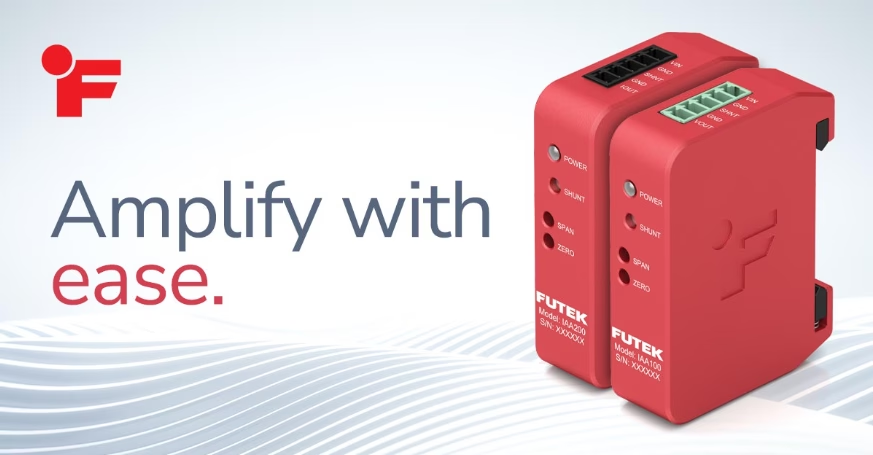
FUTEK has upgraded its IAA100 and IAA200 strain gauge analog amplifiers to deliver lower noise, improved stability and greater configuration flexibility for force, load, torque and pressure measurement applications.
The IAA100 provides a voltage output for connection to data acquisition systems, PLCs and control equipment, while the IAA200 provides a current output suited to long cable runs and electrically noisy industrial environments.
Both amplifiers retain the core performance engineers already rely on, including up to 25 kHz bandwidth, high linearity and 256 selectable gain and shunt-calibration combinations. The improvements focus on signal quality, temperature stability, power consumption and output flexibility.
What is a strain gauge amplifier?
Strain gauge sensors typically produce a low-level millivolt-per-volt (mV/V) signal that cannot be used directly by most PLCs, data acquisition systems or control equipment.
A strain gauge amplifier conditions and amplifies this small signal, converting it into a stable voltage or current output that can be transmitted, monitored and processed more reliably.
Designed for full-bridge Wheatstone bridge sensors, including compatible:
- Load cells
- Torque sensors
- Pressure sensors
- Multi-axis sensors
- Force measurement sensors
What has changed in the upgraded IAA Series?
Across both models, FUTEK has introduced:
- Lower output noise for cleaner measurements
- An expanded gain range
- Improved temperature and power stability
- Reduced power consumption
- Greater output configuration flexibility
- Built-in protection for easier system integration
These improvements can help increase measurement reliability in industrial automation, robotics, test and measurement, manufacturing, aerospace and laboratory applications.
Upgraded FUTEK IAA100 voltage-output amplifier
The FUTEK IAA100 conditions low-level signals from full-bridge strain gauge sensors and converts them into a clean voltage output for a PLC, controller or data acquisition system.
Its wide configurable gain range and built-in protection make it suitable for engineers who need to integrate Wheatstone bridge sensors without compromising measurement integrity.
| Feature | Previous IAA100 | Upgraded IAA100 |
|---|---|---|
| Bridge input range | ±0.2 to ±500 mV/V | ±0.2 to ±18 mV/V |
| Gain range | 110 to 6300 | 110 to 6575 |
| Noise at default gain | 10 mV peak-to-peak, typical | 8 mV peak-to-peak, typical |
| Temperature stability | ±25 ppm of FSR/°C | ±15 ppm of FSR/°C |
| Maximum power consumption | 1 W, instrument only | 0.75 W, instrument only |
The reduction in typical output noise from 10 mV to 8 mV peak-to-peak helps provide a cleaner signal. Improved temperature stability is also beneficial where equipment must operate reliably as ambient conditions change.
Upgraded FUTEK IAA200 current-output amplifier
The FUTEK IAA200 converts a full-bridge strain gauge sensor’s mV/V signal into an industrial current output.
Current signals are less susceptible to voltage drop and electrical interference than voltage signals, making the IAA200 particularly suitable for sensors located away from the PLC or monitoring equipment.
| Feature | Previous IAA200 | Upgraded IAA200 |
|---|---|---|
| Available output ranges | 4–20 mA and 12 ±8 mA | 4–20 mA, 0–20 mA, 5–25 mA and 12 ±8 mA |
| Bridge input range | ±0.2 to ±500 mV/V | ±0.2 to ±18 mV/V |
| Gain range | 110 to 6300 | 110 to 6575 |
| Noise at default gain | 15 μA peak-to-peak | 6 μA peak-to-peak |
| Power supply requirement | 12.5 to 26 VDC | 16 to 26 VDC |
| Maximum power consumption | 1 W, instrument only | 0.8 W, instrument only |
The most significant IAA200 improvement is its lower output noise, reduced from 15 μA to 6 μA peak-to-peak. Additional output options also give system designers greater flexibility when integrating the amplifier into new or existing industrial measurement systems.
IAA100 or IAA200: which amplifier should you choose?
The correct amplifier primarily depends on the output required by the receiving equipment and the distance over which the signal must travel.
| Choose the IAA100 when… | Choose the IAA200 when… |
|---|---|
| Your DAQ, PLC or controller requires a voltage input | Your PLC or controller requires a current input |
| The amplifier is located close to the receiving equipment | The sensor signal must travel over a long cable |
| You require voltage-based signal conditioning | The installation is exposed to electrical interference |
| Fast dynamic measurement is required | A standard industrial current loop is preferred |
For existing installations, check the sensor input range, required output and power supply before replacing an earlier amplifier. This is particularly important for the upgraded IAA200 because its power supply requirement has changed to 16–26 VDC.
Frequently asked questions
What sensors can the FUTEK IAA100 and IAA200 support?
The amplifiers are designed for compatible full-bridge strain gauge sensors with an input range between ±0.2 and ±18 mV/V. These can include load cells, torque sensors, pressure sensors and multi-axis force sensors.
What is the difference between the IAA100 and IAA200?
The IAA100 provides a voltage output, while the IAA200 provides a current output. The IAA200 is for long cable runs and electrically noisy industrial environments.
Have the bandwidth and linearity changed?
No. FUTEK has retained the established bandwidth, linearity and configurable gain and shunt-calibration capabilities of the IAA Series. The upgrades concentrate on noise, stability, power consumption and configuration flexibility.
Can the upgraded amplifiers replace existing IAA100 or IAA200 units?
Potentially, but the sensor range, output configuration, wiring and power supply should be checked first. In particular, the upgraded IAA200 requires a 16–26 VDC supply.
FUTEK strain gauge amplifiers in Australia and New Zealand
Metromatics supplies and supports FUTEK sensors and instrumentation throughout Australia and New Zealand.
Contact Metromatics to discuss your sensor, signal-conditioning, output and integration requirements or to determine whether the IAA100 or IAA200 is the right amplifier for your application.