
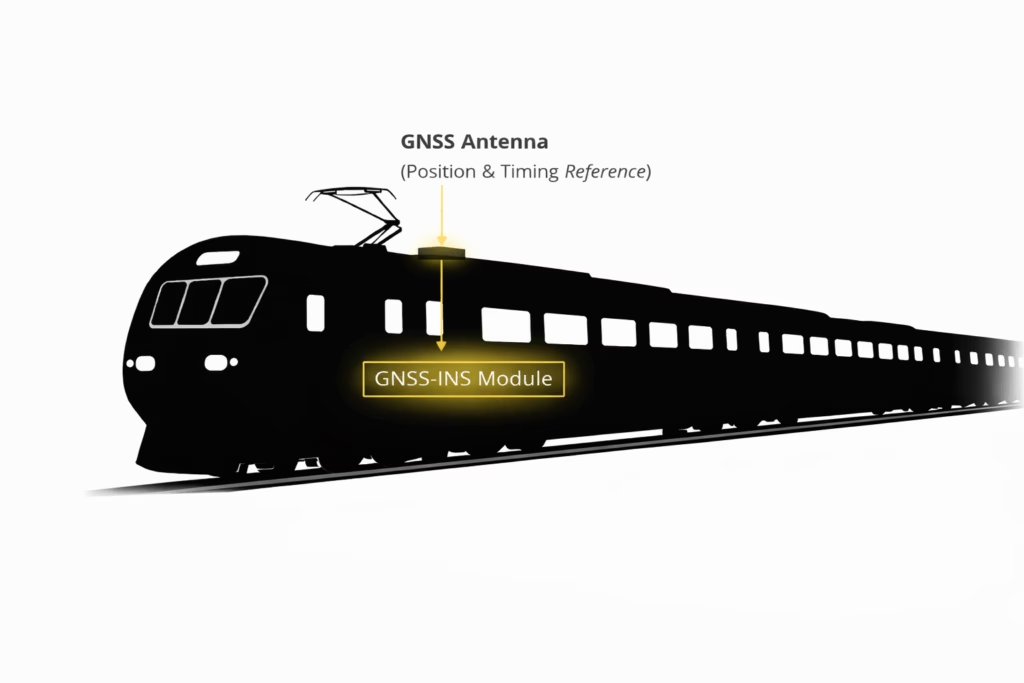
Rail and transport platforms increasingly rely on accurate motion, orientation, and positioning data. In order, to support vehicle monitoring, system integration, testing, and infrastructure assessment. Firstly, Inertial navigation sensors provide continuous reference data in dynamic operating environments. Especially where vibration, acceleration, and intermittent GNSS reception are common.
VectorNav designs and manufactures MEMS-based inertial navigation products. Integrated into rail and transport systems requiring compact, embedded navigation capability.
Metromatics is the exclusive distributor for VectorNav in Australia and New Zealand, providing local sales and technical support.
Rail and Transport Navigation Requirements
Typical rail and transport applications require:
- Reliable orientation reference (roll, pitch, yaw)
- Motion and acceleration measurement
- Position and velocity estimation where GNSS is available
- Time-aligned data capture across multiple systems
- Compact hardware suitable for embedded installation
Requirements commonly addressed using IMU, AHRS, and GNSS-aided INS technologies integrated into onboard systems or test instrumentation.
Embedded PNT for Rail & Transport Platforms
VectorNav products provide embedded positioning, navigation and timing (PNT) capability when GNSS is available most of the time.
- Positioning: GNSS-derived position for vehicle or test reference
- Navigation: Orientation and motion derived from inertial sensors
- Timing: GNSS-derived timing used for synchronisation and time-aligned data logging
GNSS-derived timing outputs used for sensor synchronisation, data correlation, and system alignment across onboard and test systems.
VectorNav products assume GNSS availability for absolute position updates. With inertial sensors maintaining continuity during short GNSS interruptions such as tunnels, cuttings, or urban corridors.
VectorNav Solutions for Rail & Transport
VectorNav’s rail-relevant product categories include:
IMU and AHRS
Used where rail and transport systems require:
- Orientation reference
- Motion and vibration measurement
- Stabilisation and control inputs
IMU/AHRS devices provide calibrated inertial data and real-time attitude outputs suitable for embedded monitoring and control applications. Learn more about these devices.
GNSS-Aided INS
Used where applications require:
- Position and velocity estimation
- Orientation and motion reference
- Integrated navigation outputs
GNSS-INS devices combine inertial sensors with GNSS receivers and onboard estimation. In order to deliver position, velocity, and attitude data suitable for vehicle monitoring, testing, and system integration. Learn more about GNSS-INS.
Dual-Antenna GNSS-INS
Used where:
- Accurate heading is required
- Magnetic interference limits magnetometer use
- Vehicle installations can support dual GNSS antennas
Dual-antenna configurations derive heading from GNSS rather than magnetic sensors, improving robustness in electrically noisy rail environments.
Typical Rail and Transport Uses
In rail and transport applications, VectorNav products are integrated as part of a larger system to support:
- Vehicle motion and orientation reference
- Ride quality and vehicle dynamics testing
- Track geometry and infrastructure assessment (when combined with other sensors)
- Time-aligned data acquisition and analysis
- Test and evaluation instrumentation
VectorNav products are embedded subsystems. Not intended as standalone navigation appliances.
What VectorNav Is Not (Context for Rail Projects)
VectorNav products are not FOG-based or strategic-grade inertial navigation systems.
In rail and transport applications, these higher-grade systems are reserved for specialist survey or research platforms. Therefore, requiring extended navigation without GNSS.
VectorNav products designed for embedded rail and transport systems, where GNSS is available most of the time. Inertial sensors maintain continuity during short GNSS interruptions.
Integration Considerations
Final system performance depends on system-level factors, including:
- Antenna placement and installation
- Vehicle dynamics and vibration environment
- GNSS availability along the route
- Integration with external sensors and data acquisition systems
VectorNav provides inertial and navigation outputs. Overall performance is determined by the device integration within the rail or transport system architecture.
Inertial Navigation Sensors for Rail & Transport with Local Support from Metromatics
As the Australian and New Zealand distributor, Metromatics provides:
- Application scoping and product selection support
- Integration assistance with existing rail and test systems
- Local warranty handling and repairs/returns
- Responsive quoting and ongoing support
For a broader overview of VectorNav inertial navigation technologies, including IMU, AHRS, and GNSS-INS solutions used across multiple industries, return to our VectorNav overview page.
Call to Action
Discuss your rail or transport application with our team.
👉 Request a VectorNav product recommendation
👉 Discuss vehicle or test system requirements
👉 Request pricing or lead-time information