
Testing a launch vehicle involves much more than measuring vibration during lift-off. Engineers must validate structures, propulsion systems, avionics, electrical power, ground equipment and recovery procedures—often while collecting thousands of synchronised measurements under extreme conditions.
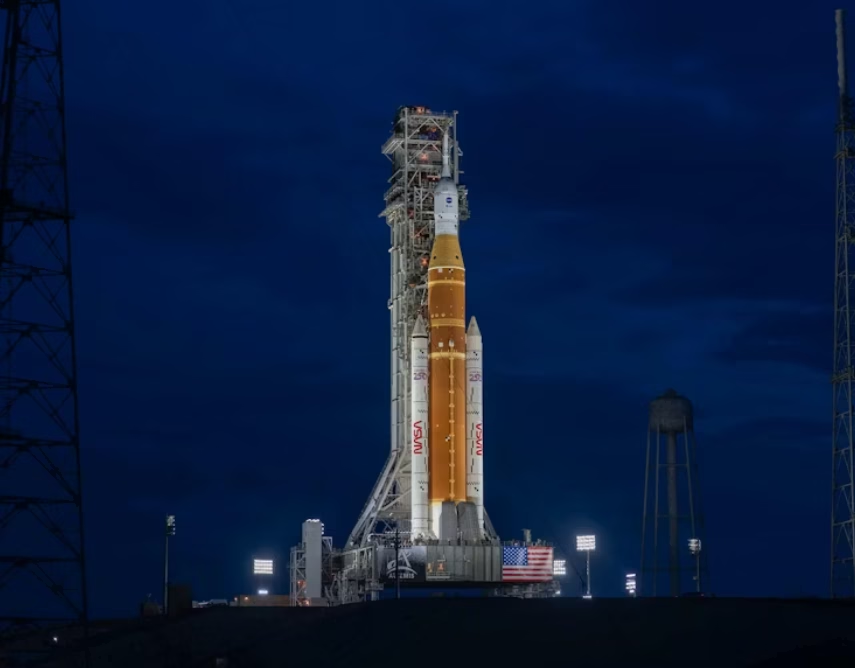
NASA’s Space Launch System (SLS) and Orion spacecraft provide a powerful example of this process. From individual components through to integrated launch systems, the Artemis program required extensive structural, environmental, propulsion, electrical and operational testing.
Dewesoft’s article, NASA’s Artemis Program: How the SLS Rocket Was Tested, describes how Dewesoft Aerospace data acquisition technology supported a number of these activities. The applications included structural testing, launch-platform monitoring, PCM telemetry processing, battery evaluation and spacecraft recovery trials.
For aerospace, Defence and research organisations in Australia and New Zealand, the story demonstrates something especially relevant: one measurement environment can bring together many sensor types and data sources, helping engineers examine how a complete system behaves—not just its individual components.
Aerospace testing begins long before launch
Before a launch vehicle reaches the pad, engineers must verify that its structures and subsystems can withstand the conditions expected throughout the mission.
Testing can involve:
- Structural loads and deformation
- Shock and vibration
- Acoustic loading
- Temperature extremes
- Pressure and fluid-system behaviour
- Electrical power and battery performance
- Avionics and communications
- Telemetry and data recording
- Ground-support and recovery equipment
These measurements may be captured at different sample rates, in different locations and from many types of sensors. To properly understand an event, engineers need the resulting data to remain accurately synchronised and easy to compare.
This is where an integrated data acquisition platform becomes particularly valuable.
1. Structural load testing
NASA used qualification test articles to verify that major SLS structures could withstand the forces associated with launch and flight. According to Dewesoft, SIRIUS data acquisition instruments recorded measurements from strain gauges, load cells, force sensors and displacement sensors during structural and cryogenic testing.
These measurement types allow engineers to compare physical behaviour with analytical and finite element models, assess safety margins and identify unexpected deformation or load paths.
The same principles apply to many Australian and New Zealand projects, including:
- Launch vehicles and propulsion structures
- Aircraft, UAVs and guided systems
- Satellite structures and payloads
- Defence platforms and mission equipment
- Composite structures
- Test rigs and ground-support equipment
- University aerospace research
A flexible system is particularly useful when a test program must expand from a small number of development channels to a much larger qualification setup.
2. Vibration, pressure and temperature monitoring
Launch vehicles experience intense vibration, acoustic energy and rapidly changing thermal and pressure conditions. These forces can affect structures, electronics, wiring, fasteners and mechanical interfaces.
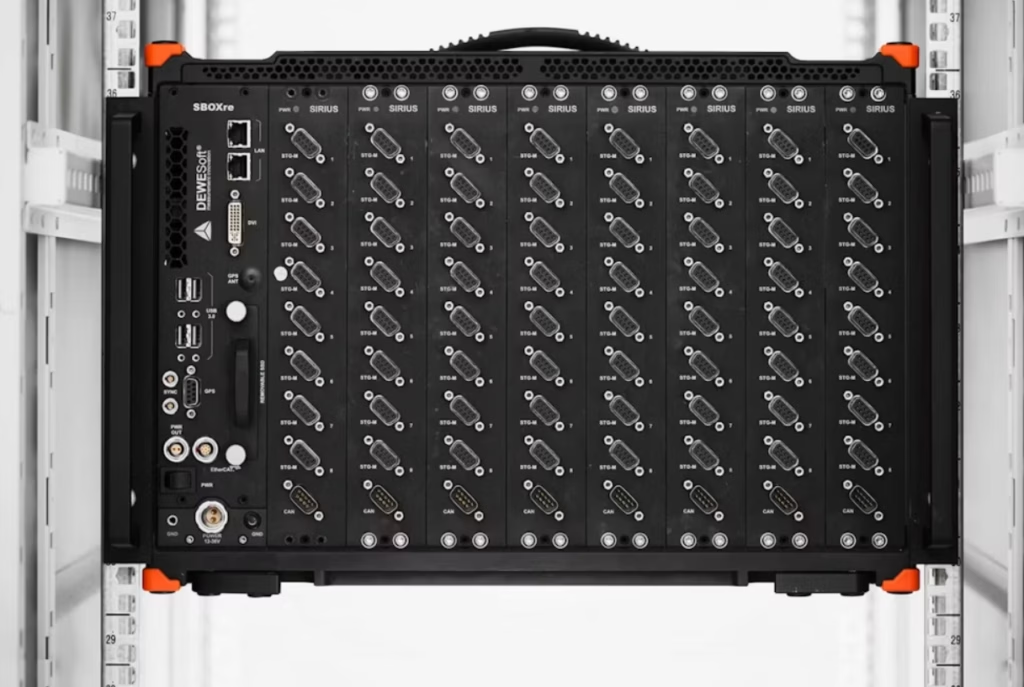
Dewesoft reports that multiple rack-mounted R8rt systems were installed on NASA’s mobile launch platforms. The systems recorded IEPE accelerometers for structural vibration analysis, together with hydraulic pressure and temperature measurements. Data from the different measurement systems could then be correlated in real time.
This type of synchronised acquisition helps engineers answer important questions:
- Did a vibration event coincide with a pressure fluctuation?
- How did structural response change as temperature or loading changed?
- Did multiple parts of the system experience the same transient event?
- Does measured behaviour agree with the predicted test profile?
Rather than treating vibration, pressure and temperature as isolated datasets, engineers can evaluate their relationship across the complete test.
3. High-channel-count PCM telemetry
Telemetry is essential when measurement data must be transmitted from a vehicle or test article to a ground station for monitoring, recording and analysis.
For Artemis, Dewesoft describes the installation of 11 R3 rack-mounted data acquisition and telemetry recorders within the Launch Control Center’s real-time and playback laboratory. The system processes PCM data from the spacecraft and can handle more than 200,000 parameters in real time.
DewesoftX can also read and decode IRIG 106 Chapter 10 data from a telemetry recorder, either live over Ethernet or from a previously recorded file.
These capabilities are relevant to applications such as:
- Flight-test ground stations
- Launch-vehicle testing
- Guided-weapon and range testing
- Aircraft and UAV development
- High-channel-count test facilities
- Real-time monitoring and post-test analysis
The ability to record, decode, scale and visualise telemetry data within one software environment can reduce the effort required to move between aerospace data acquisition and engineering analysis.
4. Battery and electrical-system testing
Electrical power is mission-critical in any spacecraft, aircraft or autonomous platform. Engineers need to understand how batteries and power-distribution systems behave during normal operation, changing loads and simulated mission conditions.
At NASA Kennedy Space Center’s Electrical Development Laboratory, Dewesoft equipment was used to monitor voltage and current in SLS and Orion battery cells. This work formed part of the evaluation of critical electrical systems before flight.
Depending on the application, a complete electrical test may need to correlate voltage and current with temperature, vibration, mechanical loads, control signals or communications data. Synchronised acquisition provides a clearer picture of how the electrical system responds as operating conditions change.
This approach is relevant to:
- Spacecraft and satellite power systems
- Electric propulsion development
- Aircraft and UAV electrical systems
- Defence power systems
- Battery packs and energy storage
- Ground-support equipment
5. Measuring spacecraft recovery forces
Testing does not end when a spacecraft returns to Earth. NASA and the US Navy conducted trials to validate the procedures used to recover the Orion capsule from the ocean.
During these trials, Dewesoft data acquisition systems collected information from load cells on rigging and winch lines, accelerometers on the capsule and cradle, strain gauges on structural elements, and motion sensors measuring the movement of the ship and capsule.
Combining these measurements helped engineers understand the forces generated during capsule capture, winching and movement in changing sea conditions.
The application demonstrates that aerospace data acquisition is not limited to laboratory or launch-pad testing. Portable and rugged measurement systems can also support field trials, maritime operations and other tests conducted in demanding environments.
What can Australian and New Zealand engineering teams take from Artemis?
Few test programs operate at the scale of Artemis, but the underlying measurement challenges are familiar to many local engineering teams.
An aerospace or Defence test program may begin with a limited number of strain, acceleration or temperature channels. As development progresses, engineers may need to add pressure, force, electrical, vehicle-bus, video, GPS, inertial or telemetry data.
Choosing a scalable platform early can help teams:
- Keep different measurement sources synchronised
- Expand channel counts as requirements evolve
- Use common software for setup, visualisation and analysis
- Compare measured results with calculations or simulation models
- Monitor critical parameters during a test
- Retain complete data for detailed post-test analysis
- Reduce the need to combine results manually from disconnected instruments
The appropriate configuration will depend on the sensors, signal types, bandwidth, channel count, timing requirements, test environment and required outputs. There is no single system configuration for every aerospace application.
Local Dewesoft application support
Metromatics supplies and supports Dewesoft data acquisition technology throughout Australia and New Zealand. We work with engineers, system integrators, Defence organisations, universities and research teams to help define suitable measurement solutions.
Metromatics can assist with:
- Application and measurement requirement discussions
- Sensor and signal compatibility
- Channel-count and sampling-rate planning
- Signal conditioning and DAQ selection
- Synchronisation of different measurement sources
- Portable, rack-mounted and rugged configurations
- DewesoftX software and analysis requirements
- System demonstrations, quotations and local support
Whether your project involves a propulsion test stand, structural qualification, vibration testing, battery evaluation, flight-test telemetry or field measurements, the starting point is understanding what needs to be measured and how the data will be used.
Planning an aerospace or Defence test program?
Send the Metromatics team your measurement types, sensor details, approximate channel count, sampling requirements and test environment. We can help identify an appropriate Dewesoft data acquisition approach for your application.
Read the full Dewesoft article: NASA’s Artemis Program: How the SLS Rocket Was Tested