
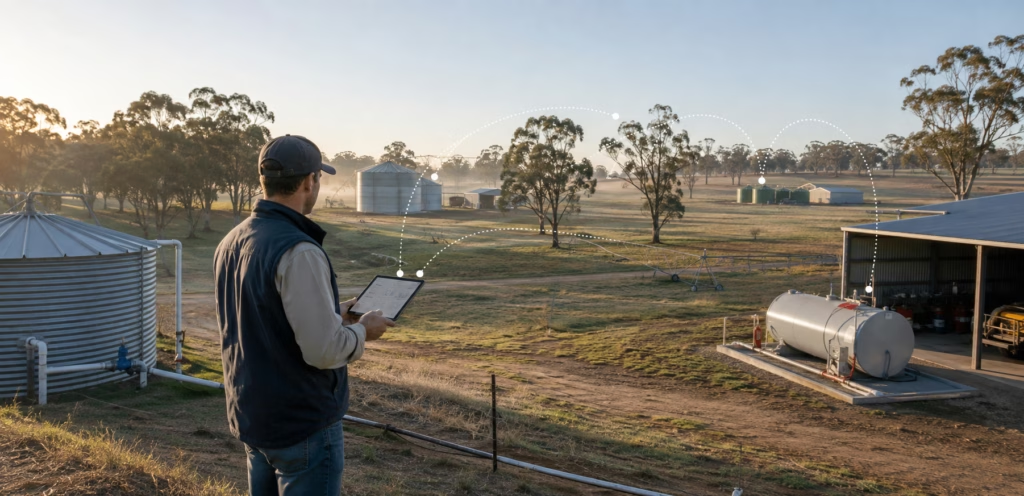
Planning milk collection starts with knowing what is in the tank. Manual checks can leave gaps between readings, especially when several tanks or sites need attention.
Remote level monitoring can give authorised users access to reported tank measurements and trends. A suitable system combines a tank-level sensor, a communications gateway and a platform for viewing the data.
Start with the information you need
Before selecting equipment, decide whether your team needs a level reading, an estimated volume, a collection-planning report or an alert when a threshold is reached.
These requirements affect the sensor, tank configuration and reporting interval. A system that reports periodically should be assessed against how quickly the tank fills or empties and how soon an operator needs to respond.
A useful dashboard should make the time of the latest reading easy to check. Remote access to the dashboard does not mean the displayed measurement updates continuously.
Select a sensor for the actual milk tank
Non-contact radar or ultrasonic measurement may be considered where the installation allows a sensor to measure the liquid surface from above. Selection still depends on the tank geometry, available mounting point, internal obstructions and operating conditions.
Foam, condensation, agitation and the cleaning process all need to be considered. A non-contact design does not, by itself, establish suitability for a dairy installation. The sensor, process connection and installation must meet the tank’s hygiene and cleaning requirements.
An existing level sensor may also be a candidate if its output, measurement performance and installation are suitable. Confirm these details before choosing the gateway.
Connect suitable sensors through the LevelCon F200
The LevelCon F200 remote monitoring gateway can collect readings from compatible industrial sensors and transmit them to the LevelCon platform. Supported interfaces include 4–20 mA and RS-485; the complete sensor connection and configuration require confirmation.
For an existing StarPin installation, Metromatics identifies the F200 as the current alternative. Before replacing StarPin with an F200, confirm that the existing sensor connection, power arrangement, communications service and reporting setup are compatible with the proposed F200 configuration.
Turn readings into useful inventory information
The LevelCon Portal provides remote access to reported measurements, historical trends and configured alerts.
If volume is required, the level measurement must be related to the tank’s geometry or calibration data. Check the configured result against a suitable reference across the operating range, rather than assuming a level reading automatically provides an accurate volume.
Agree who will receive alerts and what action they should take. Alert usefulness depends on measurement quality, reporting frequency, connectivity and the time available to respond.
Prepare these details before specifying a system
- Tank dimensions, shape, capacity and manufacturer.
- Existing sensor details and available mounting points.
- Agitators, internal pipework, foam and condensation.
- Cleaning conditions and installation requirements.
- Required level or volume accuracy and reporting interval.
- Available power, communications coverage and alert recipients.
Level monitoring supports inventory visibility. It does not establish milk quality or replace temperature monitoring, hygiene procedures or other site controls.
Discuss your milk tank monitoring application
Contact Metromatics with the tank details and the decisions you need the measurements to support. We can help assess the sensor interface, gateway and reporting requirements before a configuration is selected.