
Excessive vibration in industrial plants can lead to equipment failures, reduced product quality, and structural damage. As well as, increased maintenance costs and even complaints from nearby communities. While vibration is a normal characteristic of many industrial processes. Identifying the specific source of unwanted vibration can be a complex task.
For plant managers, maintenance teams and reliability engineers, understanding where vibration originates. This is often the first step towards improving equipment performance, reducing downtime and avoiding costly repairs.
This article explains how vibration analysis can be used to identify vibration sources within industrial facilities. Also, how modern data acquisition systems help engineers isolate and diagnose machinery-related vibration issues.
Why Identifying Vibration Sources Matters
Industrial facilities contain numerous pieces of rotating and reciprocating equipment operating simultaneously. Motors, pumps, fans, conveyors, crushers and processing equipment all generate vibration to varying degrees.
When vibration levels increase unexpectedly, the consequences can include:
- Premature bearing failures
- Shaft misalignment
- Structural fatigue
- Reduced machine life
- Increased maintenance costs
- Product quality issues
- Workplace safety concerns
- Noise and vibration complaints
Without accurate measurements, maintenance teams often spend significant time replacing components or making adjustments without addressing the true root cause.
Common Sources of Industrial Vibration
Many industrial vibration problems originate from one or more of the following sources:
Rotating Equipment
Rotating machinery is one of the most common causes of excessive vibration.
Examples include:
- Electric motors
- Pumps
- Fans
- Compressors
- Blowers
- Gearboxes
Typical causes include imbalance, misalignment, looseness, worn bearings and damaged gears.
Material Handling Equipment
Material handling systems frequently generate vibration that can be transmitted throughout an entire facility.
Examples include:
- Conveyors
- Crushers
- Feeders
- Vibratory screens
- Bucket elevators
Because vibration can travel through structures and foundations, the source may appear far from where the vibration is ultimately detected.
Heavy Manufacturing Machinery
Manufacturing processes often involve equipment that creates significant dynamic forces.
Examples include:
- Presses
- Grinding machines
- Forging equipment
- Shakeout machines
- Foundry equipment
These machines can generate low-frequency vibration capable of travelling considerable distances through building structures and surrounding ground.
Why Visual Inspection Is Not Enough
One of the biggest challenges when investigating vibration problems is that the source is not always obvious.
A machine that appears to be vibrating heavily may not actually be responsible for the vibration being experienced elsewhere in the plant.
Vibration energy can travel through:
- Steel structures
- Concrete floors
- Equipment supports
- Foundations
- Underground infrastructure
As a result, engineers often need objective measurement data rather than relying on observation alone.
A structured vibration measurement program allows maintenance teams to identify the actual source rather than treating symptoms.
How Vibration Analysis Identifies the Root Cause
Modern vibration analysis combines precision sensors, high-speed data acquisition systems and advanced analysis software to determine where vibration originates.
Accelerometer Measurements
Accelerometers are installed on machinery, structures or foundations to measure vibration levels.
Multiple sensors can be deployed simultaneously across different locations within the plant to create a complete picture of how vibration travels through the facility.
Engineers can then compare measurements between locations and identify where vibration amplitudes are highest.
Frequency Analysis Using FFT
One of the most powerful diagnostic tools available is Fast Fourier Transform (FFT) analysis.
FFT converts vibration signals from the time domain into the frequency domain, allowing engineers to identify specific vibration frequencies associated with machinery components.
Examples include:
- Rotational speed frequencies
- Bearing defect frequencies
- Gear mesh frequencies
- Structural resonance frequencies
By matching measured frequencies to equipment operating speeds, engineers can quickly determine which machine is contributing to the vibration problem.
Simultaneous Multi-Channel Measurements
Industrial plants rarely contain only one vibration source.
Modern data acquisition systems allow engineers to record vibration data from multiple locations simultaneously while maintaining precise time synchronisation.
This makes it possible to:
- Compare vibration levels across equipment
- Track vibration transmission paths
- Identify dominant sources
- Analyse machine interactions
- Detect structural resonances
The result is a much faster and more accurate root cause investigation.
Example: Identifying Vibration Sources in a Foundry
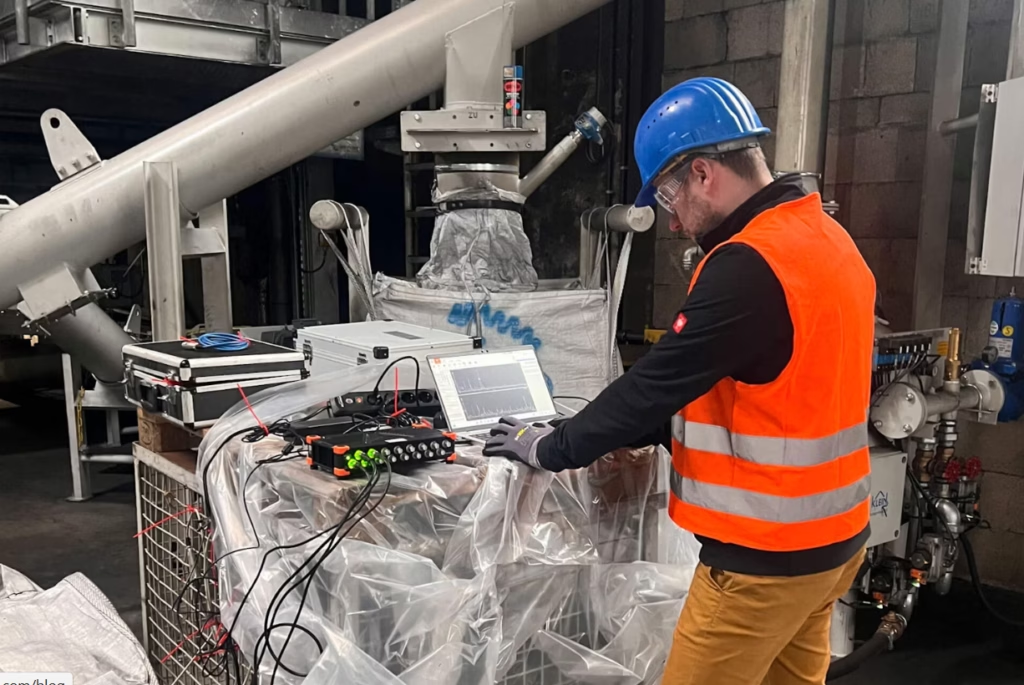
A practical example of this approach can be seen in a vibration investigation conducted within a foundry environment.
Engineers were tasked with identifying the source of excessive vibration occurring throughout the facility. Using vibration sensors at several locations, and analysing the frequency data, they identified the machine causing the vibration.
Rather than relying on assumptions. The team used measured vibration frequencies and amplitudes to isolate the contributing equipment and understand how vibration was propagating through the plant.
This type of investigation demonstrates the value of combining accelerometers, data acquisition systems and frequency analysis when diagnosing complex industrial vibration issues.
Real-World Example: Read the original Dewesoft case study demonstrating how vibration measurements and frequency analysis were used to identify vibration sources within a foundry environment.
Dewesoft Solutions for Industrial Vibration Analysis
Dewesoft provides a comprehensive range of vibration measurement and analysis solutions suitable for industrial troubleshooting, predictive maintenance and condition monitoring applications.
Key capabilities include:
High-Performance Data Acquisition Systems
Dewesoft DAQ systems provide high dynamic range measurements capable of capturing low-level and high-frequency vibration events with exceptional accuracy.
FFT and Frequency Analysis
Engineers can perform real-time FFT analysis to identify machinery frequencies, resonances and vibration signatures associated with specific equipment faults.
Multi-Channel Synchronous Measurements
Simultaneously record data from multiple accelerometers while maintaining precise time synchronisation across all channels.
Condition Monitoring and Predictive Maintenance
Track vibration trends over time to detect developing faults before they result in costly equipment failures.
Flexible Sensor Integration
Support for accelerometers, IEPE sensors, strain gauges, temperature sensors, RPM sensors and many other industrial measurement devices.
Reduce Downtime Through Better Vibration Diagnostics
Identifying the true source of industrial vibration is essential for maintaining equipment reliability and reducing maintenance costs.
By combining vibration sensors, FFT analysis, and modern data acquisition tools, engineers can quickly find vibration sources. They can understand machine behaviour and take corrective actions using objective measurement data.
Whether investigating a recurring machinery problem, evaluating structural vibration or implementing a predictive maintenance program. Accurate vibration analysis provides the information needed to make informed engineering decisions.
Local Dewesoft Support in Australia and New Zealand
Metromatics supplies Dewesoft data acquisition systems, vibration analysis solutions and condition monitoring equipment throughout Australia and New Zealand.
Our team can assist product selection, system configuration, sensor integration and application support to allow you to identify vibration sources in Industrial Plants and vibration measurement projects across manufacturing, mining, energy, transport, research and industrial facilities.
Contact Metromatics to discuss your vibration analysis requirements and discover how Dewesoft solutions can help identify and resolve complex vibration problems.