
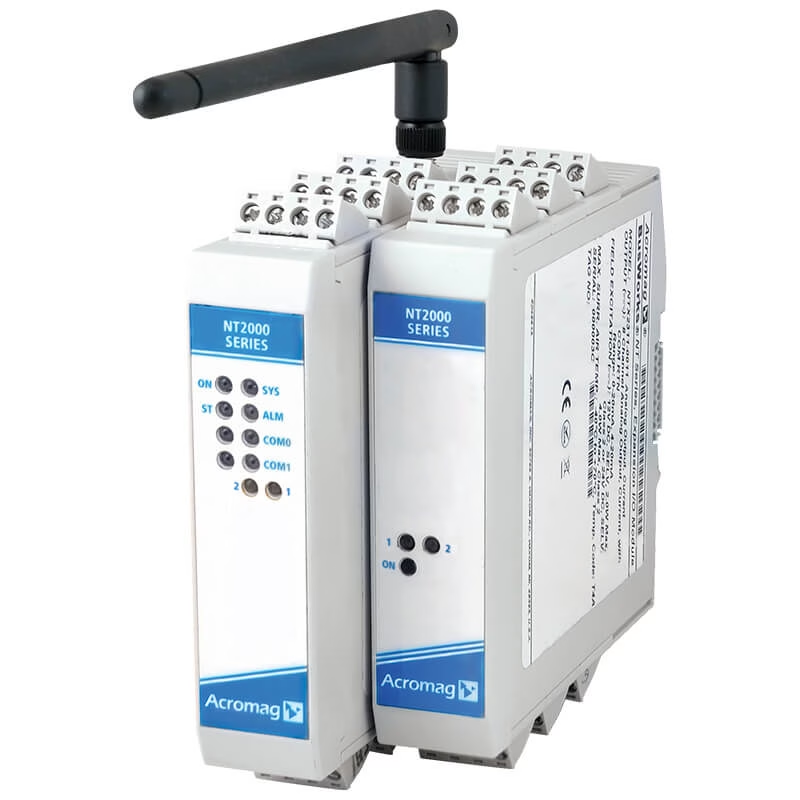
The BusWorks NTW Series Wireless Remote IO Modules provide a flexible and secure way to connect field signals such as switches, relays, transmitters, and instrumentation outputs to PLC and SCADA systems where Ethernet cabling is difficult or impractical to install. By combining Acromag’s proven BusWorks NT modular architecture with integrated dual-band Wi-Fi connectivity, NTW modules enable reliable distributed monitoring across transport infrastructure, utilities, industrial plant, and remote control cabinet environments.
Designed for modern automation systems, the NTW Series supports industrial Ethernet protocols including Modbus TCP, EtherNet/IP, OPC UA, MQTT, and REST API connectivity, allowing engineers to extend monitoring capability beyond the limits of traditional wired networks.
Available BusWorks NTW Wireless Remote IO Modules
The BusWorks NTW Series includes wireless interface modules supporting discrete, analog, temperature, resistance, and mixed-signal monitoring across PLC, SCADA, utilities, and transport infrastructure applications.
Discrete Digital I/O Modules
- NTW2110 Wireless Remote Digital I/O Module (active-low input / sinking output)
- NTW2120 Wireless Remote Digital I/O Module (active-high input / sourcing output)
Discrete AC Detection Modules
Current Analog Input Modules
- NTW2210 Wireless Remote Analog Current Input I/O Module
- NTW2220 Wireless Remote Analog 16 Current Inputs I/O Module
Voltage Analog Input Modules
- NTW2230 Wireless Remote Analog Differential Voltage Input I/O Module
- NTW2240 Wireless Remote Analog 16 Single-Ended Voltage Inputs I/O Module
Analog Output Modules
- NTW2310 Wireless Remote Analog 8 Process Current Outputs Module
- NTW2320 Wireless Remote Analog 8 Process Voltage Outputs Module
Multi-Function Mixed Signal Modules
- NTW2510 Wireless Remote Multi-Function I/O Module (current inputs)
- NTW2530 Wireless Remote Multi-Function I/O Module (voltage inputs)
Temperature and Resistance Input Modules
- NTW2610 Wireless Remote Thermocouple Millivolt Input I/O Module
- NTW2620 Wireless Remote RTD Resistance Input I/O Module
Each model supports expansion using BusWorks NTX modules and can operate alongside NTE wired Ethernet interface modules within the same distributed remote I/O architecture.
BusWorks NT Modular Remote I/O Architecture
Systems can use either NTW wireless interface modules or NTE wired Ethernet interface modules together with NTX expansion I/O modules to support up to 64 mixed signal I/O channels under a single IP address within each distributed BusWorks NT remote I/O node.
This modular architecture allows engineers to deploy hybrid wired and wireless monitoring systems across distributed control cabinets without increasing network complexity.
What Is a Wireless Remote I/O Module?
A wireless remote I/O module connects field signals such as switches, relays, transmitters, and equipment status signals to automation systems without requiring Ethernet cabling between distributed control cabinets and network infrastructure.
Typical deployment architecture:
Field signals
→ NTW Wireless Remote I/O Module
→ Wi-Fi Ethernet network
→ PLC / SCADA / IIoT monitoring platform
This approach reduces installation time and enables monitoring of equipment located across large infrastructure sites.
Why Use the BusWorks NTW Series Wireless Remote IO Platform?
The NTW Series extends the capability of Acromag’s BusWorks NT Ethernet I/O family by adding secure Wi-Fi connectivity while maintaining the same modular architecture used across wired installations.
Key advantages include:
- dual-band 2.4 GHz and 5 GHz Wi-Fi connectivity
- compatibility with BusWorks NTX expansion modules
- support for mixed signal types at each node
- up to 64 I/O points per IP address
- slim 25 mm DIN-rail installation footprint
- wide industrial operating temperature range
- global RF certification support
This makes NTW modules suitable for both retrofit monitoring and new distributed automation deployments.
Extend Industrial Monitoring Beyond Ethernet Cabling Limits
Traditional remote I/O deployments rely on Ethernet infrastructure between control cabinets and network switches. In many infrastructure environments this is not practical.
Examples include:
- long cable runs between pump stations
- transport signalling cabinets separated by distance
- utilities equipment located across large sites
- retrofit installations in existing control panels
- temporary monitoring deployments
The NTW Series provides a simple alternative by enabling wireless Ethernet connectivity directly at the I/O node.
Flexible Signal Types with NTX Expansion Modules
Each BusWorks NTW interface module can operate as part of a scalable remote I/O node using NTX expansion modules.
Available expansion signal types include:
- discrete digital I/O
- analog voltage inputs
- analog current inputs
- temperature inputs
A single BusWorks NT node can support up to 64 mixed I/O channels under one IP address, simplifying addressing and integration into automation networks.
Hybrid Wired and Wireless Deployment Flexibility
While the NTW Series provides integrated Wi-Fi Ethernet connectivity, each module also includes an RJ45 Ethernet port for configuration and flexible network deployment.
Where wireless networking is not preferred or permitted, equivalent functionality is available using BusWorks NTE wired Ethernet interface modules within the same modular architecture.
This allows engineers to standardise on one remote I/O platform across both wired and wireless infrastructure environments.
Industrial Protocol Support for PLC, SCADA, and IIoT Integration
The NTW Series integrates easily into existing automation systems using widely supported industrial Ethernet protocols including:
- Modbus TCP/IP
- EtherNet/IP
- OPC UA
- MQTT
- REST API
Peer-to-peer communication is also supported, allowing distributed monitoring architectures without additional controllers.
These capabilities enable integration with:
- PLC platforms
- SCADA monitoring systems
- cloud dashboards
- modern IIoT data platforms
Secure Wireless Connectivity for Infrastructure Applications
Wireless networking within industrial environments must meet strict security requirements.
Security features include:
- WPA3 Wi-Fi security
- TLS 1.2 encryption
- PKI certificate support
- X.509 authentication
- AES-256 encryption
These features help protect data transmission across wireless automation networks.
Typical Applications for NTW Wireless Remote I/O Modules
Transport Infrastructure Monitoring
Monitor cabinet-level signals such as:
- enclosure alarms
- power supply status
- signalling equipment status
- roadside monitoring equipment
Pump Station Monitoring
Connect signals including:
- pump run status
- fault contacts
- generator availability
- level instrumentation transmitters
Utilities and Water Infrastructure
Deploy monitoring at:
- treatment plants
- reservoir sites
- distributed control panels
- remote telemetry cabinets
Industrial Equipment Monitoring
Extend monitoring capability to:
- remote plant equipment
- auxiliary control panels
- distributed instrumentation loops
- retrofit monitoring installations
Compact DIN-Rail Installation for Control Cabinets
NTW modules install on standard DIN rail using a compact 25 mm enclosure width, making them suitable for:
- signalling cabinets
- utilities panels
- roadside enclosures
- industrial control cabinets
Pluggable terminals simplify installation and maintenance in field deployments.
Wireless Remote IO Integration Support in Australia and New Zealand
Metromatics provides local engineering support across Australia and New Zealand for integrating BusWorks NTW Series wireless remote I/O modules into transport infrastructure, utilities monitoring systems, and industrial automation environments.
Speak with our team to design scalable distributed monitoring architectures using NTW wireless interface modules and NTX expansion options to suit your application requirements.
FAQ — BusWorks NTW Wireless Remote IO Modules
Do wireless remote I/O modules require an existing Wi-Fi network?
Yes. NTW modules connect to an existing industrial Wi-Fi network using secure authentication.
How far can NTW wireless remote I/O modules communicate?
Typical communication range is approximately 100 metres line-of-sight, depending on enclosure material and antenna placement.
Can multiple NTW modules operate on the same network?
Yes. Multiple modules can operate across the same wireless automation network using Modbus TCP or EtherNet/IP addressing.
Can NTW modules be used in retrofit monitoring projects?
Yes. They are ideal where installing Ethernet cabling between control cabinets is expensive or disruptive.
What types of signals can NTW modules monitor?
Typical signals include:
- equipment run status signals
- alarm contacts
- control panel voltage presence
- 4–20 mA transmitter outputs
- distributed instrumentation loops
What is the difference between NTW and NTE modules?
NTW modules provide wireless Ethernet connectivity.
NTE modules provide wired Ethernet connectivity.
Both operate within the same BusWorks NT modular I/O platform.
Works NTW Series wireless remote IO modules supporting discrete, analog, temperature, resistance, and mixed-signal monitoring across PLC, SCADA, and distributed infrastructure environments.