
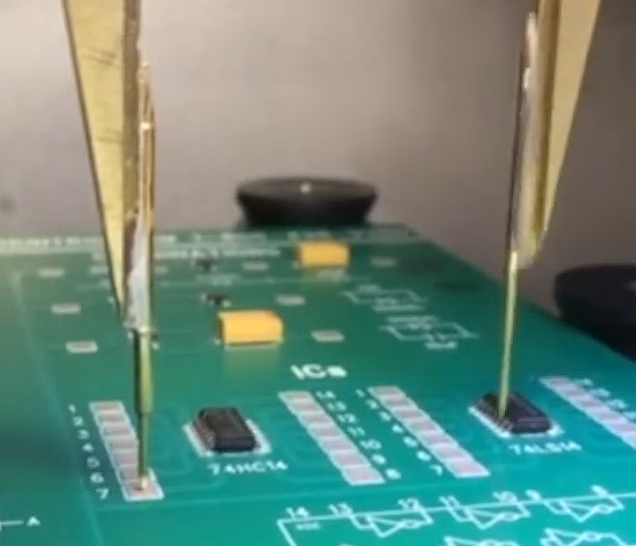
Industrial maintenance teams are responsible for keeping production equipment running with minimal downtime. When circuit boards fail, troubleshooting must happen quickly—even when schematics are unavailable or equipment cannot be powered safely.
Huntron power-off PCB diagnostic tools use Analog Signature Analysis (ASA). Firstly, this helps technicians identify component-level faults on printed circuit assemblies without energising the equipment. This enables faster repairs, reduced reliance on OEM service providers, and improved maintenance workflows across industrial environments.
Common Maintenance Challenges Huntron Helps Solve
Industrial maintenance teams frequently encounter electronics faults in environments where traditional troubleshooting methods are limited.
OEM repair lead time and cost
Sending circuit boards back to the original manufacturer can significantly increase downtime and maintenance costs. Power-off Analog Signature Analysis enables in-house diagnostics and component-level repair. Therefore, reducing both turnaround time and reliance on OEM repair services.
Legacy equipment without schematics
Many industrial facilities operate legacy systems where documentation is incomplete or unavailable. Huntron tools allow technicians to compare suspect boards with known-good reference boards. Making it possible to isolate faults without circuit diagrams.
Troubleshooting dependent on technician experience
Maintenance teams often rely on individual expertise rather than repeatable procedures. Huntron Workstation software stores diagnostic routines at the PCB level, allowing technicians to perform consistent testing across the organisation.
Unplanned downtime from failed electronics
Production equipment failures can halt operations. Huntron diagnostic systems accelerate troubleshooting by pinpointing likely fault locations and enabling faster repair workflows.
What Is Power-Off PCB Diagnostics?
Power-off PCB diagnostics use Analog Signature Analysis to evaluate the electrical characteristics of circuit boards without applying operating power.
ASA works by injecting a current-limited AC signal between test points and measuring the resulting electrical response. Comparing signatures from a known-good board and a suspect board helps technicians identify component-level differences. In addition, locate faults safely without energising the circuit board.
This approach is particularly valuable in environments where:
- powered testing is unsafe
- documentation is unavailable
- intermittent faults are difficult to isolate
- replacement boards are expensive or obsolete
Typical PCB Diagnostic Workflow Using Huntron Systems
Maintenance teams commonly follow a structured workflow when diagnosing circuit board faults using power-off diagnostics:
- Identify the failed printed circuit assembly removed from equipment
- Compare the suspect board to a known-good reference board
- Detect differences in electrical signatures at component level
- Isolate the likely fault location without energising the board
- Repair the faulty component. Instead of replacing the entire board
- Store the signature data in Huntron Workstation for future troubleshooting
This repeatable approach helps maintenance teams diagnose faults faster and reduces reliance on undocumented troubleshooting methods.
Power-Off PCB Diagnostics Compared with Traditional Troubleshooting Methods
Traditional circuit board troubleshooting in maintenance environments often depends on powered testing. Available schematics, or replacement of entire assemblies when faults cannot be isolated quickly.
Power-off diagnostics using Analog Signature Analysis provides an alternative workflow. That allows technicians to evaluate circuit boards safely without energising the equipment. As well as compare suspect assemblies with stored reference signatures from known-good boards.
This comparison-based approach helps maintenance teams isolate component-level differences. In addition, improve troubleshooting consistency across technicians, and support repair of legacy or undocumented circuit boards within existing maintenance processes.
Standardise Circuit Board Troubleshooting Across Maintenance Teams
Huntron Workstation software provides a database-driven platform for managing PCB test routines and results.
Maintenance teams can:
- store board-level diagnostic procedures
- compare suspect boards with reference signatures
- repeat tests consistently across operators
- build a reusable diagnostic knowledge base
This helps reduce reliance on individual technician experience and improves long-term maintenance efficiency.
Diagnose Dense and Complex PCBs Faster with Automated Probing
Modern industrial electronics often contain compact, densely populated circuit boards that are difficult to probe manually.
Huntron Access Probers automate probe placement using micro-stepping motors and precision positioning systems. Therefore, allowing technicians to perform repeatable tests with micron-level accuracy and reducing the time required for manual troubleshooting.
Automated probing can operate up to ten times faster than manual testing methods in suitable workflows.
Support Preventative Maintenance and Fault Prediction
Huntron diagnostic systems support more than reactive repair workflows.
By storing baseline signatures from known-good boards, maintenance teams can:
- identify emerging faults earlier
- improve future troubleshooting speed
- document recurring issues
- extend equipment service life
This enables organisations to move beyond traditional reactive repair toward structured preventative diagnostics.
Explore Huntron PCB Diagnostic Solutions
Huntron power-off PCB diagnostics typically combine several tools depending on maintenance workflow requirements:
Huntron Tracker Series
Benchtop instruments used to perform power-off Analog Signature Analysis and identify component-level faults on printed circuit assemblies.
Includes:
- Tracker 2800
- Tracker 2800S
- Tracker 3200S
Huntron Access Probers
Automated probing platforms designed for repeatable testing of dense circuit boards with micron-level positioning accuracy.
Includes:
- Access 2 Prober
- Access DH2 Prober
Huntron Workstation Software
Database-driven software platform used to store PCB diagnostic routines and standardise troubleshooting workflows across maintenance teams.
Analog Signature Analysis (ASA)
Power-off diagnostic method used to compare electrical signatures between known-good and suspect circuit boards.
→ Link to ASA explanation page
Typical Applications
Huntron power-off PCB diagnostics are used in environments where equipment uptime is critical and circuit board failures must be resolved quickly.
Examples include:
- industrial manufacturing maintenance
- automation control systems support
- utilities infrastructure maintenance
- rail electronics maintenance depots
- defence electronics sustainment workshops
- electronics repair service centres
These environments commonly operate legacy or undocumented circuit boards and benefit from safe, repeatable diagnostic workflows.
PCB Diagnostics for Rail Electronics Maintenance
Rail maintenance environments often support equipment that must remain operational with minimal downtime. Power-off diagnostics allow technicians to isolate circuit board faults safely when powered testing is restricted and documentation for legacy electronics may be unavailable.
Huntron diagnostic workflows help maintenance teams compare suspect boards with known-good references. In addition, standardise troubleshooting procedures across service depots.
PCB Diagnostics for Defence Electronics Sustainment
Defence sustainment teams frequently maintain complex electronics where component-level troubleshooting is required. However, documentation may be limited. Power-off Analog Signature Analysis enables safe diagnostics without energising equipment and supports repeatable maintenance workflows using stored reference signatures.
PCB Diagnostics for Industrial Automation Maintenance
Industrial automation systems often rely on legacy control boards that are expensive to replace or difficult to document. Huntron tools allow maintenance teams to compare suspect boards against stored reference signatures. In addition, isolate faults faster, and reduce reliance on OEM repair turnaround times.
Questions Maintenance Teams Often Ask Before Implementing PCB Diagnostics
Maintenance teams evaluating circuit board diagnostic workflows often consider:
- How are PCB faults currently identified in legacy equipment?
- Are schematics available for older circuit boards?
- Does troubleshooting depend on individual technician experience?
- How long does OEM repair typically take?
- Can boards be safely powered during testing?
Power-off diagnostics using Analog Signature Analysis helps address these common maintenance challenges by enabling safe, repeatable component-level troubleshooting workflows.
Local Support from Metromatics
Metromatics supplies Huntron diagnostic systems across Australia and New Zealand and provides local assistance with solution selection and deployment planning for industrial maintenance applications.
Contact Metromatics to discuss how power-off PCB diagnostics can support your maintenance workflow.
Frequently Asked Questions About Power-Off PCB Diagnostics
Can circuit boards be tested without powering equipment?
Yes. Analog Signature Analysis uses a current-limited AC stimulus to measure electrical response between test points without energising the circuit board.
Can faults be identified without schematics?
Yes. Suspect boards can be compared with known-good reference boards to detect component-level differences without requiring documentation.
Is this method suitable for legacy electronics?
Yes. Power-off diagnostics are commonly used to troubleshoot obsolete or undocumented printed circuit assemblies in maintenance environments.
Can maintenance teams standardise troubleshooting procedures?
Yes. Huntron Workstation software stores board-level diagnostic routines. So technicians can perform repeatable testing across maintenance teams.