
How Low-Frequency Vibration Monitoring Helps Protect Critical Infrastructure
Structural health monitoring (SHM) is becoming increasingly important as asset owners seek to improve safety, reliability and maintenance planning across critical infrastructure.
Whether monitoring bridges, rail infrastructure, industrial facilities, wind turbines or research installations, engineers need accurate data to understand how structures respond to real-world conditions.
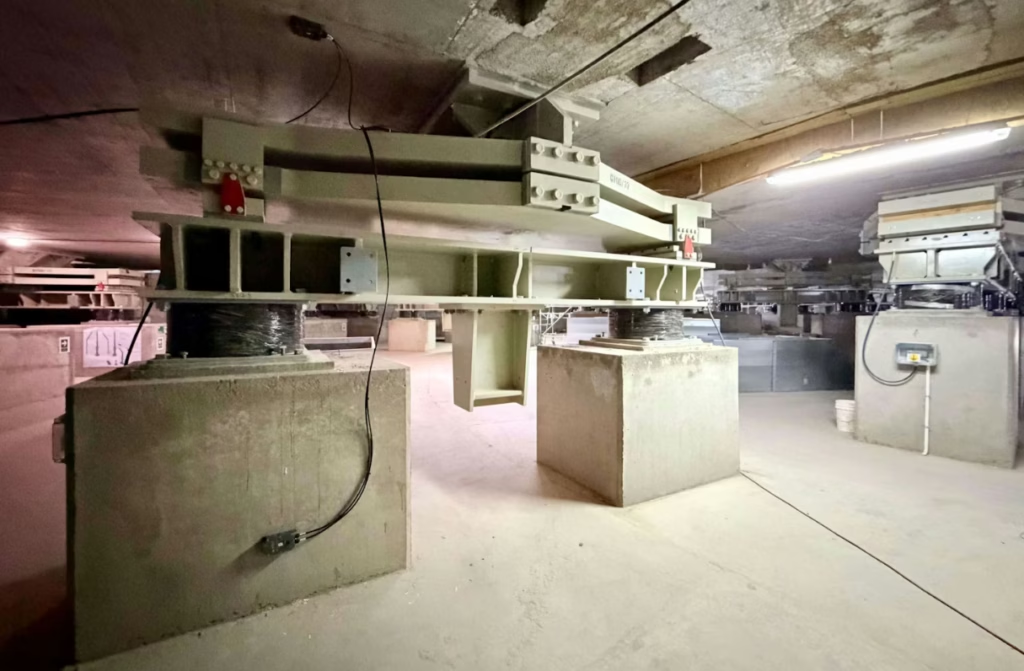
A recent project involving the Extremely Large Telescope (ELT) demonstrates how modern MEMS accelerometers and data acquisition systems are being used to measure structural vibration with exceptional precision. While the telescope itself is a unique scientific instrument. The monitoring principles behind the project apply to a wide range of infrastructure and engineering applications.
What Is Structural Health Monitoring?
Structural health monitoring is the process of continuously or periodically measuring the condition and behaviour of a structure.
Engineers use monitoring systems to identify changes caused by:
- Wind loading
- Traffic and operational loads
- Machinery vibration
- Environmental conditions
- Thermal expansion and contraction
- Construction activity
- Seismic events
By analysing vibration and structural response over time, asset owners can make informed decisions about maintenance, inspection schedules and long-term asset management.
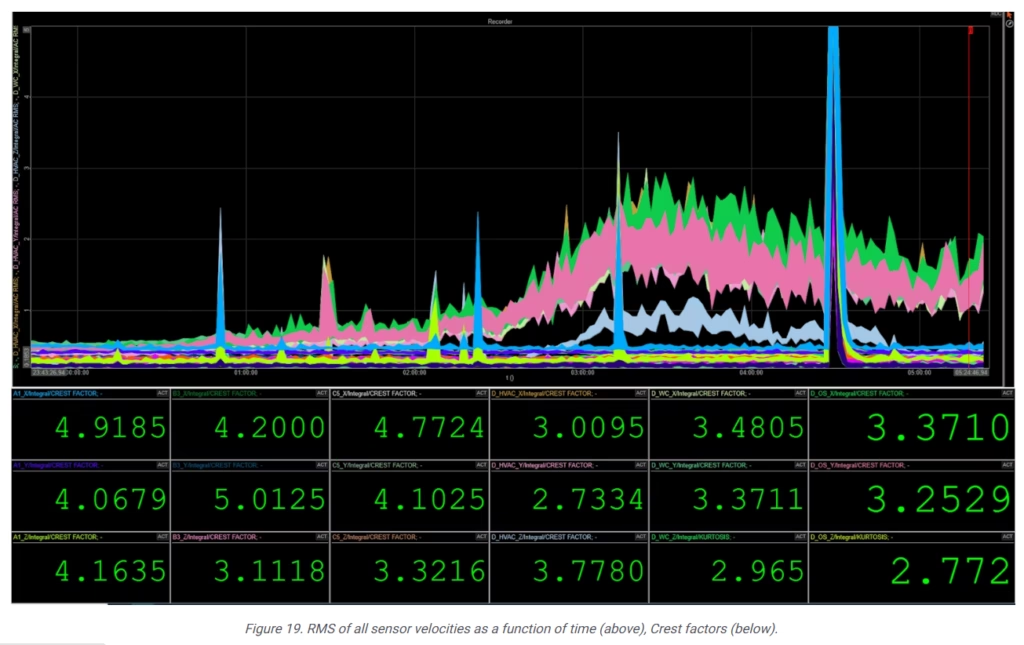
A typical evaluation of the measured vibration data with the DewesoftX software taken from Dewesoft’s case study shown below.
Monitoring One of the World’s Largest Telescopes
The Extremely Large Telescope, currently under construction by the European Southern Observatory (ESO). It will become one of the world’s most advanced optical and infrared telescopes.
With a primary mirror measuring 39 metres in diameter, the telescope is designed to observe distant galaxies, stars and planets with unprecedented detail.
Achieving this level of performance requires engineers to understand and manage structural vibration throughout the telescope and supporting infrastructure.
To support this objective, ESO has implemented a vibration monitoring system using Dewesoft technology, including:
- Dewesoft IOLITE MEMS accelerometers
- Distributed data acquisition hardware
- DewesoftX software
- Synchronized monitoring architecture
The system is designed to measure low-frequency structural vibrations. Then provide engineers with detailed insight into how the telescope responds to environmental and operational influences.
You can read the original Dewesoft case study here:
Why MEMS Accelerometers Are Used for Structural Vibration Monitoring
Large structures often experience movement at very low frequencies. Capturing these small, slow-moving vibrations requires sensors that can provide stable, accurate measurements over extended periods.
Modern low-noise MEMS accelerometers offer several advantages for structural monitoring applications.
Low-Frequency Measurement Capability
MEMS accelerometers measure low-frequency vibration. Especially, long-period structural movement commonly found in bridges, buildings, towers and large infrastructure assets.
Long-Term Monitoring
Many structural health monitoring projects require continuous data collection over months or years. MEMS-based monitoring systems are used in long-term installations where ongoing condition assessment is required.
Distributed Sensor Networks
Large structures often require measurements from multiple locations. MEMS monitoring systems can support distributed architectures that allow engineers to monitor vibration across an entire asset.
Scalable Monitoring Solutions
Where multiple measurement points are required, MEMS technology can simplify the deployment of larger structural monitoring networks.
MEMS vs IEPE Accelerometers for Structural Monitoring
MEMS accelerometers and IEPE accelerometers both play important roles in vibration measurement.
IEPE accelerometers are often preferred for high-frequency dynamic measurements and machinery diagnostics. Modern low-noise MEMS accelerometers, however, provide advantages in applications involving low-frequency vibration monitoring, long-term deployment and distributed structural monitoring systems.
Rather than replacing one another, the two technologies are often complementary and selected based on the specific measurement requirements of the project.
Applications for Structural Health Monitoring
The monitoring techniques can be applied to many infrastructure and industrial assets.
Bridge Monitoring
Measure structural response, traffic loading, vibration characteristics and long-term performance.
Rail Infrastructure Monitoring
Monitor bridges, stations, overhead line structures and other critical rail assets.
Buildings and Public Infrastructure
Assess the effects of environmental loading, occupancy and operational activity.
Wind Energy
Monitor tower vibration, structural loading and asset condition.
Mining and Industrial Facilities
Track structural behaviour and vibration in processing plants, conveyors and supporting infrastructure.
Defence and Aerospace
Monitor critical facilities, communications infrastructure and specialist platforms operating in demanding environments.
Research and Education
Support structural dynamics studies, modal analysis and engineering research programs.
Dewesoft Solutions for Structural Health Monitoring
Dewesoft provides a range of technologies suitable for structural vibration monitoring and structural health monitoring applications, including:
- IOLITE MEMS Accelerometers
- IOLITE Distributed Data Acquisition Systems
- KRYPTON Rugged DAQ Systems
- SIRIUS High-Performance DAQ Systems
- DewesoftX Data Acquisition and Analysis Software
These solutions enable engineers to collect, analyse and visualise vibration data while supporting both short-term testing and long-term monitoring projects.
Structural Monitoring Starts with Reliable Data
As infrastructure assets become larger, more complex and more critical to daily operations, the need for accurate structural health monitoring continues to grow.
The Extremely Large Telescope project highlights how modern MEMS accelerometers can help engineers. Achieved by measuring low-frequency structural vibration and gain valuable insight into asset behaviour.
From bridges and rail networks to industrial facilities and research infrastructure, vibration monitoring data plays a vital role in improving asset performance. As well as improving, reliability and long-term maintenance planning.
Metromatics supplies Dewesoft structural health monitoring and data acquisition solutions throughout Australia and New Zealand. Backed by local engineering expertise, technical support and application knowledge. Contact us to learn more.